49 works in this view — arrow keys or swipe to move between them.
Dance in Art
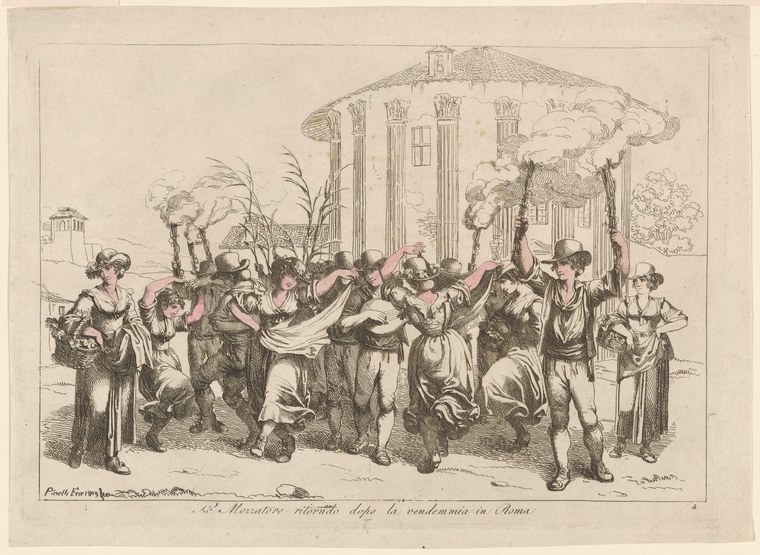
Le Mozzatore ritornando dopo la vendemmia in Roma
Unknown artist
- Collection:
- Prints depicting dance
- Source:
- New York Public Library
- Rights:
- Public domain — free to use, share and adapt.
- Recorded as:
- Public Domain
This is rare evidence of popular or vernacular dancing in the early modern period—the kind of celebration and movement that occurred outside court and ballroom, yet was thought worthy of artistic record. It shows us how people of the period understood the connection between labor, community, celebration, and movement. The work also demonstrates the role of the print in disseminating knowledge of customs, dress, and social practice across Europe.
What you are looking at
A lively outdoor celebration unfolds before a monumental Roman structure with Corinthian columns and a domed roof. The setting appears to be Rome, as the Latin inscription confirms. A crowd of figures in early modern dress—women in long gowns with elaborate sleeves and men in doublets and hose—cluster together in animated poses around what seems to be a processional or festive moment. The composition radiates outward from a central axis, with figures gesturing, turning, and interacting in a loose, organic arrangement rather than a formal line. The scene captures a specific moment: the return of the grape-harvest workers (mozzatore) to the city, according to the title. The engraving technique renders the figures with fine linear detail, the architecture with precise perspective, and the foliage—trees visible at the edges—with rhythmic hatching.
The dancing
The figures are distributed across the foreground in no strict formation, their bodies twisted and angled toward one another. Several appear to be in the midst of turning or stepping, arms raised or extended in gesture; one figure at the center appears to leap or spring. The women's voluminous skirts and the men's fitted hose suggest mobility, and the poses—some contrapposto, some actively gestural—indicate movement rather than stillness. The overall impression is one of spontaneous, celebratory motion rather than choreographed dance, though the gaiety and the raised arms suggest dancing or the threshold of dance.
The dance depicted
This is most likely a depiction of festive or vernacular social dancing associated with harvest celebration, rather than formal courtly dance. The title specifies the return of grape harvesters to Rome, placing this in a popular, rustic context. The loose organization, the outdoor setting, and the mixed-gender mingling suggest circle dances, processional dancing, or improvised rejoicing rather than the strict formations of court dances like the pavane or galliard. The engraving may document actual harvest customs or invoke them for entertainment—a common subject in early modern prints. Identification to a specific dance form is difficult, but the genre appears to be folk or popular festive dance.
How it was made
This is an engraving, rendered in line with fine hatching for shadow and texture. The technique allows precise architectural rendering and detailed costume study, but the small scale and linear medium work against anatomical precision in the bodies themselves; some figures read as silhouettes or simplified forms. The use of line to suggest movement and emotion is more important than anatomical accuracy. Engravings of this type were widely circulated and relatively inexpensive, reaching a broad educated audience—collectors, scholars, and those interested in costume, architecture, or customs. The print medium suggests this was a popular or commercially available work, likely from the 16th or 17th century based on style.
About this work
This engraving documents a harvest celebration outside a Roman monument, capturing a moment of popular dancing or festive rejoicing among grape-harvest workers and their community. The work sits at the intersection of topographical print (the architectural setting is rendered with precision), costume study (the figures' dress is rendered with care), and genre scene—a glimpse of daily life and popular custom elevated to fine art. It belongs in a gallery of dance imagery because it preserves a moment of vernacular, celebratory movement that contrasts sharply with the formal court dances more commonly recorded in art. The work reminds us that dance was not confined to palaces and that engravers found value in documenting the movement and joy of ordinary people.
How to look at it
Attend to the way the artist uses line and gesture to suggest movement without depicting formal choreography. Notice how the figures are angled and twisted toward one another, how arms extend and bodies lean—these convey spontaneity and collective joy rather than the stillness of a posed group. The raised arms and the turned heads suggest music and rhythm even though no musicians are visible. The engraving technique uses line as the primary tool for suggesting motion; the viewer's eye is drawn into the crowd by the interlocking poses and gestures, creating a sense of contagious movement radiating outward.
The period
Early modern prints, particularly from the 16th and 17th centuries, frequently depicted customs, celebrations, and daily life as subjects of artistic and intellectual interest. The study of costume, architecture, and manners was part of the broader humanist project of understanding classical civilization and documenting contemporary life. Engravings of harvest celebrations, festivals, and popular gatherings were popular; they appealed to patrons interested in natural philosophy, geography, and ethnography, as well as to those seeking entertainment or moral instruction. The choice of a Roman setting—with monumental classical architecture—may suggest allegorical or antiquarian intent, linking the harvest celebration to Roman civilization.
Where it lives
This work is held in the New York Public Library's collection of prints depicting dance. The print is catalogued but with minimal descriptive information, reflecting the challenges of studying vernacular dance imagery from the early modern period. It is a public-access resource for research into dance history, costume, and social practice.
Dance in this work
Questions about this work
Who were the mozzatori and why was their return to Rome worth documenting in art?
The mozzatori were seasonal harvest workers, in this case those who harvested grapes. Their return would have been a significant moment in the agricultural and social calendar, marked by celebration and rejoicing. That an engraver thought this worth recording suggests it was a notable or picturesque custom—the kind of popular practice that humanist scholars and print collectors found worthy of study.
Is this an actual historical record or an imaginative reconstruction?
The work is most likely a genre scene—a depiction of a type of celebration and custom rather than a specific, witnessed event. Engravers often created scenes that were recognizable and plausible rather than documentary in the modern sense. The Roman setting and the engraver's care with architectural detail suggest some claim to authenticity or at least cultural specificity, but the composition is arranged for clarity and visual impact rather than realism.
What does this tell us about early modern dance?
It shows that dance was not confined to formal settings or trained dancers. Popular celebrations involved mixed-gender dancing, loose organization, and improvisational movement. It also suggests that engravers and print patrons valued documenting such celebrations—that dance was understood as central to community life and worthy of artistic attention.
More dance artwork





