49 works in this view — arrow keys or swipe to move between them.
Dance in Art
Fanny Cerrito
Unknown artist
- Collection:
- Prints depicting dance
- Source:
- New York Public Library
- Rights:
- Public domain — free to use, share and adapt.
- Recorded as:
- Public Domain
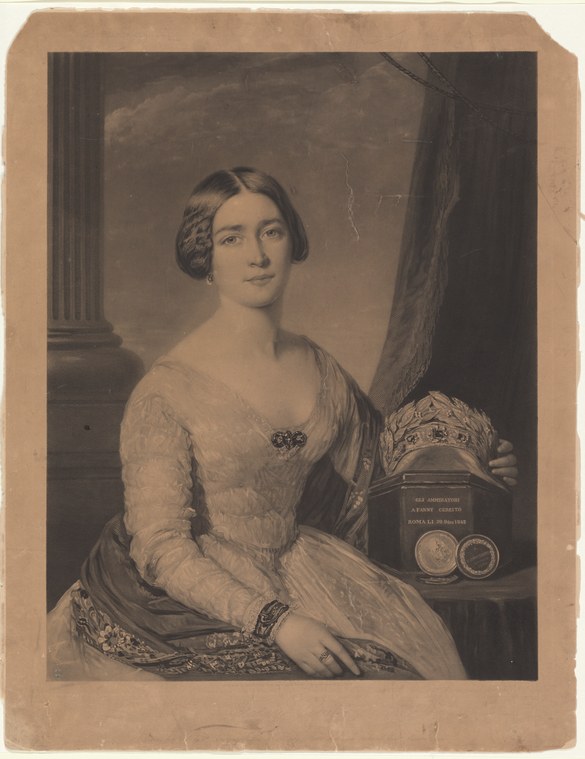
Fanny Cerrito was one of the greatest ballerinas of the 19th century, and this portrait captures how Romantic-era dancers were packaged and distributed as cultural icons through the new technology of mass-produced engraving. The commemorative tablet and formal presentation reflect the elevated social status dancers like Cerrito had achieved, distinct from earlier eras when stage performers held lower social rank.
What you are looking at
A three-quarter-length seated portrait of a woman in an elegant white lace dress with long sleeves, positioned against a dark brown interior setting with classical architectural elements—a fluted column visible at left and heavy drapery at right. She sits with her body angled toward the viewer, her gaze directed upward and to the side in a contemplative pose. Her dark hair is arranged in the fashion of the mid-19th century, parted and gathered at the nape. A richly embroidered shawl or wrap in deep tones drapes across her lap and legs. At her right side (viewer's left) sits a stone or marble tablet bearing an inscription and two circular medallion portraits, suggesting this is a commemorative or memorial work. The lighting is soft and classical, modeling her face and the delicate lace of her dress while leaving much of the background in shadow.
The dancing
A single seated female figure in a formal, dignified pose. Her torso is upright and slightly turned; her left arm rests naturally across her lap while her right hand gestures toward the commemorative tablet beside her. The pose suggests both ease and ceremony—neither fully relaxed nor rigidly formal. The artist has rendered her face with refined detail, capturing a moment of quiet reflection rather than active motion. There is no suggestion of dance movement in the body position or limbs.
The dance depicted
This is not a depiction of dance. The figure is seated in a formal portrait pose with no indication of movement, weight shift, or the dynamic positioning of a dancer's body. While the subject is identified as Fanny Cerrito, a celebrated Italian-French prima ballerina of the Romantic era, this image documents her as a person of distinction rather than capturing her in performance. It is a commemorative portrait of a dancer, not a dance image.
How it was made
This appears to be a line engraving or steel engraving, a process that would have allowed for fine reproduction and wide circulation in the mid-19th century. The delicate parallel lines visible in the modeling of flesh tones, the controlled hatching in the shadows, and the precise rendering of lace and fabric detail are consistent with engraving technique. The light brown paper support and the formal composition suggest this was a commercially produced print, likely a celebrity portrait sold as a collectible.
About this work
This is a commemorative engraved portrait of Fanny Cerrito, the renowned Romantic-era ballerina, rendered in mid-19th-century formal portraiture style. Rather than capturing her in the act of dancing, the artist presents her as a distinguished public figure—seated, dignified, and flanked by a memorial tablet that anchors her cultural significance. The work belongs in a gallery about dance because it documents how dancers of the highest rank were memorialized and circulated as images during the Romantic ballet period, and because it shows how dance celebrities transcended the stage to become subjects of fine-art portraiture and mass-market prints.
How to look at it
Note the stillness of the pose and the complete absence of the dynamic, weightless quality that would characterize a dancer in action. Observe instead how the artist uses the commemorative tablet to anchor Cerrito's identity and significance—the image is as much about documenting a famous person as about celebrating dance itself. The refined handling of her dress and the classical setting invoke the world of high culture and theatrical prestige that Romantic ballet occupied.
The artist
The artist is not recorded in the catalogue. The work's refined execution and formal composition suggest it was produced by a professional engraver working for a London or Paris publisher, as Cerrito was celebrated in both cities. The style and technique are consistent with mid-19th-century celebrity portraiture.
The period
This portrait dates to the height of the Romantic ballet era (approximately 1840s–1850s), when dancers like Cerrito, Marie Taglioni, and Carlotta Grisi commanded enormous fame and were celebrated across Europe. The rise of lithography and engraving technology in this period made it possible to distribute portraits of performers widely, feeding a new mass market for images of theatrical celebrities. The formal, dignified presentation of Cerrito here reflects the elevated cultural status that had accrued to the greatest dancers—no longer mere entertainers, but artists worthy of commemoration.
Where it lives
The work is held in the NYPL's collection of prints depicting dance. It is catalogued by subject name rather than by artist or accession number, suggesting it entered the collection as one of many dance-related prints assembled thematically rather than as a prestige work with detailed provenance documentation.
Questions about this work
Is this a portrait of a real dancer?
Yes. Fanny Cerrito (1817–1909) was an Italian-French prima ballerina who achieved international fame during the Romantic ballet period. She was known for her technical brilliance and dramatic presence, and she danced in all the major European capitals.
Why is she sitting down if she was a famous dancer?
This is a commemorative portrait, not a dance image. It presents Cerrito as a celebrated public figure worthy of formal portraiture and mass-produced commemoration. Seated poses were standard in formal 19th-century portraiture, signaling dignity and social status.
What are those circles on the tablet next to her?
They are medallion portraits, likely of historical or cultural figures. The tablet appears to be a commemorative device anchoring Cerrito's identity and significance, though the specific inscription and medallions cannot be read clearly in this reproduction.
Why is this in a dance collection if it's not a dance image?
It documents how Romantic-era dancers were circulated as cultural icons and how dance celebrities were elevated to the status of subjects for fine-art portraiture. It reveals the intersection of dance history, visual culture, and the celebrity system of the 19th century.
More dance artwork





