49 works in this view — arrow keys or swipe to move between them.
Dance in Art
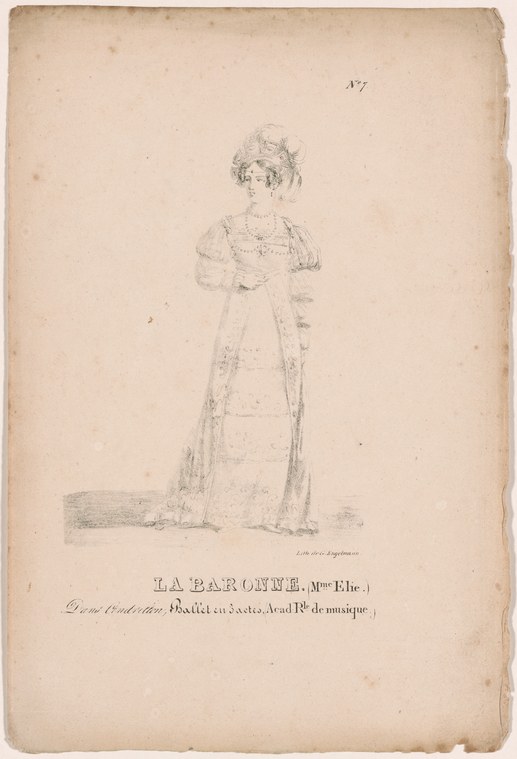
La baronne. Mme. Elie. Dans Cendrillon, Acad. Rle. de Musique
Unknown artist
- Collection:
- Prints depicting dance
- Source:
- New York Public Library
- Rights:
- Public domain — free to use, share and adapt.
- Recorded as:
- Public Domain
This is a primary document of the early Romantic ballet and its material culture. It shows us what a celebrated dancer wore and how her image was marketed and distributed; it confirms that *Cendrillon* was established enough by this date to merit professional costume documentation; and it is named evidence of a specific performer in a specific role, the kind of archival trace that allows dance historians to reconstruct performance history.
What you are looking at
A full-length portrait of a woman in early 19th-century ballroom dress, standing in a three-quarter pose against a plain background. She wears a high-waisted gown with a fitted bodice and voluminous skirt that extends to the floor, characteristic of Regency-era fashion. The dress appears to be of fine material with delicate embellishment or patterning on the bodice and sleeves. Her hair is styled in the fashion of the period, adorned with what appears to be feathers or plumes. The woman stands upright with good posture, her arms held naturally at her sides. The sketch employs fine line work with subtle shading to suggest the volume and texture of the fabric. This is presented as a souvenir or costume study, likely documenting a specific performer in a specific role, rendered with the precision typical of theatrical prints of the period.
The dancing
A single figure in a standing position with an upright, elongated frame typical of Romantic-era theatrical portraiture. The woman's arms rest naturally, showing no active movement or partnering. Her posture is formal and dignified, the carriage of her body suggesting grace and refinement rather than the dynamic extension or turnout of dance technique. Her weight appears evenly distributed on both feet, placing her in a static, presentational rather than dynamic or kinetic moment.
The dance depicted
This is not a representation of dance in action but rather a costume portrait documenting a performer in a theatrical role. The inscription indicates this is Mme Elie in the role of Cinderella from *Cendrillon* at the Académie Royale de Musique (the Opéra in Paris). *Cendrillon* ballets of the early 19th century contained dance but this image shows the performer in ball gown costume, standing for formal portraiture rather than captured in a dance moment. The gown and presentation align with the fairy-tale romance of Romantic ballet, but the image itself is a costume record rather than a dance image.
How it was made
A delicate line engraving or lithograph, likely hand-coloured or tinted. The work demonstrates the precision and economy of line typical of theatrical costume documentation prints produced for distribution to patrons and collectors. The fine parallel hatching and careful attention to fabric texture suggest professional engraving. The format—full-length portrait on a modest sheet with title beneath—is characteristic of the broadside costume prints that were sold at theatres and circulated among the public as affordable souvenirs of celebrated performances. This medium allowed wide circulation of images of celebrated performers.
About this work
This is a theatrical costume portrait documenting a named performer, Mme Elie, in the Regency-era gown she wore as Cinderella in the Opéra production of that title. It belongs in a gallery of dance art not because it depicts dance itself, but because it documents a key moment in the emergence of Romantic ballet—the turn toward fairy-tale subjects, the costuming of female principals, and the star system that celebrated named dancers. The image is part of the visual culture that surrounded and celebrated theatrical dance in early-19th-century Paris.
The work is valuable as a historical record of how a canonical ballet role was costumed and how that costume was circulated to the public. It shows not what Cinderella danced but how she was seen—and how her image was sold.
How to look at it
This is a costume portrait, not a dance image. Look at it as evidence of material culture: the quality and cut of the fabric, the height of the waistline, the way the skirt is drawn to suggest weight and volume. Note the formal presentation and the careful attention to the performer's name—this was a souvenir of a named star. The elongated proportions and upright carriage are conventions of theatrical portraiture of the period, designed to flatter and to present the performer as a refined and accomplished figure.
The artist
The artist is not recorded. The print is typical of early-19th-century Parisian theatrical costume documentation, a practice that grew as the star system in ballet developed. These prints were produced by professional engravers and lithographers working from sketches or descriptions provided by theatre management or costume designers, and were sold as affordable theatrical souvenirs.
The period
This print dates from the era of Romantic ballet's emergence in France, roughly 1820s–1840s. The Académie Royale de Musique (the Paris Opéra) was the centre of European ballet, and *Cendrillon* ballets were among the period's most celebrated fairy-tale narratives. The Regency-era silhouette—high waistline, full skirt, puffed sleeves—is characteristic of female theatrical costume of the period, before the adoption of the pointe shoe and the shorter tutu that would define mid-Romantic aesthetics. This print sits at the threshold of the modern ballet industry, when dance became a commodity and dancers' images became marketable objects.
Where it lives
The work is held by the New York Public Library in their prints collection documenting dance. It is identified as a costume souvenir relating to the Opéra's production of *Cendrillon*, likely produced in Paris in the early-to-mid 19th century. These prints were standard theatrical merchandise.
Questions about this work
Is this a ballet image?
It documents a ballet performer and role, but it is not a depiction of dance. It is a costume portrait—a souvenir print showing how the performer appeared in the ball gown scene of *Cendrillon*. You cannot see the dancing here, only the costume and the performer's formal presentation.
What was Mme Elie?
The catalogue identifies her as a performer at the Académie Royale de Musique (the Paris Opéra) in the role of Cinderella. No further biographical information is recorded in this catalogue. She was notable enough to merit a costume portrait, suggesting she was a known performer of the period.
When was Cendrillon first performed?
Multiple *Cendrillon* ballets existed in the 19th century. The most famous is the 1844 version by Jules Perrot with music by Pugni. This print likely dates from an earlier production, possibly Jean-Louis Aumer's 1822 *Cendrillon*, though the exact ballet and date cannot be determined from the image alone.
Why does this matter if it's not a dance image?
Because it records the material reality of early Romantic ballet—how celebrated dancers were costumed, how their images were circulated, and how the star system worked. These prints are primary evidence for reconstructing performance history and understanding how ballet was experienced and marketed.
More dance artwork





