49 works in this view — arrow keys or swipe to move between them.
Dance in Art
Pauline Leroux
Unknown artist
- Collection:
- Prints depicting dance
- Source:
- New York Public Library
- Rights:
- Public domain — free to use, share and adapt.
- Recorded as:
- Public Domain
Pauline Leroux appears in records of Parisian ballet of the 1830s–1850s. This portrait is evidence of her status and visibility as a performer, and of how dancers were presented to the public—as individuals rather than idealized figures. The work documents the intersection of theater and commercial print culture in the 19th century.
What you are looking at
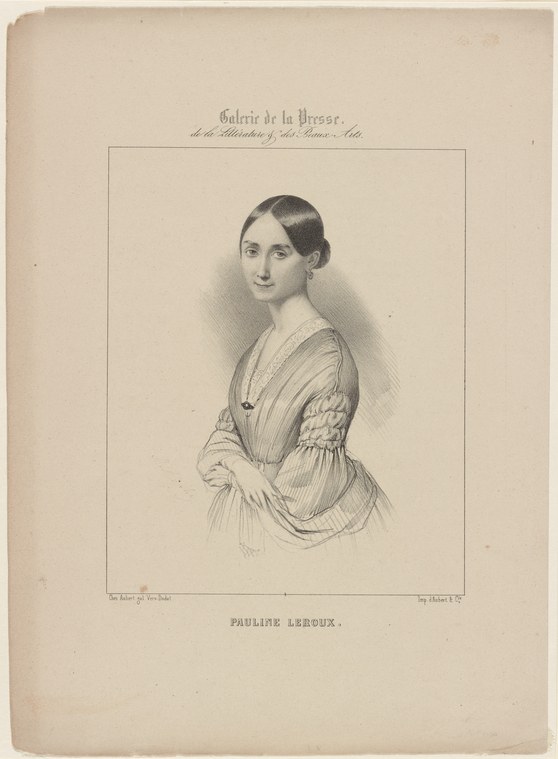
A three-quarter portrait of a young woman, shown from the waist up, against a plain background. She wears a pale striped or ribbed dress with voluminous sleeves gathered at the forearms, and a modest neckline with what appears to be a small pendant or brooch. Her dark hair is parted in the center and pulled back smoothly. She faces slightly left of center, her expression composed and direct, with one arm held at her side and the other positioned across her body in a relaxed gesture. The execution is a finely detailed engraving or lithograph with subtle shading that creates depth in the fabric and modeling of her face. The work is titled "Pauline Leroux" and attributed to the "Galerie de la Presse" (a print gallery or publication).
The dancing
A single figure, shown from the torso up, in a stationary pose rather than an active dance position. Her posture is upright and formal, her arms gently arranged rather than extended in a gesture of movement. There is no sense of bodily engagement with music or rhythm—this is a portrait, not a depiction of active dancing.
The dance depicted
This is not a dance image. It is a formal portrait of an identified woman, Pauline Leroux, rendered as a print. While the subject may have been a dancer (the name appears in records of Paris Opera and Romantic-era ballet), the image itself shows no dance, no stage setting, no costume elements specific to theatrical performance, and no bodily engagement with dance movement. It is a society or theatrical portrait rather than a scene of dance in action.
How it was made
A finely executed engraving or lithograph, most likely from the mid-19th century. The technique shows careful attention to portraiture—the modeling of the face, the texture of the fabric, and the subtle gradations of light and shadow. The print appears to have been published by or distributed through the Galerie de la Presse, a commercial print gallery in Paris, suggesting circulation through the popular market for theatrical celebrity portraits and society prints rather than as fine art.
About this work
This is a formal portrait print of Pauline Leroux, most likely a dancer or performer of the Romantic ballet era. While the subject may be connected to dance history, the work itself is a portrait rather than a depiction of dance. It belongs in a dance art gallery only insofar as it documents the identity and appearance of a historical dancer and reflects the conventions of how dancers were visualized and marketed to the public in the 19th century. The work is valuable as evidence of theatrical celebrity culture and the iconography of the Romantic dancer.
How to look at it
Attend to the face and the dress as evidence of Leroux's identity and status. The portrait is not meant to capture movement or the body in action; it is a formal presentation of a named individual for public consumption. Notice how the artist has rendered the texture of fabric and modeled the face with care—this level of finish suggests a significant subject, not a minor performer. The direct gaze and composed posture convey authority and self-possession rather than the ethereal, otherworldly demeanor often associated with Romantic ballet imagery.
The artist
The artist is unrecorded. The work was published by the Galerie de la Presse, a commercial print gallery in Paris that produced and distributed theatrical portraits and society prints. Such galleries employed engravers and lithographers to meet demand for celebrity likenesses, often drawing on sketches or photographs by recognized portraitists. The anonymity of the printmaker was typical for commercial production of this kind.
The period
The style and dress suggest a date in the 1830s or 1840s, during the height of the Romantic ballet era. This was the period of Marie Taglioni, the Sylphide, and the dominance of ethereal, supernatural themes in ballet. It was also the period when lithography and commercial print galleries made theatrical portraits widely available and affordable to a middle-class audience. Dancers became celebrities in the modern sense—their likenesses were collected, displayed, and traded as commodities. The straight-on, dignified presentation of Leroux reflects the conventions of theatrical portraiture of the period, emphasizing the individual identity and social status of the performer.
Where it lives
The work is held in the New York Public Library's prints collection, which documents theatrical culture, celebrity, and visual media of the 19th century. It is one of many such portrait prints published by the Galerie de la Presse and distributed through commercial channels in Paris and beyond.
Questions about this work
Was Pauline Leroux a famous dancer?
Pauline Leroux appears in records of the Parisian ballet world of the 1830s–1850s. She is less celebrated than figures like Marie Taglioni, but the fact that she was commemorated in a portrait print suggests she was a known and recognized performer. The survival of her portrait is evidence of her visibility and status at the time.
Why is this work in a dance gallery if it does not show dance?
The work documents dance history even though it does not depict active dance. It is evidence of how dancers were seen, named, and marketed as public figures in the 19th century. Portrait prints like this one shaped the public image of ballet and the dancer as a celebrity. They are primary sources for understanding the visual and social culture of theater.
Who was the artist?
The artist is unrecorded. The work was published by the Galerie de la Presse, a Paris print gallery, but the engraver or lithographer is not named. This anonymity was standard in commercial theatrical print production, where speed and volume of output sometimes took precedence over attribution to individual artists.
More dance artwork





