49 works in this view — arrow keys or swipe to move between them.
Dance in Art
Dancers on music covers
Unknown artist
- Collection:
- Prints depicting dance
- Source:
- New York Public Library
- Rights:
- Public domain — free to use, share and adapt.
- Recorded as:
- Public Domain
This work documents how non-European dance forms were adapted, theatricalized, and marketed to Victorian audiences through commercial performance and mass printing. It shows the quadrille—a foundational European ballroom form—being transformed into ethnic spectacle for music-hall consumption, revealing the complex relationship between social dance, theatrical entertainment, and nineteenth-century ideas about national character and exoticism.
What you are looking at
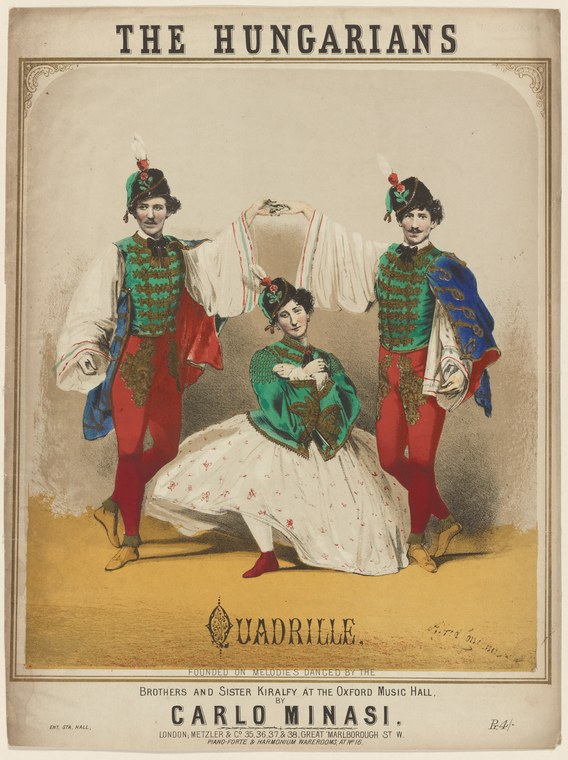
This is a chromolithographed cover for a musical quadrille titled "The Hungarians," showing four dancers in Hungarian folk costume arranged in a formal theatrical grouping. Three male dancers in richly embroidered vests (one green, two predominantly blue and red) stand wearing white billowing shirts and red knitted breeches, with decorative feathered headpieces. A female dancer sits center-front in a green embroidered jacket and a full white skirt with small red floral sprigs scattered across it. The composition is symmetrical and posed rather than captured mid-movement, with the figures arranged against a neutral background. The color palette is vivid and saturated—jewel-toned embroideries contrasting with white linen and red wool—typical of the theatrical chromolithography used for music hall and variety theater publicity in Victorian London. The title appears in bold uppercase at the top, with credits below identifying the performers as "Brothers and Sister Kirafly at the Oxford Music Hall" and the composer Carlo Minasi, with a London publisher's mark.
The dancing
The dancers hold themselves in formal, static poses rather than an active dance frame. The three standing figures are arranged with one foot slightly advanced and arms held at ease, presenting themselves to an imagined audience. The seated female figure sits upright with one hand placed on her lap. The grouping is consciously theatrical and presentational—a tableau vivant or publicity still rather than a captured moment of movement. The embroidery on the costumes is voluminous and weighted, suggesting the garments themselves were substantial and ornamental rather than designed for dynamic motion.
The dance depicted
This is promotional material for a theatrical performance of "The Hungarians," a musical quadrille composed by Carlo Minasi and performed by the Kirafly family at the Oxford Music Hall in London. The quadrille—a French-derived square dance for four couples that was enormously popular in mid-to-late Victorian ballrooms and theaters—was a standard theatrical and social dance. The image tells us that in this commercial music-hall context, the dance was presented with ethnically inflected Hungarian costumes and styling, exploiting the popularity of "national" or "character" dances in late Victorian entertainment. The work is neither documentary nor instructional; it is a promotional image designed to advertise the performance and sell sheet music.
How it was made
This is a chromolithograph—a color lithographic print in which separate stone or metal plates were used to apply successive layers of colored ink, allowing for vivid, saturated color reproduction. The technique was well-suited to theatrical and commercial promotion and allowed mass production of attractively colored images. The level of detail in the embroidery and the precision of the color separation suggest professional commercial printing, likely in London where the publisher (Metzler & Co., Great Marlborough Street) was located. Chromolithography was the dominant medium for music-hall and theater publicity in the 1870s–1890s, and this piece exemplifies the genre.
About this work
This is a chromolithographed music-cover illustration advertising a performance of a Hungarian-themed quadrille by a commercial dance troupe in late Victorian London. It belongs in a gallery of dance imagery because it documents how national and character dances were consumed and marketed as theatrical spectacle in the Victorian era, and because it shows the visual conventions used to advertise dance performance to a mass audience. The image reveals the intersection of ballroom dance, ethnographic staging, commercial music publishing, and color printing technology in nineteenth-century entertainment culture.
The work is part of a large body of theatrical ephemera and music-hall publicity that shaped public knowledge of dance. Such printed covers were mass-produced and widely circulated, making them powerful documents of how dance was understood, packaged, and sold to ordinary people. The Kirafly family were well-known variety performers, and this image captures them in the precise costume and formal presentation that would have branded their act.
How to look at it
Look at the costume detail: the density and patterning of the embroidery, the cut of the vests and the volume of the linen shirts, tells you this was costume theater rather than ballroom dress. The formal symmetrical arrangement—three standing figures flanking a seated figure—is a Victorian studio pose, not a dance position captured in motion. The chromolithographic color separation creates clean, flat areas of vivid color that read immediately from a distance, a deliberate choice for commercial printing meant to attract passersby and advertise sheet music. The inclusion of the performers' names and the composer's credit at the bottom anchors this as promotional material for a specific, knowable performance, not a generalized image of Hungarian dance.
The artist
The artist is not named on the record. The work is credited to the publisher Metzler & Co., a London music publisher and printer located on Great Marlborough Street, which was a major producer of theatrical and music-hall ephemera in the Victorian era. The chromolithograph was likely produced in-house or by a commercial printer working under Metzler's commission. This was standard practice for music-cover art of the period—the publisher's name appears, but individual artists were often uncredited.
The period
The quadrille was at peak popularity in both ballroom and theatrical contexts throughout the nineteenth century, evolving from French court dance into an international social and performance form. By the 1870s–1890s, when this piece was made, character dances and ethnically-themed variations had become standard attractions in music halls and variety theaters. The Kirafly family were part of a broader wave of commercial dance performers who capitalized on Victorian appetite for exotic and national character numbers. The chromolithographic technology itself was at its height in the 1880s–1890s as a mass medium for theatrical publicity, before photographic reproduction gradually displaced it in the early twentieth century.
Where it lives
This print is held in the New York Public Library's collection of prints depicting dance. It is a music-cover lithograph, one of a large and important body of Victorian theatrical ephemera documenting performance culture through commercial visual media.
Dance in this work
Questions about this work
Who were the Kirafly family?
The Kirafys were a famous family of variety performers and dancers active in London music halls in the late nineteenth century. They built their reputation on spectacular theatrical productions featuring exotic settings and character dances, and they were frequently advertised through chromolithographed sheets like this one.
What is a quadrille?
A quadrille is a square dance for four couples, originally from France, that became enormously popular in ballrooms and theaters throughout the nineteenth century. It consists of a series of figures performed to musical phrases, and it was frequently adapted with national or character themes for theatrical performance.
Why are the costumes so embroidered?
The vivid embroidery and ornamental detail served multiple purposes: it identified the dancers as Hungarian performers in a theatrical context; it made them visually striking and memorable from a distance; and it elevated the dance from vernacular or social practice into a spectacular art object designed for commercial entertainment and profit.
Is this a accurate document of Hungarian dance?
No. This is a Victorian theatrical interpretation of Hungarian identity, designed to appeal to London audiences and sell sheet music. The costumes, the posed arrangement, and the quadrille form itself are theatrical inventions. The image shows you what Victorian London thought Hungary and Hungarian dance should look like, not what they actually were.
More dance artwork





