49 works in this view — arrow keys or swipe to move between them.
Dance in Art
Ancient Greek and Roman dancing in prints
Unknown artist
- Collection:
- Prints depicting dance
- Source:
- New York Public Library
- Rights:
- Public domain — free to use, share and adapt.
- Recorded as:
- Public Domain
This print documents the neoclassical fascination with antiquity and the role of imagined classical dance in constructing European aesthetic ideals. It shows how dance functioned as a vehicle for depicting grace, order, and civilization in the visual arts, and how later artists created 'classical' dance through formal composition and costume rather than through documented historical knowledge. For anyone studying the reception of antiquity in European art and the iconography of dance, this image is instructive.
What you are looking at
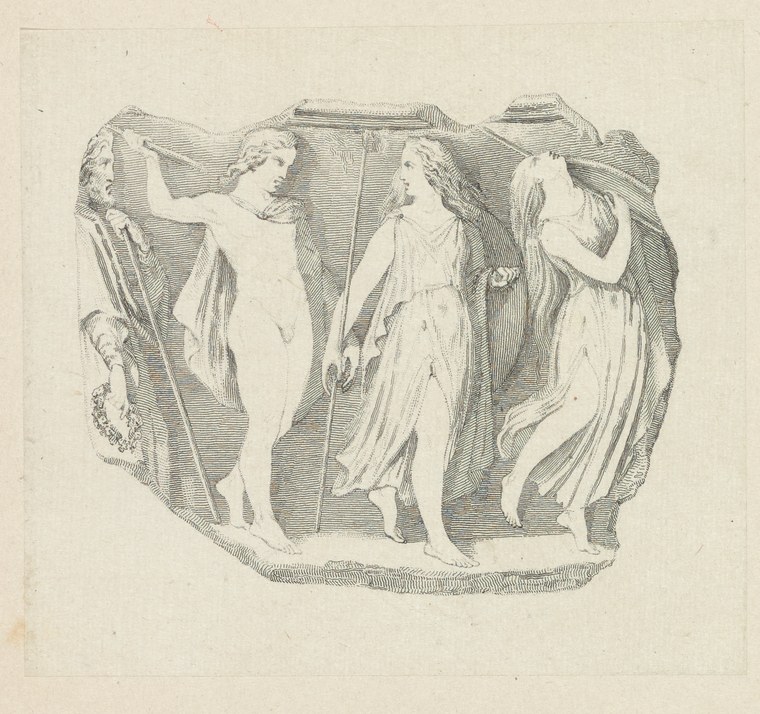
A classical engraving depicting five female figures in an allegorical or mythological scene. The composition is roughly circular, with figures arranged in a frieze-like manner against a background of drapery and architectural elements. The women are rendered in various states of dress and undress: the leftmost figure wears a long garment and holds what appears to be a staff or scepter; the central figures are partially or fully nude; the rightmost figures wear flowing drapery. The figures adopt varied poses—some standing, some in contrapposto stances—suggesting movement and interaction. The engraving employs fine parallel lines (hatching) to create volume, shadow, and the texture of fabric, typical of classical print technique. The scene has the character of a historical or mythological illustration, possibly depicting a classical narrative or allegorical subject involving dance or processional movement.
The dancing
The five figures display the formal bearing and articulation expected in classical representation. Each maintains an upright posture with carefully balanced weight; several show the contrapposto stance of classical statuary. Arms are raised, extended, or held in graceful positions—one figure raises an arm overhead, others gesture with hands extended outward or downward. The nude or semi-draped figures show anatomical attention to the torso and limbs characteristic of neoclassical art. No closed partnering holds are evident; instead, the figures suggest a processional or group formation in which individual gesture and pose dominate. The spacing and arrangement suggest a formal or ceremonial gathering rather than intimate social dance.
The dance depicted
This appears to depict either ancient Greek or Roman dance as imagined by a later neoclassical artist, or a classical allegorical subject in which dance or processional movement is a secondary element. The catalogue title explicitly indicates 'Ancient Greek and Roman dancing in prints,' confirming the subject's classical inspiration. The figures' formal poses, flowing garments, and mythological or allegorical context suggest a reconstruction or romanticization of classical antiquity rather than a document of contemporary dance practice. The lack of active footwork, specific hold types, or rhythmic gesturing makes precise identification of a particular dance style difficult; instead, the work appears to invoke the general idea of classical grace and movement as understood in the neoclassical period.
How it was made
This is a classical engraving, executed using fine parallel lines (hatching and cross-hatching) to model form and create tonal gradation. The technique allowed for precise linear detail and was favored for historical and allegorical subjects that required both legibility and refinement. The print medium enabled wide circulation and reproducibility, suggesting this image was intended for educated audiences with classical interests—collectors, scholars, and artists studying antiquity. The absence of color focuses attention on line and composition, a hallmark of eighteenth-century neoclassical printmaking. The object belongs to a long tradition of prints depicting imagined classical scenes, popular among European collectors and art academies.
About this work
This engraving presents a neoclassical interpretation of ancient dance, likely from the eighteenth century, based on its style and technique. It belongs to a broader tradition of European artists visualizing classical antiquity through the lens of contemporary aesthetic ideals—emphasizing grace, formal arrangement, and allegorical or mythological narrative. The work sits at the intersection of art history and the history of dance iconography, representing how later centuries understood and reimagined ancient movement. For dance historians, it is valuable not as evidence of actual ancient Greek or Roman practice, but as a record of how the neoclassical period imagined and valued the classical body in motion.
How to look at it
Observe the careful arrangement of the five figures and how each is posed individually yet contributes to a unified compositional whole—this is characteristic of allegorical or processional scenes rather than social dancing. Note the contrapposto stance and the classical idealization of the bodies, which emphasizes formal beauty over the capture of a specific moment of motion. Pay attention to the distinction between the draped and undraped figures: the variety suggests different roles or attributes in a mythological narrative. The print technique—fine linear hatching—creates an almost sculptural quality, as if the artist were translating three-dimensional statuary into two dimensions.
The period
This work belongs to the neoclassical movement of the eighteenth and early nineteenth centuries, a period of intense European scholarly and artistic interest in Greek and Roman civilization. Artists and collectors sought to reconstruct and visualize the ancient world through prints, paintings, and sculpture. During this era, dance was understood as an essential expression of classical virtue and beauty, and prints depicting 'antique' dancing served both antiquarian and aesthetic purposes. The formal, restrained quality of the figures reflects neoclassical ideals of order, proportion, and rational beauty, in contrast to the more exuberant movement of contemporary Baroque or Rococo art. Academic art training emphasized study of the classical body, and prints like this one circulated widely among artists and students.
Where it lives
This work is held in the New York Public Library's collection of prints depicting dance. It forms part of a broader archival category of printed dance imagery spanning multiple centuries and cultures, reflecting the library's role in preserving visual documentation of dance and performance history.
Questions about this work
Is this showing real ancient Greek or Roman dancing?
Probably not. This is a neoclassical artist's interpretation of what ancient dance might have looked like, created centuries after antiquity. The formal poses and idealized bodies reflect neoclassical aesthetic values more than documented historical evidence. It tells us what educated Europeans in the eighteenth century *imagined* classical dance to be, rather than what it actually was.
What are these five women doing?
They appear to be engaged in a processional, ceremonial, or allegorical scene rather than a recognizable dance with steps or figures. The arrangement suggests a mythological narrative or representation of classical grace and virtue. Their individual poses and gestures are formal and graceful, but there is no suggestion of active footwork, musical rhythm, or the specific hold patterns of period social dances.
Why is this in a dance collection?
The catalogue identifies this as depicting 'Ancient Greek and Roman dancing,' and movement, gesture, and the grace of the body are central to the image. For dance historians and archivists, prints showing how later ages imagined and valued dance—even if not documentary—are valuable for understanding dance's cultural meaning and how it has been visualized in art.
More dance artwork





