49 works in this view — arrow keys or swipe to move between them.
Dance in Art
Ancient Greek and Roman dancing in prints
Unknown artist
- Collection:
- Prints depicting dance
- Source:
- New York Public Library
- Rights:
- Public domain — free to use, share and adapt.
- Recorded as:
- Public Domain
This engraving demonstrates how classical dance and bodily expression were reconstructed, imagined, and circulated in Early Modern print culture. It shows that interest in ancient dance was not a matter of historical documentation but of creative invention informed by classical texts, artistic convention, and contemporary aesthetics. For historians of dance imagery, this work exemplifies how prints gave visual authority to ideas about the freedom and ecstasy of ancient ritual movement—ideas that would shape Romantic and later modern dance practice.
What you are looking at
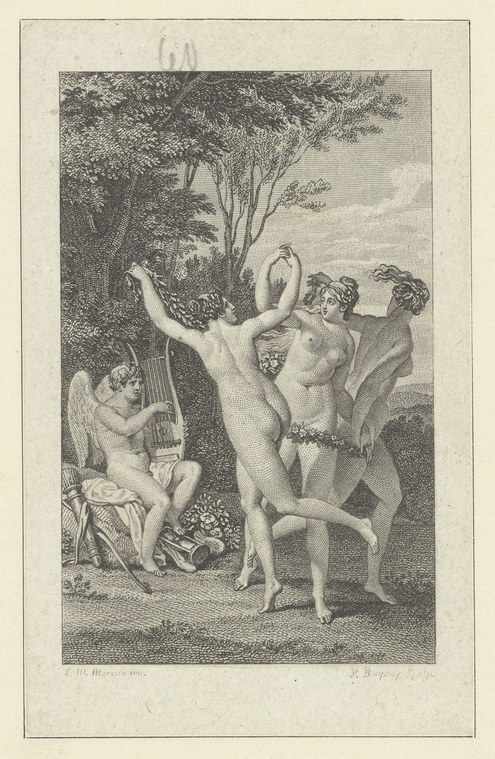
This engraving depicts a scene of classical antiquity set in a wooded landscape, with three female nudes and two putti (cherub-like children) engaged in what appears to be a bacchanalian or revelatory dance. The central figure stands with one leg raised high, arms extended upward in an exuberant gesture, her body arched backward in evident movement. To her right, a second woman watches or participates, her pose more restrained. To the left, a putto plays a stringed instrument (lyre or similar), while another putto sits lower, surrounded by garlands and vessels suggesting wine or offerings. The setting is shallow and theatrical: a large tree occupies the upper left, its foliage rendered in dense cross-hatching; the ground is indicated by simple parallel lines. The composition is framed by a dark border typical of Renaissance and Early Modern prints. The light is even and cool, created entirely through the precision of the engraver's line work.
The dancing
The principal dancer is captured mid-leap or in an ecstatic moment of raised-leg extension, with both arms lifted high and open—a posture of abandon and joy rather than formal technique. Her body is fully extended, weight transferred to one leg, the opposite knee elevated sharply. The second figure adopts a more observant stance, her body turned to address the dancer, suggesting spectatorship or participation in a shared moment. The putti are positioned asymmetrically: one actively making music, the other attending to feast items. All figures are presented nude or near-nude in classical idiom, without the encumbering costume that would prevent reading the full articulation of the body.
The dance depicted
This appears to be a bacchanalian or Dionysian revelry—a celebration of classical antiquity through the lens of Renaissance and Early Modern artistic revival. The raised leg, open arms, and evident exuberance suggest ecstatic, non-codified movement rather than a formal dance technique: this is celebration, intoxication, and divine or erotic frenzy rendered as spontaneous bodily expression. The presence of the lyre, garlands, and wine vessels confirms the bacchanalian context. Such imagery was standard in Renaissance and post-Renaissance engravings as a means of depicting ancient Greek and Roman ritual and festive life. The dance here is not a ballroom figure or a court choreography, but rather the wild, unstructured movement of mythological or historical revelers—a trope used to legitimise the depiction of nudity and uninhibited gesture within classical learning.
How it was made
This is an engraving, identifiable by its fine, regular parallel lines (hatching and cross-hatching) built up to create tone and volume, particularly in the foliage and shadows. Engraving was the primary reproductive print medium of the Renaissance and Early Modern period, allowing wide circulation of classical imagery and learned references among educated audiences. The precision of the line work and the classical subject matter suggest this was created for a cultivated audience—scholars, artists, patrons of antiquarian interests—rather than for popular broadside circulation. The technique allows for fine detail and tonal subtlety, evident in the differentiation of the figures' skin from the darker landscape.
About this work
This is a Renaissance or Early Modern engraving of a classical bacchanal, depicting nudes in ecstatic movement within an antiquarian setting. It belongs to a long tradition of Renaissance revival prints that used classical sources—real and imagined—to justify the study and depiction of the human figure in motion and in states of uninhibited expression. The work sits at the intersection of scholarly interest in classical antiquity, artistic anatomy studies, and mythological subject matter. For the gallery of dance in art, it represents an important precursor to later Romantic and Academic treatments of classical themes: the moment when Renaissance artists began to codify and visualise ancient Greek and Roman festive and ritual life through the lens of their own period's aesthetic.
How to look at it
Attend first to the central figure's raised leg and open arms: this is the visual language the artist chose for joy and abandon, and it differs markedly from the codified poses of court dance or the formal holds of ballroom. Notice how the engraver's line work becomes denser and more agitated in the tree foliage and the drapery suggestions, creating a sense of energetic naturalism around the figures. The shallow stage space and the framing of the scene as a theatrical tableau—rather than a naturalistic landscape—tell you that this is a learned construct, a representation of an imagined past rather than an observed moment. The absence of any reference to the artist's own era (no contemporary costume, no identifiable location) is deliberate: the print offers itself as a window into antiquity.
The artist
The artist is not recorded, but the style and technique are consistent with mid-16th to early 17th-century Northern European engraving practice. The subject matter and compositional approach suggest familiarity with classical literary sources (Ovid, Bacchic imagery) and with the engraved illustration tradition of the German and Netherlandish workshops, where classical and mythological subjects were staple productions for educated collectors and artists' reference libraries. Such prints often circulated in bound collections and served as models for painters and sculptors.
The period
The Renaissance and early 17th century witnessed an intense antiquarian revival, driven by the recovery and study of classical texts and the elevation of classical form as the highest artistic standard. In this context, ancient Greek and Roman dance were not understood through documentation or historical sources, but imagined through literature (especially poetry and drama), visual precedent (relief sculpture, coins, vase imagery), and contemporary aesthetic theory. Bacchanalian and Dionysian imagery was particularly popular, serving as a coded means to depict ecstatic, uninhibited bodily movement—a theme that appealed to artists interested in expressing human emotion and physical vitality beyond the constraints of courtly or religious propriety. In dance history proper, this was the era of court ballet's emergence in Italy and France, where classical allusion was central to choreographic legitimacy; yet popular and ritual forms of ecstatic movement remained largely undocumented and were often imagined through classical tropes.
Where it lives
This work is held in the New York Public Library as part of a broader collection of prints depicting ancient Greek and Roman dance and celebration. It is catalogued as belonging to a thematic group rather than a named portfolio or series, suggesting it was part of a miscellaneous holding of classical engravings assembled for reference or study.
Dance in this work
Questions about this work
Is this showing a real ancient Greek dance or is it the artist's invention?
It is creative reconstruction. Renaissance and Early Modern artists did not have access to documentation of actual ancient dances and had to imagine them from literary sources (poems, plays, historical accounts), visual precedent (sculptures, vase paintings), and contemporary aesthetic ideals. This image reflects what educated artists of the 16th or 17th century thought ancient revelry ought to look like.
Why are all the figures nude?
Nudity served multiple purposes in learned art of this period. It allowed artists to demonstrate knowledge of classical form and anatomy, it referenced the athletic and religious nudity of Greek culture, and it justified the depiction of bodies in uninhibited movement. For a bacchanalian subject, nudity also conveyed freedom from social restraint—the license granted to revelers and the divine by classical mythology.
What is the instrument the putto is playing?
It appears to be a lyre or similar stringed instrument associated with Apollo and Dionysus in classical tradition. The presence of music is essential to bacchanalian imagery and confirms that this is a festive, ritualistic moment rather than ordinary movement.
Who would have owned or used this print?
Prints like this circulated among educated collectors, artists, patrons, and scholars. They were used as reference material for painters and sculptors, bound into collections of classical imagery, and studied as models of figure drawing and composition. They were not cheap but not prohibitively expensive, making them accessible to middle-class and aristocratic patrons with antiquarian interests.
More dance artwork





