49 works in this view — arrow keys or swipe to move between them.
Dance in Art
Ancient Greek and Roman dancing in prints
Unknown artist
- Collection:
- Prints depicting dance
- Source:
- New York Public Library
- Rights:
- Public domain — free to use, share and adapt.
- Recorded as:
- Public Domain
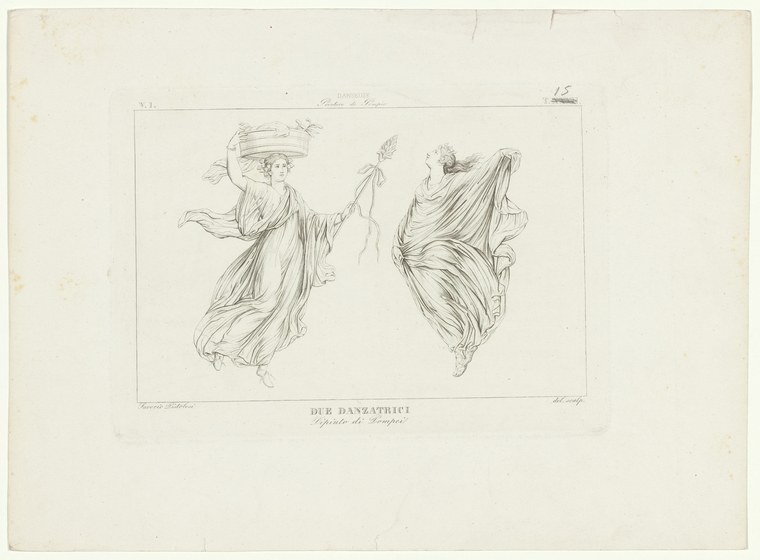
This work documents a foundational moment in European dance history: the moment when artists and intellectuals began to imaginatively reconstruct ancient Greek and Roman dance as a category of inquiry and inspiration. For dance historians, it reveals what educated Europeans believed about the mechanics and aesthetics of classical movement—assumptions that shaped ballet, modern dance, and neoclassical choreography for generations. The print also demonstrates that dance history itself is a visual and interpretive practice; these figures are not evidence of how the ancients actually danced, but rather artifacts of how a particular historical moment imagined and valued the classical body in motion.
What you are looking at
Two female figures in flowing Greco-Roman dress are depicted in mid-movement against a blank ground, each captured in a distinct pose suggestive of choreographed action. The figure on the left wears a draped garment with a headpiece or hair ornament and extends one arm upward while the other is positioned across her body; her weight appears shifted in dynamic suspension. The figure on the right, similarly draped, is shown in profile with fabric billowing around her, one arm raised and extended. Both figures occupy a shallow pictorial space defined only by a ruled rectangular frame; there is no architectural setting, landscape, or spatial context beyond the paper itself. The line work is fine and precise, executed with clear anatomical attention to the musculature beneath the drapery and the fall of fabric in motion. The title inscription at the bottom—visible in Italian—identifies these as dancers of antiquity.
The dancing
Both figures are shown in isolation rather than in partnership, each performing what appears to be a solo phrase. The left figure's pose suggests an upward extension or leap with torso slightly tilted; the right figure is turned sharply in profile with a more grounded stance and sweeping arm gesture. The drapery is rendered with careful attention to how textile moves through space—bunched, folded, and trailing—which implies the artist observed or studied actual movement. Neither figure is in a closed hold or recognizable ballroom position; instead, each occupies its own space in a manner consistent with solo or processional movement.
The dance depicted
These are reconstructive studies of ancient Greek and Roman dance, a genre of historical and antiquarian interest during the 18th and 19th centuries. The classical drapery, upright carriage, and solitary poses align with period theories about how the ancients danced—with emphasis on graceful arm movement, elevation, and expressive gesture rather than the partnered, sexually dimorphic roles of contemporary ballroom. The absence of footwork detail and the focus on upper-body extension and drapery suggest an interest in the aesthetic and visual qualities of movement rather than its kinetic mechanics. No specific Greek or Roman dance form can be named from the image alone, but the work belongs to a larger antiquarian and neoclassical fascination with reconstructing the dancing practices of the classical past.
How it was made
This is a line engraving or etching on paper, executed with the fine linear precision characteristic of 18th-century reproductive prints. The technique allows for intricate rendering of fabric texture and musculature while maintaining the clarity and repeatability that made prints the primary medium for circulating images of dance and other subjects among educated audiences. The ruled frame and formal composition suggest this is a plate from a larger series or a finished study intended for publication or collection. The absence of color and reliance on line alone emphasizes form and anatomical accuracy over atmosphere or spectacle.
About this work
This is a study of ancient Greek and Roman dancing produced as a line engraving, likely in the late 18th or early 19th century, when European artists and antiquarians were deeply invested in recovering and reimagining classical forms of movement. The two isolated female figures in flowing drapery exemplify the period's vision of ancient dance as graceful, austere, and focused on expressive gesture and elevation rather than the partnered, virtuosic forms dominating contemporary practice. As a printed work, it would have circulated among collectors, artists, and scholars interested in the classical past and its relevance to contemporary aesthetic and moral ideals.
The image belongs to a rich tradition of reconstructive dance scholarship that extended well into the 20th century. Such prints served both as historical documents and as sources of inspiration for neoclassical artists, choreographers, and designers seeking to model contemporary practice on imagined classical precedents. The work demonstrates the artist's commitment to anatomical fidelity and careful observation of drapery in motion, suggesting either study from living models or close engagement with sculptural and pictorial sources.
How to look at it
Attend first to the drapery: the artist has rendered each fold and gathered length of fabric with precision, and the folds themselves indicate the direction and energy of movement. The left figure's drapery bunches upward, suggesting a rising or lifting motion; the right figure's trails and billows as though in response to a turn or sweep of the arm. Look also at the torso and the extension of the limbs: neither figure is bent or grounded in the manner of contemporary dance; instead, both are lifted, extended, and oriented toward the viewer or across the picture plane in a way that emphasizes verticality and openness. The blank ground isolates each figure and allows the viewer to focus entirely on the body itself—a convention of antiquarian study that privileges the human form over narrative or spectacle.
The period
The late 18th and early 19th centuries saw a broad European enthusiasm for classical antiquity across all the arts, driven by archaeological discoveries, Enlightenment philosophy, and Romantic idealization of the past. In dance, this translated into interest in recovering or inventing ancient forms—a project that involved consulting classical texts, studying sculpture and vase painting, and working with artists and choreographers to reconstruct plausible movement vocabularies. Engraved and etched prints were the primary medium for disseminating such reconstructions among educated audiences. This particular work sits within a tradition of antiquarian dance scholarship that included written treatises, choreographic notation systems, and visual studies of the dressed and undressed classical body in motion. The neoclassical movement in the visual arts reinforced this interest by positioning classical forms as models for contemporary aesthetic reform.
Where it lives
Held in the New York Public Library's collection of dance-related prints, this work is catalogued as part of a broader holding of historical and reconstructive dance imagery. It appears to be a single print or plate from a larger series focused on ancient dance forms. The bare catalogue record—lacking artist attribution, precise date, and medium specification—is typical of historical prints in research collections, where attribution and provenance information has been lost or never recorded.
Questions about this work
Are these meant to be specific ancient Greek or Roman dances?
The title identifies them as ancient dancers but does not name a specific dance form. The poses and costume suggest a generalized vision of classical femininity and grace rather than a documented historical practice. In the 18th and 19th centuries, such reconstructions were often imaginative projects based on literary sources, sculpture, and aesthetic theory rather than historical evidence.
Why are there no men, and why are both figures dancing alone?
The absence of male dancers and the solitary poses reflect period assumptions about ancient Greek and Roman women's dances, which were often imagined as graceful, modest, and suitable for private or religious contexts rather than the public spectacle associated with male performers. European neoclassical aesthetics valued female movement that was elevated, restrained, and visually spectacular but not sexually powerful or technically complex.
What technique was used to make this print?
The fine, precise line work and the formal composition suggest this is a line engraving or etching, likely 18th or early 19th century. This medium allowed for intricate anatomical and drapery detail and was the standard way to circulate images of dance and historical subjects among educated audiences in this period.
How did artists know what ancient dancers looked like?
They didn't, really. Reconstructions like this were based on classical texts (Homer, Lucian, Plutarch), sculpture and vase painting, and contemporary aesthetic theories about what the ancients would have valued. The result was as much a projection of current ideals onto the past as a recovery of historical fact.
More dance artwork





