49 works in this view — arrow keys or swipe to move between them.
Dance in Art
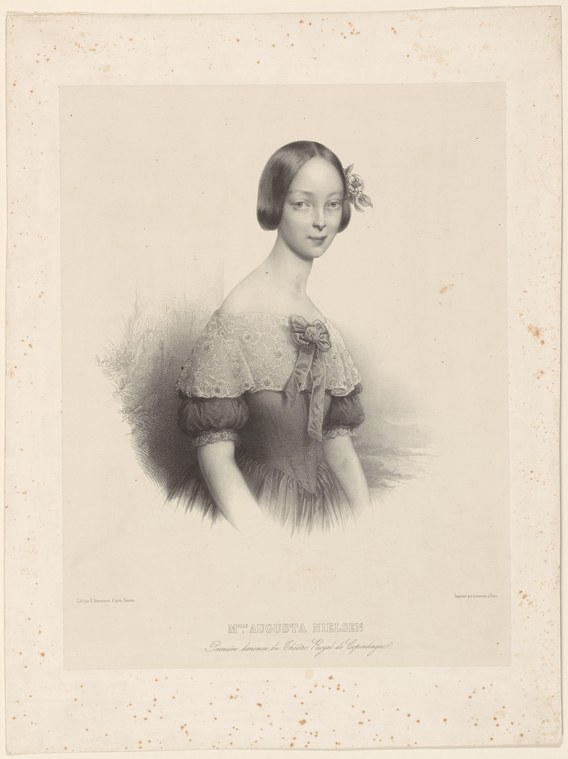
Melle. Augusta Nielsen: Première danseuse du Théâtre Royal de Copenhague
Unknown artist
- Collection:
- Prints depicting dance
- Source:
- New York Public Library
- Rights:
- Public domain — free to use, share and adapt.
- Recorded as:
- Public Domain
It documents the cultural standing of a leading Romantic-era ballerina at a moment when dancers were becoming subjects of fine-art portraiture rather than remaining purely theatrical figures. The inscription in Danish and French attests to Nielsen's international fame and the prestige of the Royal Danish Ballet in European theater networks.
What you are looking at
A three-quarter-length portrait of a young woman in formal 19th-century dress, shown against a plain background. She wears a dark corseted bodice with short, off-shoulder sleeves trimmed in white lace, and the upper arm is draped with sheer fabric. Her hair is parted in the center and swept to one side, adorned with a small floral ornament. She gazes slightly to her left with a composed expression. The artist has used careful tonal gradation to model her face and neck, while the fabric textures—the crisp white lace, the soft sheen of the bodice, the delicate gauze of the sleeves—are rendered with particular attention. The lower portion of the composition fades into suggestion; the figure emerges from and dissolves back into the neutral ground. This is formal society portraiture of the mid-19th century, not a dance scene or action study.
The dancing
A single figure in repose, not in motion. Her posture is upright and stationary, with her shoulders level and her head held with the formal composure expected in portraiture. The slight turn of her head and the gentle tilt suggest the social ease of a woman of rank, but there is no gesture that implies dance, movement, or physical exertion of any kind. Her arms are not visible below the upper arm.
The dance depicted
No dance is depicted in this image. Although the sitter is identified as a prima ballerina, the portrait itself is a standard formal portrait; it does not show her dancing, in a ballet costume mid-performance, or in any pose that references her profession. The dress is elegant society wear, not stage costume.
How it was made
This is a reproductive engraving or lithograph, in black ink on paper, executed in the polished 19th-century style typical of portrait prints for public circulation. The technique—careful stippling and linear hatching to build tone—allowed subtle modeling of the face and delicate rendering of lace and fabric. The image is inscribed with the sitter's name and her title (Première danseuse du Théâtre Royal de Copenhague / First dancer of the Royal Theatre of Copenhagen) in a formal cartouche at the base. Such prints were produced for sale to the public, for display in homes, and as commemorative records of notable stage performers.
About this work
This is a formal portrait of Augusta Nielsen, identified as the prima ballerina of the Royal Danish Theatre, rendered as a reproductive engraving or lithograph in the mid-19th century. Though the sitter was celebrated for her dancing, the work is not a dance image; it is a conventional society portrait in which her status as a performer is noted through inscription rather than shown through pose or costume. It belongs in a gallery of dance in art as an artifact of how dancers were publicly commemorated—as objects of formal portraiture rather than as bodies in motion—and as a record of the social rank and international reputation of a significant stage artist of the era.
How to look at it
Attend to the contrast between the sitter's identity (a celebrated stage performer) and the conventions of her representation (a static, formally composed society portrait). Note how the artist has signaled her rank and profession through inscription and through the subtly fashionable elegance of her dress, rather than through any choreographic or dramatic reference. The soft focus and tonal gradation in the lower half of the figure create an effect of emergence and dissolution typical of mid-century reproductive prints, which were admired for their capacity to suggest presence and immediacy while maintaining formal distance.
The artist
The artist is not recorded in the catalogue. The inscription at the base indicates the engraver's name and the date, but the image provided does not allow legible reading of this text. The work is consistent with the commercial portrait-print industry of mid-19th-century Europe, which employed skilled reproductive engravers to produce saleable prints from paintings or drawings of notable public figures.
The period
This portrait dates to the era of Romantic ballet (roughly 1830–1870), when dancers—especially prima ballerinas—became celebrities in urban European society and were frequently portrayed by painters and printmakers. Formal portraiture was a mark of cultural distinction; the fact that a dancer was deemed worthy of such commemoration signals the elevated status of the art form and of star performers. At the same time, the absence of any reference to dance in the pose or costume reflects a convention of the period: public portraiture of women, even performers, emphasized gentility, feminine restraint, and social propriety rather than the physicality or spectacle of their stage work.
Where it lives
The work is held in the Prints depicting dance collection at the New York Public Library. It is a reproductive print, likely one of a commercial edition, and was presumably acquired as part of a broader collecting effort to document dance history through portraiture and theatrical imagery.
Questions about this work
Was Augusta Nielsen actually a dancer?
Yes. The inscription identifies her as Première danseuse (first dancer / prima ballerina) of the Royal Theatre of Copenhagen, indicating she was a leading figure in the Danish ballet during the Romantic era. The Royal Danish Ballet was a prestigious institution, and such a title would have been earned through exceptional training and performance.
Why doesn't the portrait show her dancing?
Formal portraiture of the 19th century, even of performers, typically presented sitters in repose and in fashionable society dress rather than in working costume or action. Dancers were celebrated in theatrical prints and lithographs, but formal fine-art portraits usually emphasized social standing and personal elegance. Her profession is noted through the inscription, not through her pose.
What is this print made of and how was it produced?
Based on the visual qualities—the fine linear hatching, the subtle tonal gradations, and the paper surface—this appears to be an engraving or possibly a lithograph, a reproductive technique that allowed artists to create multiple copies for public sale. Such prints were the primary means of circulating images of celebrated public figures before photography became widespread.
More dance artwork





