49 works in this view — arrow keys or swipe to move between them.
Dance in Art
Ancient Greek and Roman dancing in prints
Unknown artist
- Collection:
- Prints depicting dance
- Source:
- New York Public Library
- Rights:
- Public domain — free to use, share and adapt.
- Recorded as:
- Public Domain
This work is a historical artifact of the visual grammar of classical revival and theatrical representation in the 19th century. It demonstrates how artists of the period used elaborate engraving technique to render scenes of classical antiquity and heightened emotional expression, a visual language that shaped contemporary ideas about ballet, pantomime, and dramatic movement.
What you are looking at
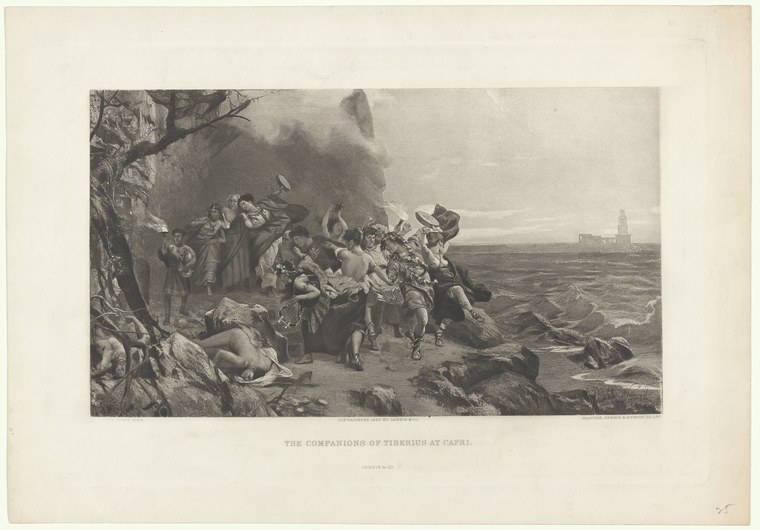
This engraving depicts a crowded shore scene with classical or early Christian figures gathered near a rocky cliff face beside a harbor. In the middle distance, a fortified city with towers is visible across the water. The composition is divided between the densely packed human figures in the foreground—some standing, some seated or reclining on rocks—and the expansive seascape beyond. The figures wear draped classical dress and appear to be in states of distress, supplication, or emotional intensity. The print employs dramatic chiaroscuro typical of 19th-century narrative engraving, with deep shadows in the rocky crevices and bright highlights catching the figures and distant architecture. The scene suggests a moment of collective experience—martyrdom, pilgrimage, shipwreck, or religious gathering.
The dancing
The figures are arranged in no organized formation; they crowd the space in varied postures—standing, kneeling, seated, and sprawled—creating a composition organized by dramatic intensity rather than dance steps. Many gestures are upraised and expansive, suggesting prayer, lamentation, or exhortation. There is no synchronized movement, no pair-work, no closed or open hold, and no visible footwork pattern. The bodies are oriented toward each other and toward the viewer in a theatrical but non-choreographic manner.
The dance depicted
This is not a depiction of dance. The title references 'companions of Tiberius at Capri,' a historical or literary allusion to a gathering at a specific location. While the scene is theatrical and emotionally heightened, the figures' postures and arrangement show no evidence of organized dance movement, rhythmic formation, or the technical control expected of dancers. This is a narrative history or religious scene rendered with dramatic bodily expression, but expression is not dance.
How it was made
This is a steel or copper engraving, a labor-intensive intaglio process requiring fine line-work to model form and light. The technique was the standard for reproductive prints of this quality in the 19th century, allowing wide distribution to an educated and affluent audience. The detailed handling of drapery, the subtle gradations of shadow through parallel line-work (hatching and cross-hatching), and the precision of architectural rendering in the background are characteristic of mid-to-late 19th-century book and gallery engraving. The print comes from a collection at the New York Public Library, suggesting it was a published work, possibly illustrating a classical text, history, or literary narrative.
About this work
This is a 19th-century engraving depicting a legendary or historical crowd scene at Capri, rendered in the dramatic neoclassical style of narrative history engraving. The work belongs in the Gallery of Dance in Art not as a depiction of dance, but as an example of how classical subjects and emotionally heightened bodily expression were visualized in the period when modern theatrical dance was emerging. It represents a visual language of the body—theatrical, expressive, gestural—that influenced how dance itself was conceived and depicted in high art.
How to look at it
Attend to the variety of bodily postures and the absence of any rhythmic or spatial pattern—this crowd does not move in unison or in any organized formation. Notice how the artist uses classical drapery and the rocky setting to suggest high emotion and narrative importance without choreography. The precision of the engraving technique—the fine parallel lines that model shadow and form—was the method by which such scenes reached a literate public in the 19th century, making this a document of how classical subjects were visualized in an age of mechanical reproduction.
The period
This engraving dates stylistically to the mid-to-late 19th century, an era when neoclassical subjects remained popular in high art despite the emergence of Romanticism and realism. The technique and composition reflect the dominance of engraving as the primary medium for reproducing and circulating ambitious narrative art to a wide audience. This was the period when ballet was establishing itself as a major theatrical form in Europe, often drawing on classical and romantic narratives; the visual conventions of history engraving—dramatic gesture, emotional intensity, flowing drapery—influenced how dancers' bodies were understood and represented in contemporary dance imagery.
Where it lives
The work comes from the New York Public Library's collection of prints depicting dance and classical subjects. It is likely a published engraving, possibly illustrating a book on classical history, literature, or antiquity, or a standalone art print for collectors. The presence of a title inscription at the bottom indicates it was a finished work intended for sale or distribution.
Questions about this work
Is this a dance scene?
No. While the figures are rendered with dramatic theatrical expression, there is no organized dance movement, synchronized formation, or visible footwork. This is a narrative or historical scene—possibly depicting a legendary gathering, religious event, or moment of emotional crisis. The theatrical intensity of the poses may reflect contemporary ideas about expressive bodily movement, but the composition is not choreographic.
What does 'companions of Tiberius at Capri' mean?
The title refers to a historical or literary reference to a gathering at Capri (a Roman island) during the reign of the emperor Tiberius. The specific event depicted is not certain from the image alone, but it may allude to a classical historical narrative, a literary interpretation of Roman history, or a scene of martyrdom or religious gathering. Further research into the print's publication history and context would clarify the reference.
Why is this in a dance art collection?
The work illustrates how the 19th-century visual language of classical subjects, theatrical expression, and the human body in heightened emotional states influenced the emerging discipline of theatrical dance. The engraving technique and neoclassical subject matter were central to how dance imagery was conceived and circulated in the same period when ballet was establishing itself as a major European art form.
What technique is used?
This is an engraving, an intaglio printmaking process in which lines are incised into a metal plate (usually steel or copper) and filled with ink. The artist builds form and shadow through fine parallel lines (hatching), a labor-intensive method that produced prints of high detail and tonal subtlety. Engravings were the dominant medium for reproducing ambitious narrative art in the 19th century.
More dance artwork





