49 works in this view — arrow keys or swipe to move between them.
Dance in Art
Prints after William Hogarth
Unknown artist
- Collection:
- Prints depicting dance
- Source:
- New York Public Library
- Rights:
- Public domain — free to use, share and adapt.
- Recorded as:
- Public Domain
For dancers and choreographers, this image offers evidence that 18th-century artists understood the body's expressive capacity in non-theatrical contexts—that gesture, posture, and collective movement patterns were worthy of the same careful observation as formal dance. Historians of performance should note that Hogarth treats audience response as inseparable from the performance itself, a principle that shadows modern participatory and immersive theater.
What you are looking at
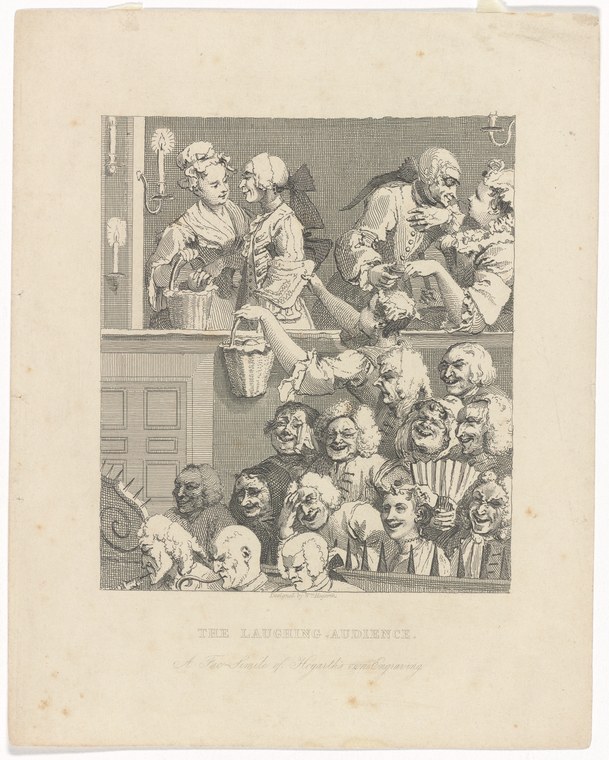
A rowdy theater audience roars with laughter, packed into a playhouse box and gallery. The composition is divided vertically: an upper tier shows well-dressed figures in a theater box leaning forward with animated expressions—some gesturing wildly, others doubled over in mirth—while the lower tier depicts a crush of spectators in the pit, their faces contorted in cacophonous laughter. The figures wear 18th-century dress: the women sport tall coiffures and silks, the men wear coats and tricorns. The setting is clearly a Georgian playhouse, with the box's architectural frame and drapery visible at left. The engraving captures a specific moment of unrestrained hilarity, with bodies straining forward, mouths agape, and arms thrust outward—a snapshot of collective, physical comedy that treats audience reaction as performance in itself.
The dancing
The figures are not dancers in the formal sense, but their bodies express exuberant, physical comedy through laughter and gesture. Torsos lean sharply forward from the waist, necks crane, mouths open wide, and arms gesture expressively upward and outward. The upper-tier figures show greater control and fashionable posture, while the pit crowd displays more unrestrained contortion—bent spines, twisted necks, and splayed limbs. There is no coordinated formation or dance hold; instead, the composition shows the body language of uncontrolled mirth, with each figure's pose amplifying the next.
The dance depicted
This is not depictive of theatrical dance but of the dance of laughter itself—the bodily expression of comic response. The image likely relates to 18th-century pantomime or farce, where physical comedy in the performance space prompted equally physical audience response. The exaggerated gestures and contorted bodies suggest the work documents a moment of hysterical rather than choreographed movement, though the way the artist has arranged these figures as a compositional cascade implies an interest in the rhythm and pattern of collective bodily expression. The title *The Laughing Audience* confirms this is a study of audience reaction as a social and physical phenomenon.
How it was made
This is an engraving, executed with fine parallel lines (hatching) to create tone and model the figures' volume and expression. The technique allows precise rendering of facial features and textile detail—crucial to reading the intensity of emotion—and the controlled line work creates a sense of decorum and distance that paradoxically frames chaotic, unrestrained behavior. The scale and composition suggest this was a popular print intended for distribution; Hogarth's work was widely circulated through engravings, which made satirical and moralistic commentary available to a broad urban audience.
About this work
This engraving documents a moment of collective physical response in an 18th-century London playhouse, treating laughter as a bodily phenomenon worthy of serious artistic attention. Rather than depicting a performance on stage, it choreographs the audience itself—showing how bodies in proximity, responding to shared stimulus, create their own kinetic patterns. The work sits at the intersection of social satire, anatomical observation, and performance documentation: Hogarth was interested in how people actually moved and gestured in moments of genuine feeling, and the playhouse audience offered a laboratory for that study. It belongs in a gallery of dance in art because it recognizes that expressive bodily movement extends beyond trained dancers and formal choreography into the spontaneous, collective, and ungoverned physical life of social spaces.
How to look at it
Attend first to the compositional rhythm: notice how Hogarth has stacked and clustered the figures to create a visual crescendo of hilarity, with the upper box acting as a kind of chorus to the wilder figures below. Look at the faces—the artist has rendered each expression with individual specificity, from barely suppressed smirks to open-mouthed roars. Trace the line of the bodies: they spiral and tilt, creating a sense of physical abandon. The print's power comes from its recognition that laughter is not a still moment but a cascade of bodily contractions; by freezing that cascade, the engraving reveals its underlying structure.
The artist
William Hogarth (1697–1764) was an English painter, printmaker, and social satirist whose work combined moral commentary with acute observation of human behavior. He pioneered the 'modern moral subject'—narrative sequences that used the human body, dress, and setting to expose hypocrisy and folly in contemporary life. Hogarth was deeply interested in movement, expression, and the bodily language of emotion; his treatise *The Analysis of Beauty* (1753) theorized the expressive potential of line and curve in the human figure. He engraved and published his own work to reach a wide audience beyond the aristocracy, making prints a vehicle for social critique.
The period
The 18th century saw the rise of commercial theater in London and the emergence of new audiences—merchants, professionals, and the middling sort alongside the gentry. Theatrical genres such as pantomime and ballad opera exploited physical comedy and slapstick to appeal to these diverse crowds. Simultaneously, the century witnessed growing interest in the theory of expression and emotion: philosophers like David Hume and later Charles Darwin studied the involuntary bodily signs of feeling. Hogarth's work participates in this culture of attention to the body as a text of social meaning, and his audience scenes document the new phenomenon of urban, commercial entertainment and the collective effervescence it produced.
Where it lives
The record identifies this as a print after William Hogarth, held in the New York Public Library's collection of prints depicting dance. The catalogue information is sparse, but the image and title together establish it as an engraved satirical print from the 18th century, likely one of several related compositions on theater and social behavior.
Questions about this work
Is this actually about dance?
Not in the formal sense—there is no choreography or trained dancers here. But the image treats laughter and emotional response as a bodily phenomenon worthy of the same careful observation an artist might lavish on a formal dance. For performers and those interested in movement, it offers evidence that 18th-century artists understood the expressive power of the human body in collective, unscripted moments.
Why is an audience image in a gallery of dance?
Because dance and performance are not confined to the stage or to trained dancers. The expressive movement of bodies in social space—how they cluster, gesture, respond to stimulus—is a form of kinetic culture. Hogarth's print documents how theater produces movement not just among performers but among spectators, collapsing the boundary between stage and audience.
What is the joke or moral here?
Hogarth typically uses satire to expose folly, hypocrisy, or excess. Here, the print may be mocking the loss of decorum and self-control induced by popular entertainment, or celebrating the democratic leveling that occurs when a crowd laughs together. The composition itself—which treats all bodies equally, regardless of rank—suggests a democratic rather than strictly moralistic intent.
More dance artwork





