49 works in this view — arrow keys or swipe to move between them.
Dance in Art · 1873
Imogene quadrille
Unknown artist
- Source:
- Library of Congress
- Rights:
- Public domain — free to use, share and adapt.
- Recorded as:
- Public Domain
This object documents the publishing and distribution of ballroom music in the late 19th century—a crucial but often overlooked infrastructure of social dance. The quadrille was central to courtship and social hierarchy among the middle and upper classes; printed scores like this one made such dances accessible and standardized across different regions and countries. For historians of dance, material culture, and social history, such title pages reveal how the dance repertoire was commercialized, aestheticized, and consumed.
What you are looking at
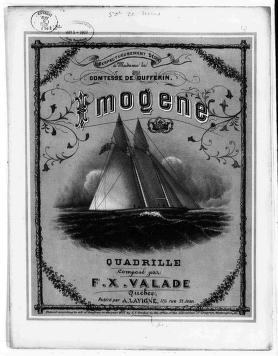
A sailing ship in full canvas occupies the center of this engraving, rendered in dramatic perspective against a calm sea. The vessel—a two-masted schooner or similar craft—is shown under full sail, heeling slightly with the wind. The composition is framed by ornamental borders typical of 19th-century sheet music covers: decorative floral and scrollwork elements fill the top and sides, creating a theatrical frame around the ship. The title "IMOGENE" appears prominently above the vessel in bold lettering, with "QUADRILLE" and the composer credit "F.X. VALADE" below. The engraving is executed in fine black line work against a white ground, with tonal variation achieved through cross-hatching and stipple to suggest the volume and movement of the sails and the texture of the water. The entire composition reads as a formal title page rather than a depiction of dance itself.
The dancing
No human figures are visible in this image. This is not a scene of dancers or choreography, but rather a maritime subject—a ship under sail. There are no bodies, holds, frames, or gestures to analyze as dance content.
The dance depicted
The image contains no depiction of dance. The quadrille was a popular ballroom dance of the 19th century, typically performed by four couples in a square formation. This engraving is the title page or cover of a musical composition for a quadrille named 'Imogene,' composed by F.X. Valade. The ship imagery is purely symbolic or decorative—possibly chosen for its name association, the elegance of the vessel, or as a metaphor for the piece's character. Without figures performing the dance, we cannot assess movement, style, or technical execution.
How it was made
This is a wood engraving or steel engraving, likely produced via intaglio printing, as evidenced by the fine parallel lines, cross-hatching, and precise tonal control throughout. The ornamental borders and typography indicate this is a commercial music publisher's product, probably from a Paris or European printing house given the French composer's name and the refined execution. The technique allowed for mass reproduction: multiple impressions could be pulled from the engraved plate, making the score widely accessible to amateur musicians and dancing masters. The quality of the line work suggests a skilled engraver trained in the mid-19th-century tradition.
About this work
This is a decorative title page for a published quadrille composition by F.X. Valade, named 'Imogene.' It dates to 1873, when the quadrille remained one of the most fashionable ballroom dances across Europe and America. Rather than depicting dancers or a ball, the artist has chosen a sailing ship as the central image—a choice that may reference the piece's title, evoke a mood, or simply reflect the romantic taste of the period. The engraving exemplifies how 19th-century music publishers marketed dance music: through attractive, refined printed covers that appealed to affluent households where such dances were performed. While the image itself shows no dance, it is an artifact of dance culture and the commercial apparatus that sustained ballroom dancing in the gilded age.
How to look at it
Observe the technical precision of the engraving: the uniform fineness of the lines, the careful modeling of the ship's form through cross-hatching, and the integration of the ornamental border with the central image. The ship is rendered with enough detail that its rigging is legible—sails, masts, and lines are all carefully articulated, suggesting that the choice of subject was intentional, not merely decorative. Notice the hierarchy of lettering: the title 'IMOGENE' dominates, while the word 'QUADRILLE' and the composer's credit are smaller and serve to anchor the ship's image within the context of a dance composition. The composition is symmetrical and formal, reinforcing the sense of a published, authorized text rather than a sketch or unique creation.
The artist
The composer F.X. Valade is not recorded in major biographical databases, but the name and style are consistent with a mid-19th-century French or European composer working in the commercial music industry. Hundreds of quadrille composers produced dance music of this era, many now largely forgotten; their works survive primarily as printed scores in library collections. The engraver's name is also unrecorded, which is typical for commercial music publishing, where the engraver was an anonymous craftsperson rather than a credited artist.
The period
The quadrille dominated European and American ballroom culture from the 1820s through the 1890s. By 1873, when this score was published, the quadrille was no longer novel but remained the standard ballroom figure dance, taught to all young people of genteel status and performed at balls, assemblies, and private dances. The publishing industry in Paris, London, and other major cities produced thousands of quadrille scores, many with distinctive titles and slight variations in structure. Engraved title pages with ornamental borders were the norm; music publishers competed for attention through attractive cover design. Simultaneously, the rise of chromolithography and other printing technologies was beginning to make illustrated covers even more elaborate. This modest but refined engraving represents the height of the mid-century style before color printing became standard.
Where it lives
This engraving is held in the Library of Congress collection and was sourced from that institution's digital collections. It is a printed sheet—a single leaf of music or a title page from a published score—and represents a mass-produced commercial object, not a unique artwork. Multiple impressions of this engraving would have been printed and circulated.
Dance in this work
Questions about this work
Why is there a ship on a dance music cover?
The reason is not certain, but several explanations are plausible: the piece may be named after a ship, the ship may evoke the grace and movement of sailing as a metaphor for dance, or the image may simply have appealed to the publisher's aesthetic taste. Ship imagery was popular in 19th-century decoration and was often used to suggest elegance, travel, and modernity. Without the composer's or publisher's own explanation, the symbolism remains open.
Is this actually a dance scene?
No. This is a title page for a printed musical score, not a representation of people dancing. It is an artifact of dance culture—evidence of how ballroom music was published and marketed—but it does not depict the dance itself. To see what the quadrille actually looked like when performed, one would need to consult contemporary dance manuals, paintings of balls, or written descriptions.
What is a quadrille and who danced it?
The quadrille was a ballroom figure dance for four couples (eight people) arranged in a square. It originated in France in the early 19th century and became the dominant social dance across Europe and America by the mid-1800s. It was performed at formal balls, assemblies, and private dances by the middle and upper classes. The dance was codified through published manuals and scores like this one, which ensured that people across different regions could learn and perform the same choreography.
How do we know this is from 1873?
The catalogue record provided by the Library of Congress dates this object to 1873. The style of the engraving, the typography, and the period references are all consistent with that date, though without additional documentation (such as a publisher's mark or a date printed on the cover), the dating cannot be independently verified from the image alone.
More dance artwork





