49 works in this view — arrow keys or swipe to move between them.
Dance in Art · 1889
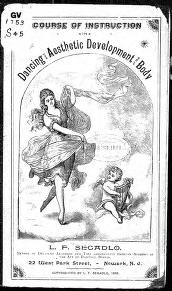
Course of instruction in dancing and aesthetic development of the body
Unknown artist
- Source:
- Library of Congress
- Rights:
- Public domain — free to use, share and adapt.
- Recorded as:
- Public Domain
This work is a rare primary source for understanding how aesthetic movement and physical culture were presented and sold to students in the 1880s—what language was used, what ideals were invoked, what bodily carriage was held up as an example. The classical framing and emphasis on 'development' reveal the philosophical foundations of a movement that would eventually contribute to both modern dance and early 20th-century dance pedagogy. For historians, this cover is evidence of the professionalization and gendering of dance instruction in this period.
What you are looking at
This is a cover or title page for an instructional manual on aesthetic dance and body development, printed in 1889. The composition is centered on an oval frame containing three figures in classical dress: a central female dancer in a flowing Greco-Roman gown with her body in a graceful contrapposto stance, flanked by two cherubic putti or child figures. The female figure's posture suggests an idealized, harmonious alignment of the body. The surrounding decorative border includes ornamental flourishes typical of late 19th-century print design. The text at top reads "COURSE OF INSTRUCTION" and at bottom identifies the publisher. The overall aesthetic is earnest and aspirational—the work positions dance as a serious subject worthy of systematic instruction and connected to classical ideals of beauty and bodily perfection.
The dancing
The central figure is an adult woman standing in a relaxed, balanced posture with one leg lightly supporting her weight while the other is softly bent, a stance that emphasizes ease and natural alignment rather than rigid positioning. Her arms are positioned gracefully, one extended and one held close to her body, creating an impression of flowing, continuous movement. The two putti flank her symmetrically, their smaller scale and cherubic form reinforcing the allegorical framing of dance as virtue or natural grace. The composition suggests an educational rather than performative context—the woman is presented as a model of correct bodily carriage rather than executing a specific choreographic phrase.
The dance depicted
This work cannot be confidently assigned to a named dance style, but its visual language and context point to the aesthetic and physical culture movement of the late 19th century. The classical references in costume and the emphasis on bodily alignment suggest a connection to the Delsarte system or similar methods of "aesthetic movement" instruction that were influential in American and European dance education during this period. The title promises both dance instruction and 'aesthetic development of the body,' indicating that the manual addressed posture, grace, and the cultivation of bodily beauty as much as specific choreography. The classical female figure in idealized repose was the visual currency of such pedagogical materials.
How it was made
This is a wood engraving or steel engraving, executed with fine linear hatching typical of 19th-century reproductive printmaking. The technique allowed for precise tonal modeling and enabled mass reproduction of the image, making it economical for use as cover art on an instructional publication. The quality and fineness of the engraving suggest professional execution intended for a middle-class audience seeking self-improvement through instructional manuals. The decorative border and balanced composition indicate this was a title page or cover designed to convey authority and refinement to potential purchasers.
About this work
This is a pedagogical title page from an 1889 instructional manual on dance and body culture. It represents the moment when aesthetic ideals drawn from classical sculpture and philosophy were being systematized into teachable dance and movement practice for American and European students. The image constructs dance as a serious educational subject aligned with ideals of natural grace and classical beauty. The work belongs in a dance gallery because it documents how dance was understood and marketed as a self-improvement practice in the Gilded Age, when systematic instruction in 'aesthetic development' attracted middle-class students seeking bodily cultivation and refinement. The classical references and allegorical framing reveal the aspirations and conceptual vocabulary of late 19th-century dance pedagogy.
How to look at it
Attend to the posture and positioning of the central figure—notice how the artist has chosen to depict not active movement or technical execution, but rather a state of ideal repose and balanced alignment. The figure is presented as a living sculpture, embodying classical principles. The presence of the allegorical putti reinforces that this is not a scene from a social dance or theatrical performance, but rather a visualization of an abstract ideal: the properly developed, aesthetically cultivated body. The ornamental, symmetrical composition is itself a kind of argument about order, harmony, and cultivation.
The period
The 1880s-1890s saw the flourishing of the Delsarte system and related 'aesthetic movement' approaches to physical training and dance, particularly in the United States and Britain. These systems were rooted in a romantic idealization of classical aesthetics and Greco-Roman ideals of the body, mediated through the philosophy of François Delsarte and popularized by educators like Steele MacKaye. The period witnessed an explosion of instructional manuals on posture, gesture, and 'aesthetic development' aimed at middle-class women and men. This manual is one of hundreds produced during this period, reflecting a broader cultural moment in which dance and physical culture were repositioned as respectable, educational, and scientifically grounded subjects rather than entertainment or frivolous display.
Where it lives
This work comes from the Library of Congress collections. It is cataloged as a printed instruction manual or educational text from 1889, and the image shown here is the title page or cover of that publication.
Questions about this work
Who was L. Scordala?
The name at the bottom likely indicates the publisher or printer, but biographical information is not recorded in the catalogue. The work itself is what survives.
What is the 'Delsarte system' and does this manual teach it?
The Delsarte system was a method of physical training and gesture developed by the French pedagogue François Delsarte and popularized in America in the late 19th century. It emphasized natural, expressive movement and the alignment of gesture to emotion and idea. This manual's emphasis on 'aesthetic development' and classical ideals suggests it was influenced by or related to Delsarte pedagogy, though we cannot confirm the specific curriculum without examining the interior text.
Was this kind of 'aesthetic dance' the same as ballet?
No. While both ballet and aesthetic movement were formalized movement practices, they were distinct. Ballet was a theatrical, technical form; aesthetic movement was often taught to non-professionals as physical and moral cultivation. Aesthetic practitioners valued natural grace and classical ideals over the technical virtuosity demanded in ballet.
More dance artwork





