49 works in this view — arrow keys or swipe to move between them.
Dance in Art · 1882
Days of youth; Minuet
Unknown artist
- Source:
- Library of Congress
- Rights:
- Public domain — free to use, share and adapt.
- Recorded as:
- Public Domain
This work matters as a cautionary example: it demonstrates how descriptive titles and thematic content can conflate with dance imagery in archival systems. It also documents late 19th-century photographic practice and the commercial reproduction of portraits for mass distribution.
What you are looking at
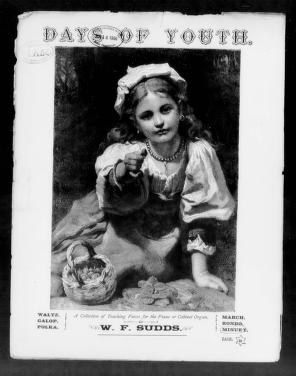
A young girl in late 19th-century dress sits at center, wearing a white blouse with puffed sleeves and a dark skirt or pinafore. Her hair is styled in period fashion with a light-colored ribbon or headpiece. She holds what appears to be a small dog or similar animal in her lap. At her feet sits a wicker basket or container. The photograph is rendered in soft greyscale tones typical of late 1800s portraiture. The title "Days of Youth" and text crediting "W. F. Sudds" appear printed below the image, along with "March" and what may be a publication date. The composition is studio-based with a plain, dark background that emphasizes the figure.
The dancing
The girl is seated in a composed, stationary pose rather than depicted in active movement. Her posture is upright and formal, typical of portrait photography of the period. Her hands are engaged with the animal in her lap. There is no depiction of dance movement, hold, or frame in this image.
The dance depicted
This image does not depict dance. It is a portrait photograph of a child in period dress, presented as a sentimental domestic scene. The title "Days of Youth" is thematic rather than descriptive of movement. No dancer, dance hold, or choreographic content is visible.
How it was made
This is a photographic print, likely a halftone or photomechanical reproduction suitable for publication in a magazine or periodical, as suggested by the printed caption and credit line. The soft focus and tonal range are consistent with late 19th-century photographic printing technology. The printed text and publication formatting suggest this was distributed as part of a commercial or editorial product, not as a fine art photograph intended for exhibition.
About this work
This work is catalogued as a dance image but is not a depiction of dance. It is a studio portrait photograph of a young girl in 1880s dress, reproduced with printed caption and artist credit. The inclusion of "Days of Youth" in the title may have prompted its entry into dance image collections, but the image itself records a static, domestic scene of childhood rather than any choreographic or movement content. It represents the circulation of sentimental portraiture through print media in the Gilded Age.
How to look at it
Attend to the formal conventions of Gilded Age portrait photography: the studio setting, the careful arrangement of dress and accessories, the soft-focus printing technique designed to flatter. The presence of the small animal and the titled theme signal the work's function as sentimental domestic narrative rather than documentary or artistic statement. The printed credit and publication format reveal its original circulation context.
The artist
W. F. Sudds is credited on the print. Without additional records, little can be established about this photographer's practice or training. The professional presentation and publication context suggest studio portraiture was their primary work.
The period
The 1880s saw rapid expansion of photographic reproduction technology and the emergence of illustrated magazines and periodicals as vehicles for domestic and sentimental imagery. Portrait photography was increasingly affordable and popular among the middle classes. The softly focused, romanticized aesthetic of this image aligns with prevailing taste in late Victorian portraiture, which favored painterly effects and emotional rather than documentary content.
Where it lives
The work is held by the Library of Congress. It is reproduced here as a printed publication item, suggesting it circulated as part of a periodical or commercial print series rather than as a unique photograph or original fine print.
Questions about this work
Is this actually a dance image?
No. The image shows a seated child in period dress, not a dancer or dance movement. The title "Days of Youth" is thematic and does not describe choreographic content. It appears to have been misclassified in a dance image collection, possibly due to its sentimental title or its presence in a context where it was grouped with other Gilded Age imagery.
What is the small object the girl is holding?
It appears to be a small dog or similar pet animal. The animal is rendered as a dark form in her lap, a common motif in Victorian portrait photography used to emphasize the subject's youth, innocence, and domestic circumstance.
Who was W. F. Sudds?
Sudds is credited as the photographer, but no additional biographical information is available from the catalogue record or the image itself. The professional quality and commercial reproduction suggest an established studio photographer working in the late 19th century.
More dance artwork





