49 works in this view — arrow keys or swipe to move between them.
Dance in Art · 1905
Indian dance
Unknown artist
- Source:
- Library of Congress
- Rights:
- Public domain — free to use, share and adapt.
- Recorded as:
- Public Domain
This poster documents a crucial moment in American entertainment history: the period when musical comedy and vaudeville were the dominant forms of commercial dance performance, before the later codification of jazz, tap, and musical theater into distinct technical vocabularies. For historians of vernacular dance, celebrity culture, and theatrical marketing, it reveals how performers were sold to audiences and how the body was presented in commercial entertainment before film.
What you are looking at
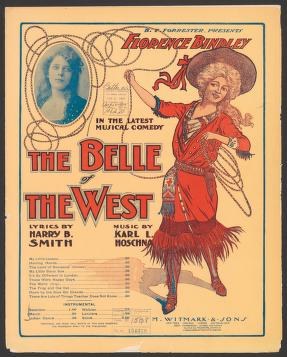
This is a theatrical poster for a musical comedy, printed in full color lithography. The composition is divided into two focal areas: on the left, a photograph or photomechanical reproduction of a young woman's face in profile, framed in an oval; on the right, a stylized illustration of a woman in bright red costume striking a dynamic pose. She wears a short red dress with puffed sleeves and a wide-brimmed hat decorated with feathers, leaning backward with one leg raised and bent at the knee, her body weight shifted dramatically to one side. The background is a warm buff or cream color. At the top in red letters reads the title "The Belle of the West," and at the bottom are credits identifying Harry P. Smith as the book author and Karl L. Rohrmann. The poster employs the commercial aesthetic of early 1900s musical theater marketing, with vibrant color, bold typography, and the figure positioned to suggest movement and entertainment.
The dancing
A single figure dominates the right side of the composition, captured in a moment of exaggerated theatrical posture rather than actual dance technique. Her weight is clearly shifted to the supporting leg (stage left), with the opposite knee raised and bent sharply, creating an angular, comedic line rather than the flowing extension of classical dance. Her torso is tilted backward in an off-balance attitude, with one arm raised expressively. The pose suggests the style of musical comedy performance and vaudeville entertainment rather than any formalized dance vocabulary—it is a comic rather than balletic presentation of the female body in motion.
The dance depicted
This is not a representation of any recognizable dance form, but rather a theatrical performance costume from American musical comedy of the 1905 era. The pose and presentation belong to the tradition of song-and-dance performance in Broadway and touring musical theater, where comic physical expression and costume spectacle mattered more than technical dance vocabulary. The woman's exaggerated stance and comedic lean suggest the style of light musical entertainment or 'gaiety' theater popular in that period, in which performers moved between song, light dramatic acting, and physical comedy rather than executing specific dance styles. The image documents what audiences came to see: the performer as a whole theatrical entity, not a trained dancer in any traditional sense.
How it was made
This is a color lithographic poster, a technique that dominated theatrical advertising from the 1880s through the 1920s. Lithography allowed bold, saturated color and large-scale reproduction suitable for street display, and was cheaper than other color printing methods of the time. The image combines photomechanical reproduction (the oval portrait on the left) with hand-drawn illustration (the figure on the right), a common hybrid approach in theatrical marketing. This mixing of photographic and illustrative elements suggests the work was designed for broad commercial distribution to theater lobbies and street advertising, and reveals how theaters marketed performers—by selling the image of the star herself as much as the entertainment.
About this work
This is a color lithographic poster advertising "The Belle of the West," an American musical comedy from 1905 featuring Harry P. Smith's book and Karl L. Rohrmann's score. It documents the aesthetic of early-twentieth-century musical theater marketing and performance, a form of entertainment in which dance was integrated with song, comedy, and spectacle but was not formalized as a separate art. The image shows not a dancer but a performer in theatrical costume, positioned for maximum visual impact and entertainment value. It belongs in a dance archive not because it depicts technical dance, but because it captures the commercial theatrical context in which American musical comedy operated—the seedbed from which jazz dance, musical theater dance, and American popular dance eventually developed.
How to look at it
Attend to the artificial, exaggerated quality of the pose. This is not a dancer caught mid-movement but a performer striking an attitude for comic effect—the backward lean, the raised knee, the theatrical tilt of the hat all suggest vaudeville or music-hall comedy rather than trained technique. The contrast between the realistic oval portrait (establishing her as a celebrity personality) and the stylized comic figure (establishing her as an entertainer) reveals the dual marketing strategy: promote the star's beauty and familiarity while advertising the spectacle of her performance. The vibrant red of the costume dominates the composition, signaling theatrical extravagance and drawing the eye to the body as costume and display.
The artist
The artist is not recorded. The work bears the hallmarks of commercial lithographic poster design from the early 1900s—a period in which theater posters were produced by in-house design studios and printing firms rather than individual fine artists, and attribution was rarely considered important. The photomechanical portrait and the illustrative figure suggest the work was produced by a professional poster house with access to both photographic and lithographic reproduction technology.
The period
In 1905, American musical theater was in the midst of the "Edwardian musical comedy" boom, a transatlantic phenomenon in which light, comedic musicals with beautiful female performers, spectacular costumes, and accessible melodies dominated commercial theater. This was the era of Florenz Ziegfeld's emerging theatrical empire and the height of the "Gibson Girl" aesthetic in American popular culture—the romanticization of the young, attractive, fashionably dressed woman as a marketable commodity. Dance in this context was not yet a specialized discipline but a component of entertainment that blended song, comedy, acrobatic feats, and physical expressiveness. The poster's emphasis on the star's face and fashionable costume, alongside her exaggerated theatrical pose, reflects the values of the period: entertainment as visual spectacle, performance as celebrity, and the female performer as the primary draw.
Where it lives
This poster is held in the Library of Congress collections and is catalogued as a work from 1905. It is a theatrical advertisement, one of thousands produced for American musical comedy productions of the period. The presence of the photographer or illustrator's mark in the lower right corner suggests it was produced by a professional commercial poster firm.
Questions about this work
Is this a dance?
Not in a technical sense. This is a theatrical performance pose from American musical comedy—a hybrid form in which song, comedy, and physical spectacle mattered more than formalized dance technique. The exaggerated backward lean and raised knee suggest comic entertainment rather than any recognizable dance style. What it documents is the context from which modern American dance eventually emerged.
Why is it in a dance archive?
Because it captures a crucial historical moment: the period before 'dance' was separated from 'musical theater performance' into distinct technical disciplines. For historians of American vernacular dance, entertainment labor, and how dance was commercialized, this poster is an important document of what counted as movement for money in 1905.
Who is the performer?
The poster does not identify her by name in the visible portions of the image. She is presented as a generic 'Belle'—a beautiful young woman in fashionable dress, the type of performer who populated musical comedy. The oval portrait suggests she was a known performer or celebrity of the period, but her individual identity is not preserved in the catalogue record.
What does the title mean?
"The Belle of the West" is a stock title from musical comedy, suggesting a beautiful, charming young woman associated with the American West (a popular romantic setting). The 'belle' was a standard character type in musical theater of this era—a young, attractive, witty female lead around whom the plot and comedy revolved.
More dance artwork





