49 works in this view — arrow keys or swipe to move between them.
Dance in Art · 1913
He's mah dancing man
Unknown artist
- Source:
- Library of Congress
- Rights:
- Public domain — free to use, share and adapt.
- Recorded as:
- Public Domain
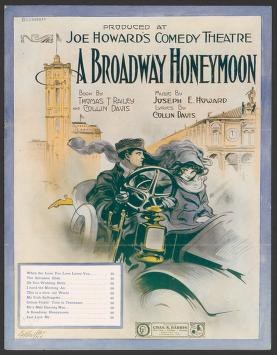
As promotional material for a 1913 musical comedy, this broadside captures how Broadway packaged entertainment and suggests the kinds of visual gags and modern-world references that appealed to early 20th-century audiences. It is a valuable record of period theatrical design conventions and the way producers marketed musicals before film became dominant. The motorcar motif also marks the moment when automobiles were still exotic enough to be comedic or attention-grabbing spectacle on stage.
What you are looking at
This is the cover of a theatrical promotional sheet for Joe Howard's 'A Broadway Honeymoon,' a comedy produced by Blanche Ring and directed by Julian E. Roward. The image centers on a pair of figures in a motorcar rendered in loose, expressive watercolor or ink wash. The vehicle, drawn in bold green lines, dominates the composition and carries two passengers in theatrical dress. The male figure, on the left, wears a dark suit and hat; the female figure beside him is rendered in softer tones, suggesting period costume. The setting evokes the early 1910s urban vaudeville world, with the motorcar itself—still a novelty—serving as both practical stage prop and symbol of modern entertainment. The composition is dynamic and slightly chaotic, with splashing ink effects around the vehicle suggesting speed or exuberance. At the top, ornate lettering announces the production; credits for composer (Blanche Ring), librettist (John C. Egan), and music publisher (Harms & Co.) are displayed below the image in typographic panels.
The dancing
The two figures in the automobile are rendered with minimal anatomical detail, their bodies positioned to suggest sitting upright in the vehicle. The male figure leans slightly forward with arms positioned as if controlling the automobile; the female figure sits beside him in a posture suggesting either engagement or surprise. Neither figure displays balletic or formal dance posture; their positions are naturalistic and tied to the specific prop—the motorcar. The artwork prioritizes the vehicle and the theatrical moment over anatomical precision or dance vocabulary. No footwork or formal frame is visible.
The dance depicted
This work does not depict theatrical dance in any recognizable form. While it is a promotional image for a theatrical musical comedy, the scene shows two performers in a stage prop (motorcar) rather than an actual dance. The figures are posed in character for a comedic situation rather than executing dance movement. The theatrical context and musical production do not constitute evidence of dance choreography or performance in the image itself.
How it was made
This appears to be a lithographic or color lithographic poster, based on the characteristic broad washes of color, bold outlines, and printed lettering. The technique allowed for relatively rapid production of multiple copies for promotional distribution. The loose, expressionistic style of the motor-car illustration—with splashing ink effects and minimal detail—is typical of early 1910s theatrical advertising, where impact and readability at a distance were valued over naturalism. The combination of bold imagery with integrated typography is characteristic of the Art Nouveau and early Modern design conventions of the period.
About this work
This is a theatrical broadside or poster for 'A Broadway Honeymoon,' a 1913 musical comedy produced by Blanche Ring. The work is a rare example of early 20th-century musical-theater promotion, documenting both the visual style of Broadway advertising and the kinds of staged tableaux that theatrical productions employed. Though produced to advertise a musical, the image itself does not depict dancing but rather a comedic scene featuring a motorcar—a contemporary reference to modernity and technology that would have appealed to urban audiences of 1913. The piece is significant as a document of theatrical culture and the relationship between visual design and stage entertainment in the early Jazz Age.
How to look at it
Look at the motorcar as the focal point and the source of the comedy: it is rendered with exaggerated speed and splash, suggesting both physical movement and the thrill of new technology. The passengers are secondary to the vehicle itself—a common compositional choice in early 20th-century theatrical satire. The expressive brushwork and ink splashing convey energy and chaos rather than any formal aesthetic principle. The work is designed to catch the eye quickly from a distance, which is why fine detail is sacrificed for bold shape and color contrast. Notice how the theatrical credits are integrated into the design as equal visual elements, not afterthoughts.
The artist
The artist is unknown. The work is credited to Joe Howard (composer and performer), Blanche Ring (producer and performer), and Julian E. Roward (director), but none of these credits identify the visual designer or lithographer. The style is consistent with commercial theatrical poster design of the early 1910s in New York, but without a signature or documented attribution, the designer remains unidentified.
The period
In 1913, Broadway was experiencing a boom in musical comedy after the success of operettas and revues in the previous decade. Theatrical posters and broadsides were the primary means of advertising; they were pasted on walls, in theaters, and distributed as promotional materials. The emphasis on a motorcar as a comedic element reflects the cultural obsession with automobile technology in the early 1910s—not yet normalized, still sufficiently novel to be funny. The visual style employs Art Nouveau and early Modernist design conventions: bold outlines, expressive color, simplified forms, and integrated typography. This was also the era of Tin Pan Alley songwriting, when composers like Joe Howard were prolific suppliers of popular songs for stage production.
Where it lives
This work is held in the Library of Congress and is catalogued as a theatrical poster or broadside from 1913. It is part of the institutional record of American theatrical promotion and popular entertainment in the early 20th century.
Questions about this work
Is this a poster or a stage design?
This is a promotional broadside—a printed poster designed to advertise the production to the public. It would have been displayed in theaters and on streets. It is not a stage design or scenic plan, though it may reflect elements that appeared in the actual stage production.
Who were Joe Howard and Blanche Ring?
Joe Howard (1867–1961) was a composer and performer; Blanche Ring (1877–1961) was a singer, dancer, and producer. Both were major figures in Broadway musical comedy in the early 20th century. Ring was known for her vivacious comic performances and was a significant female presence in theatrical production during an era when women producers and performers were rare.
Why is a motorcar in a musical-comedy poster?
The automobile was still a novel and comedic subject in 1913. Producers used contemporary technological references to appeal to urban audiences and signal that their show was modern and up-to-date. Motorcar chases and automobile-related gags were popular in vaudeville and musical comedy of the era.
What does this tell us about theatrical dance in 1913?
While this specific image does not show dance, the fact that a musical-comedy production like this was a major form of entertainment tells us that theatrical singing, comedy, and spectacle were at least as valued as pure dance. Broadway dance in 1913 was largely embedded in musical comedy and vaudeville rather than existing as an independent art form.
More dance artwork





