49 works in this view — arrow keys or swipe to move between them.
Dance in Art
Le Dieu Bleu (ballet in 1 act) | Articles and Essays | Bronislava Nijinska Collection | Digital Collections
Unknown artist
- Source:
- Library of Congress
- Rights:
- Public domain — free to use, share and adapt.
- Recorded as:
- Public Domain
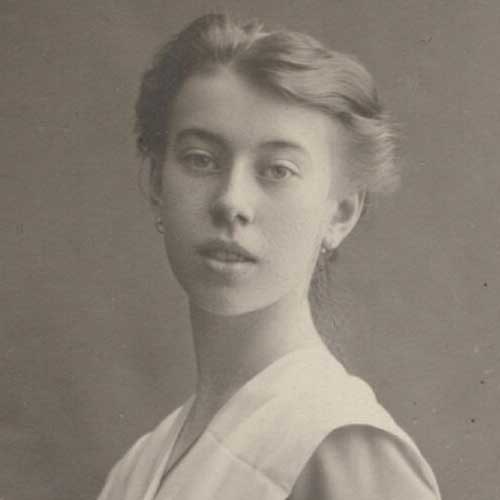
This photograph documents a figure in the Nijinska circle and the visual culture of early 20th-century ballet documentation. It belongs in the dance archive as a primary source for understanding the people and practices around one of modernism's most important choreographers and ballet companies, even though the image itself is a portrait rather than a record of dance itself.
What you are looking at
A portrait photograph of a young woman in early 20th-century dress, shown from the shoulders up against a plain grey background. She wears a white or cream-coloured garment with draped or gathered fabric across the shoulders and chest, characteristic of 1900s–1910s fashion. Her hair is styled in the period's typical upswept arrangement, with waves pinned up at the crown. The lighting is soft and even, typical of studio portraiture of the era. Her gaze is direct but contemplative, and her posture is upright and composed. The photograph appears to be a professional studio portrait, likely a publicity or archival photograph rather than a candid image.
The dancing
The subject is a single seated figure, shown from mid-torso upward. There is no active dance posture visible—the pose is that of formal portraiture, with the body turned slightly three-quarter to the camera and the head held level. The shoulders are relaxed and aligned; the neck is elongated and graceful. No foot position or active weight transfer can be assessed from the framing. This is a studio portrait of a person, not a depiction of movement or dance itself.
The dance depicted
This is a portrait photograph, not a dance image. The catalogue record identifies it as related to *Le Dieu Bleu*, a ballet in one act, and it is held in the Bronislava Nijinska Collection. The subject may be a dancer associated with that production, but the photograph itself documents a person in repose, not a moment of dance. No dance style can be identified from this image alone.
How it was made
This is a black-and-white silver gelatin or platinum print photograph, likely made between 1905 and 1920. The technical quality—the soft modelling of light, the neutral background, the precision of focus—indicates professional studio work, probably by a theatrical or portrait photographer. The durability and tonal range of the print suggest archival value and wide circulation among theatre professionals and the press during the period.
About this work
This is a formal studio portrait photograph of a woman from the early 20th century, housed in the Bronislava Nijinska Collection at the Library of Congress. The catalogue associates it with *Le Dieu Bleu*, a one-act ballet, but the photograph itself shows only a portrait. The image is significant primarily as a historical document of a person connected to that production and to the Nijinska archive, rather than as a dance image per se. It represents the intersection of dance history and theatrical portraiture during the Ballets Russes era.
How to look at it
Approach this as an archival photograph and portrait rather than a dance image. Attend to the fashions and styling conventions of the period—the hair, the fabric, the pose—as markers of early 20th-century theatrical practice. The photograph documents not a moment of movement but the presentation of a person, and it is valuable for what it tells us about how dancers were photographed and circulated through theatrical culture.
The artist
The photographer is not recorded in the catalogue. The quality and style of the work suggests a professional theatrical or society portrait studio active in Europe between 1905 and 1920, possibly Paris or another major centre of ballet and theatre.
The period
This photograph was made during the height of the Ballets Russes era, when Sergei Diaghilev's company transformed European theatre and dance. *Le Dieu Bleu* premiered in 1912 with choreography by Michel Fokine. The practice of commissioning studio portraits of dancers and company members was standard for publicity, archival documentation, and press circulation. Such photographs served as both artistic records and promotional tools for the dance world.
Where it lives
This photograph is part of the Bronislava Nijinska Collection at the Library of Congress. Nijinska (1891–1972) was a pioneering choreographer and dancer, the sister of Vaslav Nijinsky, and a central figure in the Ballets Russes. The collection contains photographs, documents, costumes, and other materials documenting her artistic life and practice.
Questions about this work
Is this a picture of someone dancing?
No. This is a studio portrait photograph, a formal pose without movement. It was likely made for archival or publicity purposes in connection with the ballet *Le Dieu Bleu* or the dancer's career, but it does not document dance itself.
Who is the person in the photograph?
The catalogue record does not identify the sitter by name. She is associated with *Le Dieu Bleu* and the Nijinska Collection, which suggests a connection to the Ballets Russes circle, but the specific identity remains uncertain.
What is *Le Dieu Bleu*?
*Le Dieu Bleu* (The Blue God) was a one-act ballet choreographed by Michel Fokine for the Ballets Russes, with a score by Reynaldo Hahn. It premiered in 1912 and was inspired by Hindu dance and aesthetics. The work was an example of the Orientalist interests common in early 20th-century European theatre.
Why is a portrait in a dance gallery?
It documents a person connected to dance history and the Nijinska archive, and it represents the visual and archival culture of early 20th-century ballet. Not every object in a dance collection depicts movement; some preserve the lives and contexts of dancers and choreographers.
More dance artwork





