49 works in this view — arrow keys or swipe to move between them.
Dance in Art · 1874
Aladdin quadrille
Unknown artist
- Source:
- Library of Congress
- Rights:
- Public domain — free to use, share and adapt.
- Recorded as:
- Public Domain
The print preserves evidence of the quadrille's status as both a ballroom social dance and a subject for theatrical entertainment at the height of the Victorian era, showing how the dance was taught, advertised, and performed in formal settings. It demonstrates the fine detail with which engravers documented ballroom dance technique and costume, making it valuable for historians of both dance practice and Victorian theatrical culture.
What you are looking at
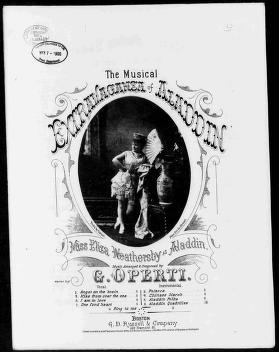
This is a theatrical print advertising a musical stage production titled *Aladdin*, presented within an ornate decorative frame in the Victorian manner. The central image shows a scene of social dancing: three figures—two women in full skirts and a man in dark dress—are arranged in the formal posture of ballroom dance. The nearest couple stands in a closed ballroom position, while a third figure (likely female, in a pale dress) stands to the side. The setting appears to be an interior space, suggested by the theatrical staging and the formal arrangement of the dancers. The print is rendered in black and white, with fine line work and careful shading to define the figures' forms and the fabric of their costumes. The decorative border frames the central image with typography and ornamental flourishes typical of mid-Victorian theatrical promotion. The overall effect is one of elegant social propriety—these are ballroom dancers in costume, not folk performers or street dancers.
The dancing
The principal couple demonstrate a closed ballroom position: the man stands upright in dark coat and trousers, his posture formal and his frame erect. The woman nearest to him wears a full, voluminous skirt typical of 1870s fashion, and her upper body is held in the closed position required by ballroom etiquette. Her skirt is caught at the moment of movement, showing the sweep of fabric that occurs in turning. The second female figure to the side wears a lighter dress and stands in a supporting or waiting position. The hold and posture suggest a waltz or quadrille—dances requiring an upright frame and controlled, measured movement. The dancers' bodies are fully clothed in formal evening wear, consistent with respectable ballroom dancing of the period.
The dance depicted
The work is explicitly titled a quadrille, and the image supports this identification. The quadrille was a four-couple square dance performed to a set sequence of five figures, and by the 1870s it was the standard opening dance at formal balls and a frequent subject of theatrical music and spectacle. The *Aladdin Quadrille* appears to be a piece of dance music composed for performance in a musical theatre production of *Aladdin*, a story adapted repeatedly for Victorian musical theatre. The three dancers shown here—one couple in the central position and a third figure—represent a moment from the sequence, frozen to advertise the theatrical spectacle. The formal dress, ballroom setting, and closed-position hold all confirm that this is ballroom quadrille, not folk or Oriental dance, despite the Eastern-themed title of the musical.
How it was made
This is a wood engraving or steel engraving, executed with fine lines and careful cross-hatching to achieve tonal depth and definition. The ornamental border and typography are integral to the design, indicating this was a promotional print for distribution—likely a cover for sheet music or a playbill. The technique of engraving allowed for fine detail in the dancers' costumes and features, and for the reproduction of the image in large quantities for advertising purposes. The skill evident in the rendering of fabric folds and the dancers' postures suggests this was the work of a professional theatrical engraver, a common practice in mid-Victorian commercial culture.
About this work
The *Aladdin Quadrille* is a mid-Victorian theatrical print promoting a musical stage production, featuring a formal ballroom scene of three dancers in elegant evening dress. The work documents both the quadrille as a social dance form and its integration into theatrical entertainment during the 1870s, when musical comedy and operetta were at the height of their popularity. As a commercial engraving, it represents the visual culture of theatrical promotion and the centrality of ballroom dance to respectable entertainment and courtship ritual in Victorian society.
How to look at it
Attend to the dancers' posture and the closed ballroom hold, which define the formal discipline of the ballroom quadrille. Notice how the woman's full skirt is caught mid-movement, revealing the momentum of the figure and the constraint of formal dress. The engraver's careful rendering of the dancers' faces and upper bodies reflects the theatrical requirement that ballroom dancers maintain composure and elegance even while moving through complex spatial figures. The decorative frame signals that this is not a scene from life but a staged, advertised spectacle.
The period
The quadrille dominated European and American ballrooms from the early 19th century through the 1870s, when this print was made. By this date, the waltz had begun to challenge its supremacy, but the quadrille remained the opening dance at formal balls and a staple of ballroom instruction. The 1870s saw a boom in theatrical musical comedy, drawing heavily on European operetta (particularly Gilbert and Sullivan and their imitators), and exotic-themed productions like *Aladdin* were particularly popular. The print's ornate Victorian design and formal typography reflect the period's aesthetic preferences and the commercial sophistication of theatrical marketing.
Where it lives
This is a theatrical print from the Library of Congress collection, sourced from their holdings of Victorian-era theatrical ephemera and sheet music covers.
Dance in this work
Questions about this work
What is a quadrille?
A quadrille is a square dance for two, three, or four couples, performed to a set sequence of five figures. It was the dominant ballroom dance in Europe and America from the early 1800s until the late Victorian era, when the waltz and later dances began to replace it. It appears frequently in 19th-century art because it was both a status marker of refined society and a subject of theatrical entertainment.
Why would a dance be named after a story like *Aladdin*?
In the 19th century, it was common to compose and market dances in response to popular theatrical productions, stories, or current events. A quadrille titled *Aladdin* would have been published as sheet music to accompany a musical theatre production of *Aladdin*, and it may have been performed as part of the show or as a social dance outside the theatre, allowing audiences to take the spectacle home with them.
How do you tell the difference between a waltz and a quadrille in a picture?
A waltz typically shows two dancers in a closed ballroom position rotating continuously, often with the woman's skirt swept upward by the momentum of the turn. A quadrille shows the dancers in the ballroom position but within a square formation, often with multiple couples, and depicts a moment in a set sequence of figures rather than continuous rotation. The title of this work confirms it is a quadrille, and the formal arrangement of the three figures supports this.
More dance artwork





