49 works in this view — arrow keys or swipe to move between them.
Dance in Art · 1921
Tango chante
Unknown artist
- Source:
- Library of Congress
- Rights:
- Public domain — free to use, share and adapt.
- Recorded as:
- Public Domain
The poster shows how a non-European dance form—the Argentine tango—was translated into European visual and theatrical conventions, and what aesthetic values were emphasized in that translation. It is evidence of how dance was sold and understood as entertainment in a specific historical moment and place, and it demonstrates the power of commercial art to shape popular understanding of a dance form.
What you are looking at
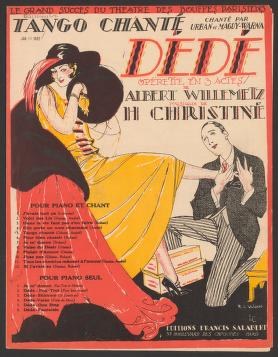
A theatrical poster for a sung tango, rendered in the Art Deco style characteristic of 1920s French commercial art. The composition centers on a woman in a flowing yellow gown with a dramatic black feathered or fringed shawl, her body angled in an elegant contrapposto stance. She gazes downward with an expression of romantic intensity or melancholy. Behind her, a man in formal evening dress—a dark suit with white shirt front—leans toward her with evident desire, his posture and gesture conveying the intimate dynamics of the tango. The background is a warm rust or terracotta red, against which the figures stand out with sharp silhouette. The woman's skirt catches the light and suggests movement, while the overall composition emphasizes the sensual, close proximity characteristic of the dance. Text at top and bottom frames the image in the manner of period theatrical posters, identifying the work and its performers.
The dancing
The woman stands with weight distributed lightly, her body forming an elegant S-curve enhanced by the drape of her gown; her head is tilted back and away from her partner in the classic pose of romantic surrender. The man's frame is upright but angled toward her, one arm extended or at her back in the characteristic close embrace of tango, his gaze directed at her. The distance between them is intimate but not closed—the space itself becomes part of the choreography. Both figures are rendered with the smooth, simplified forms favored in Art Deco design, emphasizing line and silhouette over anatomical detail, yet the posture of each shows clear knowledge of ballroom hold and frame.
The dance depicted
This is a poster for *Tango Chanté* (Sung Tango), a theatrical production that combined the Argentine tango with vocal performance—a fusion popular in Paris during the 1920s. The image captures the essential character of the tango as it was understood in Europe at that moment: a dance of passion and melancholy, performed by a couple in close contact, characterized by a backward tilt of the woman's head and torso that expresses both vulnerability and control. The poster emphasizes the sensual rather than the athletic or technically complex aspects of the dance; this was tango as cabaret entertainment and romantic theatre, not competitive ballroom dancing. The sung tango was a distinctly Parisian interpretation of an Argentine form.
How it was made
This is a lithographic poster, a medium perfectly suited to the bold, flattened forms and limited but sophisticated color palette of Art Deco design. Lithography allowed for broad areas of solid color, precise linear work, and the kind of elegant lettering visible here; it was also the standard commercial printing method for theatrical posters and advertisements of the period, ensuring wide circulation among Parisian audiences. The technique's capability for fine detail in the faces and hands contrasts with the simplified geometry of the garments and background, creating visual hierarchy that guides the eye first to the emotional exchange between the dancers. The hand-drawn quality and the slight irregularities in color registration are characteristic of period lithography and speak to this as a mass-produced but artisanal object.
About this work
This is a French theatrical poster from 1921 advertising a sung tango production. It exemplifies the intersection of dance, music, and visual art in the Parisian entertainment culture of the early twentieth century, a moment when Argentine tango had been fully absorbed into European cabaret and theatrical practice. The image is not a documentary record of actual dancers or a specific performance, but rather an idealized representation designed to sell the romantic fantasy of tango to Parisian audiences. As such, it reveals what qualities—melancholy, sensuality, close partnership, elegance—the producers believed would attract viewers. The Art Deco aesthetic, with its streamlined forms and sophisticated color harmony, elevated the tango from street dance to fashionable art form suitable for theatrical consumption. For historians of dance imagery, the poster documents the visual language by which early twentieth-century France understood and marketed the tango: as a European drawing-room and stage dance rather than as the competitive or transgressive form it held in Argentina.
How to look at it
Attend first to the posture of the woman: her backward tilt and downward gaze are the visual signature of the tango, a pose that appears in countless photographs and images of the period and that has become iconic. Notice how the artist has used the drape and movement of her gown to suggest the actual movement of the dance—the skirt is caught mid-turn or mid-sway, giving the static image a sense of arrested motion. Observe the proximity and angle of the man's body: the tango is a dance of close contact and subtle frame, not a wide open position, and the poster makes this clear. Finally, look at the emotional content of the faces: the melancholy, intensity, and mutual focus that the artist emphasizes are as much a part of tango's meaning as the steps themselves.
The artist
The artist is not recorded. The work was published by Éditions Francis Salabert, a Parisian music publisher and theatrical promoter active in the early twentieth century. The style is consistent with commercial poster design of the mid-1920s Art Deco movement, a moment when such work was often unsigned or attributed only to the publishing house. The poster's composition and elegance suggest a trained commercial designer, but attribution would require archival research beyond what the image itself supports.
The period
The tango arrived in Paris from Buenos Aires around 1910 and rapidly became fashionable in cabarets, dance halls, and theatre. By 1921, when this poster was made, the tango had shed much of its association with working-class Buenos Aires culture and been fully integrated into Parisian entertainment as a symbol of modernity, exoticism, and refined sensuality. The 1920s saw a boom in sung tango and tango poetry; major singers like Carlos Gardel began to internationalize the form. Simultaneously, the visual arts were dominated by Art Deco, which prized elegance, simplification, and the stylization of the human form—a perfect match for selling tango to a fashion-conscious Parisian audience. This poster sits at the intersection of several cultural currents: the continued Europeanization of Argentine dance forms, the rise of mass entertainment and mass marketing, and the dominance of geometric modernism in commercial design.
Where it lives
The poster is held in the Library of Congress collections. It is a commercial theatrical poster, one of thousands produced in Paris during the 1920s, printed by lithography for public distribution and display in theatres, music halls, and on the streets. Such posters are ephemeral objects, and survival is partly a matter of chance; they are now valued as evidence of popular culture and commercial art history as much as for their intrinsic aesthetic merit.
Dance in this work
Questions about this work
Was tango actually danced this way in the 1920s?
The pose and frame shown here reflect one version of tango as it was performed in European cabarets and on stage. Argentine tango in Buenos Aires was more varied and often more aggressive in its movement and styling. This image shows tango as a European, and specifically Parisian, interpretation: refined, melancholic, and theatrical. The pose—the woman's backward tilt—became iconic and was widely imitated, so the poster both documents and helped construct how Europeans understood tango.
Why is the artist not named?
Commercial poster designers of the early twentieth century were often uncredited; the publisher's name and the theatrical production were what mattered to the commercial purpose of the object. Many such works are now attributed only to the publishing house or not at all. Attribution would require research in the publishers' archives or in specialist collections of commercial graphic design from the period.
What is 'tango chanté'?
Tango chanté means 'sung tango'—a theatrical or cabaret format in which tango music and dance were accompanied by singing and vocal performance. This was especially popular in Paris and represented a fusion of Argentine and French performance traditions. The form often emphasized lyrical and romantic content, quite distinct from the purely instrumental and choreographic tango of ballroom or street performance.
Why is this an Art Deco design?
Art Deco was the dominant aesthetic of high-end commercial and theatrical design in the 1920s, prized for its elegance, geometric clarity, and modernity. The flattened forms, simplified color palette, and emphasis on silhouette and line seen here are characteristic of the style. Using Art Deco to market tango associated the dance with cosmopolitan sophistication and contemporary fashion.
More dance artwork





