49 works in this view — arrow keys or swipe to move between them.
Dance in Art · 1920
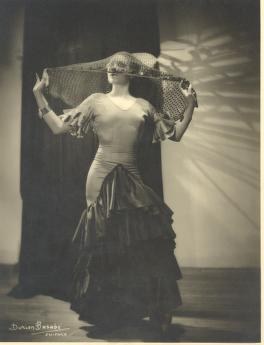
Katherine Dunham in Tango
Unknown artist
- Source:
- Library of Congress
- Rights:
- Public domain — free to use, share and adapt.
- Recorded as:
- Public Domain
Katherine Dunham was foundational to modern dance and to the global recognition of Black dance in the 20th century; this image is a rare early photographic record of her as a young performer. The photograph is important not as a record of a specific choreography but as evidence of how African American dancers were presented, framed, and commodified in early 20th-century theatrical culture—the studio setting, the dramatic lighting, the refined costume and pose all served to position Dunham within a discourse of high art and sophistication.
What you are looking at
A woman in evening dress stands alone against a dark interior, holding aloft a large decorative fan or feathered accessory that spans the width of her body. She wears a pale, fitted bodice and a darker skirt with deep pleats or ruffles at the hem, typical of 1920s silhouette. The pose is statuesque and theatrical: her body faces the camera while her gaze is directed upward and away, her arms raised symmetrically to frame the fan above her head. The lighting is dramatic, with bright sidelighting creating strong shadows that model her torso and the folds of her skirt, and illuminating the fan to make it a focal point. The setting is a studio interior with plain dark walls and floor, the kind used for theatrical or portrait photography. The overall effect is one of refined presentation—this is a posed, professional image made to document a performer.
The dancing
A single female figure in contrapposto stance, weight settled on one leg with the other subtly bent. Her arms are raised in a symmetrical frame, hands at about shoulder height, elbows slightly bent, creating an open and balanced silhouette. The pose is controlled and statuesque rather than dynamic or mid-movement. Her gaze is lifted and her neck extended, enhancing the sense of elevation and grace. The hold and frame suggest ballroom or theatrical dance training: the posture is upright, the arm position refined and geometric.
The dance depicted
The catalogue identifies this as 'Katherine Dunham in Tango,' but the image does not depict tango in motion. Dunham was a pioneering Black dancer, choreographer, and dance anthropologist; this appears to be a studio portrait or costume photograph rather than a candid moment of dance. The pose—statuesque, symmetrical, and lifted—is consistent with ballroom or theatrical dance training of the era, but it does not show the characteristic embrace, lead-follow dynamic, or forward motion of tango. The elegance of the pose and the refined costume align with 1920s theatrical or ballroom contexts, but the specific dance being 'performed' here is ambiguous. This is more accurately a portrait of a dancer in evening dress than documentation of a particular dance style in action.
How it was made
This is a platinum print or gelatin silver print, a professional studio photograph from the early 20th century. The signature visible in the lower left corner suggests this is the work of an identified photographer, though the name is not recorded in the catalogue. The photographic technique allows precise control of lighting and composition; the dramatic sidelighting and tonal range are characteristic of fine art photography of the 1920s era. The print was likely circulated as a promotional or publicity image for Dunham's theatrical work, making it part of the machinery of early African American performance visibility.
About this work
This is a studio portrait photograph of Katherine Dunham, the pioneering African American dancer and anthropologist, posed in evening dress with an ornamental fan. Made in the early 1920s, it documents her as a performer and public figure at a crucial moment in African American theatrical dance history. The image sits at the intersection of portrait photography, theatrical documentation, and performance publicity—it captures not a moment of dance but the persona of a dancer, the formal presentation of Black female elegance and artistry for public consumption.
How to look at it
Attend to the formal, composed nature of the pose: this is not a dancer caught in motion but a performer holding a carefully constructed frame for the camera. The symmetry of the arms and the lift of the gaze are deliberate artistic choices, not the result of dance-in-action. The ornamental fan is a theatrical prop or accessory, not a functional object, and its placement at the apex of the composition makes it as much the subject as Dunham's body. The dramatic sidelighting emphasizes sculptural form, treating the body as an object of visual art rather than a moving subject.
The artist
Katherine Dunham (1909–2006) was a dancer, choreographer, anthropologist, and civil rights activist who transformed modern dance through her integration of Caribbean, African, and other diaspora forms into concert dance. She founded a technique and school that influenced generations of dancers; she was also a trained anthropologist whose fieldwork informed her choreography. At the time this photograph was made, Dunham was in the early stages of her theatrical career; she would later become one of the most influential figures in 20th-century dance.
The period
The 1920s saw the emergence of African American concert dance and the beginnings of Harlem Renaissance culture. While jazz and vernacular forms flourished in clubs and cabarets, Black dancers were simultaneously pursuing legitimacy and recognition in concert and ballroom contexts. Theatrical photography of this era served as a tool for positioning performers within a visual economy of respectability and artistry. The photograph aligns with broader practices of fine art portraiture and studio documentation that were used to elevate Black performers' public status.
Where it lives
The photograph is held in the Library of Congress collection. It is a professional studio print, likely made for theatrical promotion or publicity purposes, and forms part of the documentary record of early 20th-century African American performance.
Questions about this work
Is Dunham actually dancing in this photograph?
No. This is a posed studio portrait, not a candid moment of dance. Dunham is holding a composed, statuesque frame for the camera. While the pose reflects ballroom or theatrical training, it documents her as a performer and public figure rather than capturing a specific dance style in motion.
Why does the catalogue call this 'Tango' if she is not dancing?
The catalogue record may be incomplete or may reflect a historical attribution that conflates the subject (Dunham as a dancer) with a specific performance context. Without additional documentation, it is not clear whether this photograph was made in connection with a specific tango performance or whether the title has been assigned for other reasons. The image itself does not depict tango.
Who was Katherine Dunham?
Dunham (1909–2006) was a groundbreaking African American dancer, choreographer, and anthropologist. She founded a dance technique that integrated Caribbean, African, and diaspora forms into concert dance; her school trained generations of dancers. She was also a trained anthropologist whose fieldwork directly informed her choreography, making her one of the most intellectually sophisticated figures in 20th-century modern dance.
More dance artwork





