49 works in this view — arrow keys or swipe to move between them.
Dance in Art · 1913
My tango queen
Unknown artist
- Source:
- Library of Congress
- Rights:
- Public domain — free to use, share and adapt.
- Recorded as:
- Public Domain
This document shows how tango entered American popular culture not primarily through dance instruction or authentic performance, but through theatrical spectacle and commercial entertainment aimed at middle-class audiences. The image reveals how early 20th-century theatrical publicity worked: the performer's photograph became the draw, and the dance itself was marketed as part of a complete theatrical package rather than as a subject worth depicting visually.
What you are looking at
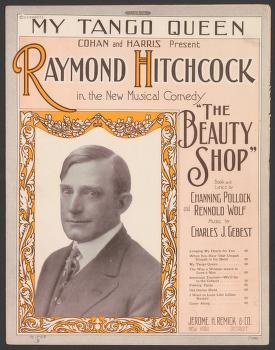
This is the cover page of sheet music for "My Tango Queen," a 1913 musical comedy. The design employs Art Nouveau typography and ornamental borders in gold and warm brown tones. At the center is a formal photographic portrait of a man in a dark suit jacket and white collar, framed by an elaborate decorative golden border with organic, flowing curves characteristic of the period. The man's expression is serious and composed, gazing directly outward. Above the portrait, the title "MY TANGO QUEEN" appears in display type, with the composer credit "RAYMOND HITCHCOCK" below in the photograph's frame. Additional credits list "CHARMING FOLLIES" and "HAROLD WOLFE" as librettists, and "CHARLES J. GENET" as another creator. The bottom of the page carries publication information from "HARMS & FRANCIS CO."
The dancing
Only a single male figure appears, shown from the chest up in a formal photographic portrait with no visible dance pose or frame. His posture is upright and stationary, facing the camera frontally. The image documents the artist or principal performer rather than depicting dance itself. No movement, hold, or physical relationship to another dancer is evident.
The dance depicted
The title promises tango content, and tango was indeed a craze in American popular culture in 1913. However, this cover does not depict tango dancing or any dance movement. It is a publicity image for a theatrical musical comedy that featured tango music and likely featured tango choreography, but the image itself is a performer or composer portrait, not a dance scene.
How it was made
This is a lithographic sheet music cover, a common medium for theatrical promotion in the early 20th century. The photograph has been reproduced lithographically, allowing the publisher to combine the crisp photographic image with hand-drawn decorative lettering and Art Nouveau borders printed in color. Sheet music covers were mass-produced for distribution to theaters, music shops, and performers, making them among the most widely circulated images of performers and theatrical properties of the era. The combination of photographic realism with ornamental design was typical of the period's commercial graphics.
About this work
This is the cover of sheet music for a 1913 American musical comedy that capitalized on the tango craze sweeping through ballrooms and theatrical stages. Rather than depicting the dance itself, the cover functions as publicity for the show and its star, Raymond Hitchcock, whose photograph is the central image. The tango appears in the title but not in the visual content—the sheet music cover was a commercial object designed to advertise the show and sell the music, not to document choreography or technique. It represents the theatrical and commercial apparatus around early 20th-century tango in America, when the dance was exotic enough to headline a Broadway show and popular enough to sell recreational sheet music to amateur performers.
How to look at it
This cover should be read as a commercial object rather than a dance document. Note how the photograph dominates the composition and how the ornamental borders frame it as the principal attraction. The Art Nouveau lettering positions the title and performer name as equal visual weight to the photograph itself—both are graphic elements. The viewer is invited to recognize the performer's face, to appreciate the elegance of the design, and to be persuaded to purchase the music. The absence of any tango imagery is itself significant: the dance is promised in the title but not visualized, leaving it to the viewer's imagination or knowledge of the theatrical show.
The artist
Raymond Hitchcock (1865–1929) was an American comedian and musical theater star of considerable prominence on Broadway in the early 20th century. He specialized in comic musical theater roles and starred in numerous comedies and musical comedies throughout his career. He was known for his charm and light comedic touch rather than for dance ability, which suggests that the "tango queen" of the title may have been another performer, with Hitchcock in a supporting comic role.
The period
The tango craze of 1913 was at its height in America. The dance, which had originated in the working-class neighborhoods of Buenos Aires, had been adopted by Argentine elites and then exported to Europe, where it became fashionable in upper-class ballrooms. By 1910–1914, tango had reached the United States and become a popular sensation, both as a social dance and as a theatrical spectacle. American musical theater immediately capitalized on the craze by incorporating tango music and dancing into shows, as the title of this piece demonstrates. Sheet music for tango dances and songs became a major commercial product. However, the tango of the ballroom and the tango of the stage were often quite different—theatrical tango was typically more exaggerated, more heavily costumed, and more narratively framed than the social dance.
Where it lives
This is sheet music published by Harms & Francis Co. (a major music publisher of the era), dating from 1913. The Library of Congress, which holds the original, preserves such materials as documentary evidence of theatrical and popular culture. Sheet music covers are typically bound into collections of published scores and are also valued as examples of commercial graphic design and theatrical history.
Questions about this work
Why doesn't the cover show tango dancing if the music is about tango?
Sheet music covers in this era often functioned as publicity for performers rather than as documentation of the dance itself. The publisher prioritized the star's image as the selling point. Consumers would encounter the full theatrical spectacle in the theater; the sheet music cover needed to catch the eye and sell the product, for which a recognizable photograph proved more effective than a dance scene.
Who was Raymond Hitchcock?
Raymond Hitchcock was a major Broadway star of musical comedy, known for his comic acting and charm. He was not known as a dancer, which suggests he had a supporting comic role in this show rather than being the titular tango queen.
What was the tango craze in America in 1913?
Between roughly 1910 and 1920, tango became a fashionable and somewhat controversial ballroom dance in North America and Europe. It had originated in Argentina and was seen as exotic and modern. American theaters and popular entertainments rushed to incorporate tango into shows to capitalize on public interest. The dance was danced socially in ballrooms and professionally on stage, though the theatrical version was usually more dramatic and heavily costumed.
More dance artwork





