49 works in this view — arrow keys or swipe to move between them.
Dance in Art · 1913
A tango dream
Unknown artist
- Source:
- Library of Congress
- Rights:
- Public domain — free to use, share and adapt.
- Recorded as:
- Public Domain
Sheet music covers are primary sources for dance history, revealing which dances were commercially viable, who performed them, and how the entertainment industry branded and sold them to the public. This cover documents a specific performer and song from the moment when tango became an international phenomenon, offering insight into the intersection of music, dance, celebrity, and commercial culture in 1913.
What you are looking at
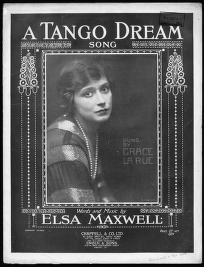
A portrait-format sheet music cover from 1913 showing a single female figure against a dark background, framed by ornamental Art Deco borders of vertical stripes and geometric forms. The woman is positioned centrally and gazes toward the viewer with a composed expression. She wears what appears to be an early 20th-century dance costume or dress with beaded or sequined decoration across the bodice and shoulders, catching light in stark contrast to the dark ground. The composition is formal and theatrical, typical of commercial sheet music covers of the period, with the title "A Tango Dream" and credit to performer "Elsa Maxwell" prominently displayed in period typography. The styling and presentation suggests this was a popular song or musical number associated with the tango craze that swept the United States and Europe in the early 1910s.
The dancing
A single standing figure, facing forward in a frontal pose with shoulders squared to the viewer. The woman's posture is upright and stationary rather than captured mid-movement; her arms are relaxed at her sides or held loosely. There is no visible partnering or group choreography. The presentation emphasizes the performer's identity and presence rather than active dance motion, consistent with the conventions of theatrical portraiture and entertainment publicity of the period.
The dance depicted
The title explicitly identifies this as a tango-related work, and the date (1913) places it at the height of the international tango boom that began around 1910. The tango had recently arrived in Europe and North America from Argentina and was rapidly adopted in ballrooms, concert halls, and commercial entertainment. This sheet music cover documents that cultural moment, though the portrait itself does not show the characteristic close partnering, embrace, or tilted line of the ballroom tango. The image appears designed to market the song and the performer rather than to illustrate the dance itself.
How it was made
This is a sheet music cover, produced as a lithograph or similar commercial print process. The technique allowed for the combination of photographic portraiture (or a high-quality drawn image) with bold typography and decorative borders, enabling mass production and wide distribution. The Art Deco framing and the photomechanical quality of the image indicate this was a professionally manufactured product for retail sale, suggesting significant commercial investment in the song and performer.
About this work
This is a sheet music cover for a tango song from 1913, featuring the performer Elsa Maxwell. It documents the early phase of the international tango craze, when the dance transitioned from Argentine popular culture to a dominant feature of ballrooms and entertainment venues in Europe and North America. The cover prioritizes the celebrity performer over detailed choreographic documentation, a common commercial strategy of the period. The object is significant not as a precise record of how the tango was danced, but as evidence of how the dance was packaged, marketed, and consumed as entertainment in the early 20th century.
How to look at it
Observe the formal, promotional nature of the image: this is a celebrity portrait, not a choreographic document. The performer is presented as a fashionable, composed figure for public consumption, wearing a modern, ornamental costume. The Art Deco border frames the image as a high-end commercial product, signaling that this song and performer were considered desirable and contemporary. The absence of a partner, movement, or ballroom setting indicates that the cover designer prioritized the star's marketability over an accurate representation of the dance itself.
The artist
The artist is not recorded. The cover was produced by a commercial publisher as part of the sheet music industry. Elsa Maxwell (1883–1964) was a well-known American pianist, socialite, and entertainment figure who moved in elite circles and was involved in theatrical and society events, though she was not primarily known as a professional dancer.
The period
The tango arrived in Europe from Argentina around 1910 and became a sensation in ballrooms, cabarets, and concert halls by 1912–1914. It was initially considered scandalous for its close partnering and hip-driven movement, which contrasted sharply with the upright, arm-driven style of the Viennese waltz and other ballroom dances of the Victorian and Edwardian eras. The dance was rapidly commercialized in sheet music, recordings, theatrical productions, and dance instruction. By 1913, when this cover was published, the tango had achieved mainstream commercial acceptance in the Anglo-American entertainment market, though it remained controversial in conservative circles. The Art Deco visual style of the cover reflects the modernist aesthetic emerging in commercial design during this period.
Where it lives
This is a sheet music cover held by the Library of Congress, reflecting the institution's role in documenting American popular music and entertainment from the early 20th century. Sheet music covers were mass-produced commercial objects, widely distributed through music retailers, and are now studied as primary sources for social, cultural, and music history.
Dance in this work
Questions about this work
Why does the cover not show the tango being danced?
Sheet music covers of this period functioned primarily as advertisements for the song, composer, and performer, not as instructional or documentary images. The cover's main goal was to attract buyers and promote the entertainment product, making the performer's identity and marketability more important than an accurate depiction of the choreography.
Who was Elsa Maxwell?
Elsa Maxwell (1883–1964) was an American socialite, pianist, and entertainment organizer who was known for hosting fashionable society events and theatrical entertainments in New York and Europe. She was well-connected in elite circles but was not a professional concert dancer or choreographer.
What made the tango so popular and controversial in 1913?
The tango arrived from Argentina as a sensual, hip-driven dance performed in a close embrace between partners, which shocked conservative Victorian and Edwardian society. However, it was quickly adopted by ballroom dancers and entertainers, and by 1913 had become a fashionable commercial phenomenon in urban entertainment venues, even though moral objections persisted.
Is this a lithograph or a photograph?
The cover appears to be a commercial print, most likely produced via lithography or a photomechanical process that could combine photographic portraiture with typography and decorative borders. It is not a hand-drawn painting or an original photograph, but a mass-produced sheet music cover.
More dance artwork





