49 works in this view — arrow keys or swipe to move between them.
Dance in Art · 1919
Minuet : No. 1.
Unknown artist
- Source:
- Library of Congress
- Rights:
- Public domain — free to use, share and adapt.
- Recorded as:
- Public Domain
This object shows how dance music was marketed and consumed in the early 1920s: not primarily as instruction in how to dance, but as a fashionable commodity tied to theatrical celebrity and modern femininity. The image testifies to the cultural prestige of dance at this moment—sufficient to anchor a theatre revue and to sell sheet music—while revealing that the actual practice of dance was left to the purchaser's own understanding or instruction elsewhere.
What you are looking at
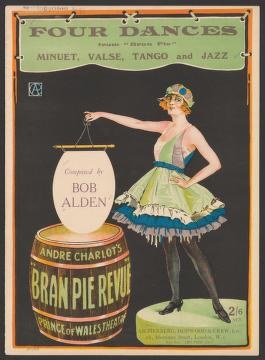
A woman in a pale yellow-green Empire-waist dress trimmed with blue fringe stands in profile against a black background, one arm extended toward a large cylindrical container labeled "BRAN PIE REVUE" in bold gold lettering. The container sits on a pedestal, and the woman's pose is elegant and gestural, her free arm raised at the elbow. The composition is a theatrical cover design for sheet music: the title "Four Dances" appears in decorative type at top, with "Minuet, Valse, Tango and Jazz" listed below. The artist's credit reads "Composed by Bob Alden," and "Andre Charlot's" branding suggests a London production. The woman wears a headband or tiara and her posture suggests a moment of presentation or invitation—she gestures toward the container as though unveiling it. The color palette is restrained: yellows, blues, blacks, and flesh tones, with the modish dress and asymmetrical fringe hem marking the design as 1919.
The dancing
A single female figure occupies the center of the composition, drawn in a clean outline with anatomically sound proportions. Her weight appears balanced on one leg, with the other leg subtly advanced, suggesting a moment of stance rather than active movement. Her extended arm and raised hand create a graceful, presentational gesture—the hold is open and theatrical rather than a closed dance position. The dress and the woman's poised bearing suggest a performer rather than a social dancer, and the overall frame is that of a theatrical advertisement rather than the documentation of an actual dance step.
The dance depicted
The title promises four distinct dance types—minuet, valse (waltz), tango, and jazz—but the image itself depicts neither a specific dance nor the execution of any of these styles. The figure's pose is presentation rather than dancing: her stance and gesture are those of a performer preparing to introduce or display something (in this case, the novelty "Bran Pie Revue" container). The work functions as a theatrical poster or cover design, using the prestige of dance music and André Charlot's London revue to sell sheet music. The four dances named in the subtitle were standard fare in 1919 ballroom and theatrical music, but this image does not show us how any of them were actually danced.
How it was made
This is a chromolithographic poster or cover design, evidenced by the flat color fields, clean outlines, and separation of colors into distinct areas without gradient or shading. Chromolithography allowed for economical color reproduction at scale and made such designs widely reproducible for commercial theatrical distribution. The style is characteristic of entertainment graphics of the 1910s–20s: crisp, Art Deco influenced, with bold text and a single striking figure silhouetted against a dark ground. The technique was ideally suited to sheet music covers and theatrical advertisements, and this image was almost certainly printed as a cover for the published score.
About this work
This is a 1919 chromolithographic design for a sheet music cover advertising four ballroom and jazz dances composed by Bob Alden for André Charlot's London revue production, "Bran Pie Revue." The image shows a fashionable woman in an Empire-waist dress with blue-fringed trim in a graceful presentational pose, gesturing toward a container bearing the revue's name. The work sits at the intersection of commercial graphic design and dance culture: it sells sheet music through theatrical association and the appeal of fashionable female beauty, but it documents the theatrical packaging of dance music rather than the dance itself. The four dances named in the subtitle—minuet, valse, tango, and jazz—represent a snapshot of the dance music market in early 1920s London, where traditional ballroom forms coexisted with the newer syncopated styles of the Jazz Age.
How to look at it
Observe the woman's pose: her balance, her arm positions, and the overall openness of her frame tell us this is a theatrical gesture of presentation, not a dance step from any of the four dances promised in the title. Notice how the revue's container is the true subject of the composition—the woman presents it. The design uses the glamour and modernity of the female figure to sell the product; the actual choreography of the dances remains invisible. The color scheme—the pale dress against the black ground—emphasizes the figure as a silhouette, a marketing image rather than a document of movement.
The artist
The artist is not recorded. The design bears all the hallmarks of London theatrical poster design of the period: the clean Art Deco influence, the stylized female figure, the bold typography, and the chromolithographic execution. The credit to composer Bob Alden and producer André Charlot suggests this was produced within the Charlot organization's graphics department or by a freelance designer working for the London entertainment industry. Such theatrical cover designs were often unsigned or credited only to the production house.
The period
In 1919–20, ballroom dancing was at the height of its social popularity in Britain and America, and dance music publishing was a major commercial enterprise. The minuet and waltz represented tradition and respectability; the tango was the exotic modern import of the previous decade; and jazz was the newest and most controversial trend, associated with American culture and syncopated rhythm that shocked conservative audiences. André Charlot's revues were celebrated venues for fashionable entertainment in London's West End, and the association of a composition with a Charlot production lent considerable prestige. Sheet music was a primary medium for disseminating dance music to the domestic market; a striking cover design was essential marketing.
Where it lives
The work is held by the Library of Congress. It is catalogued as a sheet music cover from 1919, part of the broader collection of American and British theatrical and popular music publishing.
Questions about this work
Does this image show us how to dance any of these four dances?
No. The woman's pose is one of theatrical presentation, not dance instruction. Her stance and gesture are designed to catch the eye and sell the sheet music; the actual steps and holds of the minuet, waltz, tango, or jazz would have been conveyed through live performance, dance instruction manuals, or the purchaser's own experience.
Why would these four dances be grouped together on one composition?
They represented the full spectrum of fashionable dance music in 1919: the minuet and waltz as established ballroom standards, the tango as a modern exotic form, and jazz as the newest and most controversial trend. A composition that included all four would appeal to a wide market of dancers and music consumers.
What does the 'Bran Pie Revue' container mean?
It is the title of André Charlot's theatrical revue—a stage production featuring musical numbers, comedy, and dance. The revue was the primary source of these musical compositions, and the cover design links the sheet music directly to the theatrical production, enhancing its prestige and marketability.
What was André Charlot's significance in dance and theatre?
André Charlot was a celebrated London theatre producer and impresario known for glamorous revue productions in the 1920s. His name on a piece of sheet music or a theatrical design was a mark of quality and fashionable entertainment.
More dance artwork





