49 works in this view — arrow keys or swipe to move between them.
Dance in Art
Carib Song | Notes on Dunham's Work | Articles and Essays | Selections from the Katherine Dunham Collection | Digital Collections
Unknown artist
- Source:
- Library of Congress
- Rights:
- Public domain — free to use, share and adapt.
- Recorded as:
- Public Domain
The image documents the visual language and aesthetic aspirations of mid-century theatrical dance within diaspora communities—the styling choices, the formal bearing, the use of crown and jewelry to signify status and cultural identity. For historians and dancers, it is evidence of how performers presented themselves and were presented to audiences, and how costume and pose conveyed meaning within the Dunham technique tradition.
What you are looking at
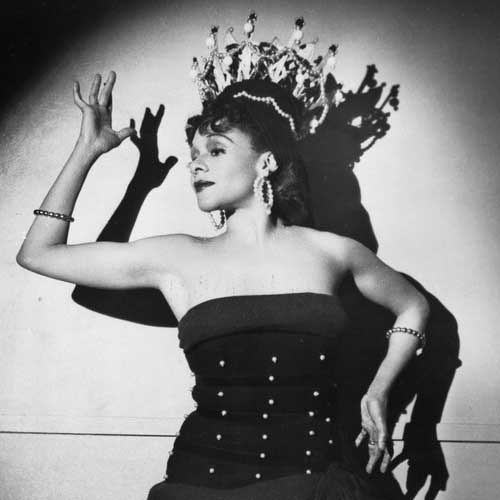
A striking black-and-white portrait of a woman photographed from the shoulders up, set against a dramatically lit backdrop. She wears a strapless, form-fitting black dress with a double row of pearl buttons down the front, and long black gloves that extend past the elbow. A substantial jeweled crown sits atop her head—ornate and tiered, catching the light. Large pear-shaped earrings frame her face. Her right arm is raised gracefully, hand gesturing expressively near her head in a pose both regal and theatrical. Her gaze is directed upward and to the side, her expression alert and composed. The lighting is classical studio portraiture: a strong key light from the front creates dramatic shadows and highlights the planes of her face, the sheen of the gloves, and the sparkle of the crown. The background is plain and slightly textured, keeping focus entirely on the figure.
The dancing
The subject stands alone in an upright, dignified posture. The raised right arm with flexed wrist creates an open, expansive line from shoulder to fingertips—a pose of poise and presence rather than active movement. The gloved forearms are visible and elegant, the hands expressive. The neck is long and extended, the head held high. This is a portrait pose drawn from theatrical tradition rather than a captured moment of movement; the body is still, arranged for maximum visual impact and aristocratic bearing.
The dance depicted
This is a theatrical costume portrait rather than a depiction of dance in motion. The styling—crown, gloves, formal gown, and the posed elegance—suggests a performer in formal theatrical dress, possibly from a classical or operatic context. The title 'Carib Song' and the catalogue connection to Katherine Dunham's work indicate this may document a performer associated with Caribbean or diaspora dance traditions, though the pose itself is static and formally composed rather than capturing actual choreography or movement quality. Without the performer's name or detailed provenance, precise dance identification is not possible from the image alone.
How it was made
This is a black-and-white studio photograph, likely gelatin silver print, employing professional portraiture lighting and composition. The clean, high-contrast tonality and the careful arrangement of subject and backdrop indicate this was shot in a commercial studio setting, the type of publicity or performance documentation common in mid-twentieth-century entertainment photography. The technique allows both intimacy—fine detail of jewelry and fabric—and formal distance, creating a portrait suitable for promotion or archival record.
About this work
This is a studio portrait of a performer in formal theatrical costume: strapless black dress, long gloves, and an ornate crown, posed with controlled grace and an upward gaze. Titled 'Carib Song' and held within the Katherine Dunham Collection at the Library of Congress, the work documents the visual presentation of a performer associated with diaspora dance traditions, though the photograph itself captures a static, posed moment rather than choreography or movement. The image is a record of costume, bearing, and theatrical identity rather than a dance action; it belongs in this collection as documentation of the performer and performance aesthetic of mid-twentieth-century theatrical dance.
How to look at it
Observe the careful construction of the pose: the lift of the spine, the extension of the neck, the raised arm creating an open line, the direction of the gaze. Note how the photographer used lighting to model the form—the play of shadow and highlight on the face, the luminescence of the gloves, the glitter of the crown. The formal frontality of the pose and the studio setting place this within a tradition of theatrical portraiture. The costume details—the cut of the dress, the choice of gloves, the ornate crown—should be read as meaningful choices about how the performer wished to be seen and how the Dunham Company presented itself to audiences.
The artist
The photograph is attributed to an unknown photographer within the Katherine Dunham Collection. The Dunham Collection at the Library of Congress preserves documentation of Katherine Dunham's revolutionary technique and her company's performances, including performance stills, costume records, and promotional photography. Such portraits served both publicity and archival purposes, recording the appearance and bearing of dancers in the company.
The period
This photograph dates to an era when theatrical dance in the United States was being professionalized and codified, particularly within African American and diaspora communities. Katherine Dunham's technique, developed in the 1930s–1940s, synthesized Caribbean, African, and European dance forms and was revolutionary in bringing Caribbean and African dance vocabularies to American concert stages. By the mid-twentieth century, formal studio portraiture of performers was standard practice for documentation, publicity, and artistic record. The styling of this portrait—the crown, the formal dress, the regal posture—reflects theatrical convention and the aesthetics of concert dance presentation of the period.
Where it lives
This photograph is part of the Katherine Dunham Collection at the Library of Congress, one of the most comprehensive archives of mid-twentieth-century American theatrical dance. The collection preserves records of Dunham's technique, her company, and the performers who trained in and performed her work.
Questions about this work
Is this a photograph of an actual performance?
No. This is a studio portrait taken in a controlled setting, not a candid or staged performance photograph. The subject is posed and still, the backdrop plain, the lighting artificial and carefully arranged. It documents the performer's appearance and costume rather than capturing movement or choreography.
What does the crown signify?
The crown is a costume element, likely part of a character or role in a specific work. In the context of the Dunham repertory, it may indicate royalty, divinity, or cultural significance within a Caribbean or African-diaspora narrative. Without knowing the specific dance, we cannot assign it a precise meaning.
Why is the arm raised?
The raised arm creates an open, expressive pose conventional in theatrical portraiture and formal photography of performers. It conveys grace, dignity, and presence—qualities valued in concert dance presentation. This is a portrait composition, not a movement gesture captured in time.
Who is the performer?
The catalogue record does not identify the performer by name. The photograph is titled 'Carib Song' and held within the Katherine Dunham Collection, suggesting the subject was associated with Dunham's company or worked within the diaspora dance traditions that Dunham's technique synthesized.
More dance artwork





