49 works in this view — arrow keys or swipe to move between them.
Dance in Art · 1888
Summer hours minuet
Unknown artist
- Source:
- Library of Congress
- Rights:
- Public domain — free to use, share and adapt.
- Recorded as:
- Public Domain
This work documents the market for dance-adjacent domestic imagery in the Gilded Age: the minuet, once a living social practice, had become a nostalgic reference point for parlor culture and was used to market sentimental goods to middle-class women. It shows how Victorian commerce co-opted dance terminology and courtly associations to sell ideals of genteel domesticity, a phenomenon central to understanding how dance functioned in mass culture outside the concert hall or ballroom.
What you are looking at
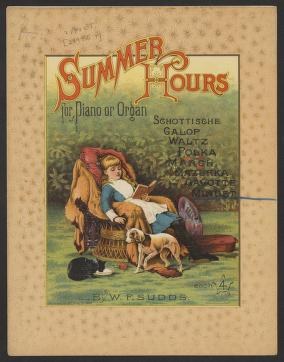
A richly colored chromolithograph shows an intimate domestic scene of a woman and child in a garden setting, c. 1888. The woman, dressed in fashionable late-Victorian clothing with a high collar and leg-of-mutton sleeves, sits in an upholstered chair or settee with her arm around a young child beside her. The child wears a lighter dress. A small dog rests at their feet. The background depicts flowering shrubs and garden foliage in soft greens and pinks. The palette is warm and nostalgic, dominated by sepia and rose tones with gilded accents on the decorative border. The overall mood is sentimental and leisurely—a moment of maternal tenderness in a cultivated outdoor space. The title *Summer Hours* and attribution to the minuet suggest this may be sheet music or a parlor piece cover, though no musical score is visible in the image itself.
The dancing
The woman's posture is relaxed and seated, with her body angled toward the child in a gesture of protection and affection. Her arm curves around the child's shoulders. The child sits upright but at ease. Neither figure is in motion or displays the formal bearing associated with dance. The small dog is curled passively at their feet. The composition emphasizes stillness, intimacy, and rest rather than any coordinated movement or partnered technique.
The dance depicted
This image does not depict dance. Although titled *Summer Hours* and credited to a minuet, the visual content shows no dancers, no dance posture, and no movement. If this is a minuet cover or accompaniment, the minuet is referenced only in the title and musical attribution; the image represents a moment of leisure and domesticity rather than the formal court dance itself. The minuet was a stately couple's dance, but neither the posture nor the context of this work aligns with that form.
How it was made
This is a chromolithograph, a color printing process that allowed mass production of richly colored images for middle-class consumption. The printing technique is evident in the careful registration of multiple color layers, the subtle gradations in the background flora, and the decorative gold or metallic accents on the border. Chromolithography made such imagery affordable for parlor decoration, sheet music covers, and trade cards during the Gilded Age—indicating a broad domestic rather than elite audience.
About this work
This is a chromolithographic illustration from the 1880s, apparently a cover or accompaniment to a musical piece titled *Summer Hours* in the minuet style. The image, however, does not represent the dance itself but rather a sentimental Victorian domestic scene—a woman and child in a garden, a popular subject for late-19th-century consumer imagery. The association with the minuet is nominal and may reflect only the musical genre of the accompanying piece, not the visual content. The work belongs in a dance image collection as a historical artifact of how dance forms were commodified and marketed in the popular domestic sphere, even when the image itself depicts leisure rather than performance.
How to look at it
Attend to the disconnect between the title and the image: the minuet is invoked in the text but absent from the visual. Look at how the woman and child are positioned as objects of leisure and affection rather than as dancers or even as social performers. The decorative border and chromolithographic finish position this as a commodity for the home, not a record of actual dance practice. The work reveals how dance forms become cultural signifiers divorced from movement itself.
The artist
The artist is not recorded. The work is attributed only as sheet music or parlor piece cover, likely by a commercial chromolithographer active in the 1880s. The level of finish and the decorative sophistication suggest a professional publishing house rather than an amateur, but no signature or firm mark is evident in the visible image.
The period
The 1880s saw an explosive growth in chromolithographic domestic imagery marketed to middle-class households. The minuet itself had ceased to be a living social dance by the 19th century and existed primarily as a nostalgic reference in music and literature. This cover represents the minuet in its late-Victorian form: a historical association, a mark of gentility and European refinement, deployed to lend cultural weight to domestic consumer goods. The image, with its emphasis on the mother-child bond in an idealized garden, reflects late-Victorian sentimentality about childhood and feminine domesticity.
Where it lives
The work is held by the Library of Congress and appears to be catalogued as a sheet music cover or related parlor music illustration from the 1880s. No accession number, edition size, publisher, or circulation information is recorded in the catalogue.
Questions about this work
Why is this titled a minuet if there are no dancers?
The minuet was a Baroque court dance that had become obsolete as a living social practice by the 1880s. By then it survived mainly as a musical form and as a cultural reference point for gentility and European refinement. The title likely indicates the musical genre of an accompanying piece rather than the image's subject matter. The work shows how dance forms were invoked in Victorian culture as historical markers of good taste, not as descriptions of actual movement.
What is a chromolithograph and why was it used for this?
Chromolithography is a color printing process that allows multiple colors to be printed in layers, creating rich, detailed images. It was fast, affordable, and produced images of professional quality, making it ideal for mass-market domestic goods like sheet music covers, trade cards, and parlor decoration. This technique enabled publishers to reach middle-class homes and attach cultural prestige to consumer goods.
Is this a famous work or artist?
No artist is recorded in the catalogue. The work is documented only as a late-19th-century sheet music cover or parlor illustration. It is representative of thousands of similar chromolithographs produced for the domestic market, many of which were never individually attributed or catalogued.
More dance artwork





