49 works in this view — arrow keys or swipe to move between them.
Dance in Art · 1894
Novelty dance
Unknown artist
- Source:
- Library of Congress
- Rights:
- Public domain — free to use, share and adapt.
- Recorded as:
- Public Domain
This work is valuable not for depicting technique or choreography, but for showing how novelty dances and theatrical pieces were commodified and sold as consumer goods in the 1890s. It reveals the visual and commercial strategies used to market entertainment to middle-class amateur musicians, and the role women's beauty and fashionable dress played in that marketing.
What you are looking at
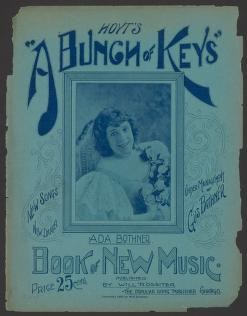
This is a color lithographic cover or advertisement for sheet music, printed around 1894. A young woman in a pale dress with puffed sleeves and a high neckline sits or reclines against a soft blue background, her body angled toward the viewer. She holds a large bouquet of colorful flowers—roses in red and pink tones dominate—which nearly obscures the lower half of her body. Her face is turned slightly away, her expression contemplative or demure. The composition is intimate and poster-like, emphasizing the woman as the central decorative element. Text frames the image: at top, in ornate blue lettering, "HOLT'S" and "A BUNCH OF KEYS"; at bottom, "ADA DUFFIN" (or similar) and "Holt's New Music" with a price of 25 cents. The overall effect is of a fashionable novelty song cover, the kind produced in quantity for the mass music market of the 1890s.
The dancing
A single figure, a young woman, dominates the composition. Her posture is relaxed and informal—not a dance stance—with weight settled into a seated or semi-reclining position. Her arms are occupied with holding flowers rather than executing any recognizable dance movement. Her body faces the viewer at a three-quarter angle; there is no closed hold, frame, or partnership evident. The gesture is one of static repose, not motion.
The dance depicted
The image does not depict dancing. The catalogue assigns it the tag "novelty dance" but the visual evidence does not support active dancing. The woman is posed for a portrait-like or promotional image. The title 'A Bunch of Keys' appears to be the name of a song or theatrical piece (there was indeed a Victorian theatrical work called 'A Bunch of Keys' or similar), and the flowers may be a visual pun or thematic element rather than evidence of choreographic content. Without movement, partnering, or costume typical of stage dance, this appears to be sheet music cover art.
How it was made
This is a color lithograph, a commercial printing process well-suited to the rapid production of sheet music covers in the 1890s. Lithography allowed for soft gradations of color, particularly visible in the pale blue background and the delicate rendering of the woman's face and dress. The technique was economical and could be reproduced in large quantities, making it ideal for popular songs sold to amateur musicians and the concert-hall public. The presence of a price and publisher information confirms this was mass-market consumer goods.
About this work
This is a novelty song cover from the 1890s, a form of commercial print that sits at the intersection of visual art, music publishing, and theatrical promotion. While catalogued under 'novelty dance,' the image itself shows a woman in fashionable dress posed with flowers rather than engaged in recognizable choreography. It is a document of how dance or theatrical entertainment was marketed to the general public in the Gilded Age—through appealing imagery, celebrities' names (Ada Duffin), and accessible retail price points. It belongs in a dance archive as evidence of how 'dance' functioned as a cultural category and sales tool, even when the actual image might not depict movement.
How to look at it
Attend to the contrast between the title 'A Bunch of Keys' (which might reference theatrical action or be a pun) and the static, portrait-like pose of the actual image. The woman is presented not as a dancing body but as a beautiful object for consumption. Notice the fashion details—the dress, the arrangement of the flowers, the soft background—which date the work and situate it within commercial visual culture. The lithographic technique allows the printer to render the woman's face and skin in soft, flattering detail, a key selling point for sheet music covers aimed at women consumers.
The artist
The cover credits Ada Duffin as performer and "Holt's New Music" as publisher. Beyond this, the artist and Ada Duffin's biographical details are not established in the catalogue record. Holt's New Music was a commercial music publisher operating in the late 19th century, producing sheet music for popular songs, dance numbers, and theatrical pieces.
The period
In the 1890s, the 'novelty dance' was a popular theatrical form—short, topical, often comic pieces inserted into variety shows, revues, and musical theatre. The craze for novelty dances reflected broader Gilded Age appetite for entertainment, celebrity, and fashionable culture. Sheet music covers became increasingly elaborate and illustrative in this period, featuring celebrity performers and appealing imagery to drive sales to amateur pianists and singers. The visual style—soft, flattering portraiture combined with bright color—was standard for mass-market entertainment imagery of the decade.
Where it lives
This work comes from the Library of Congress, catalogued as a novelty dance from 1894. It is a commercial print object—sheet music cover or advertisement—designed for mass distribution and consumption, not a fine art object.
Questions about this work
Is this actually a dance image?
Not in the sense of depicting choreography or performance. The image shows a woman posed with flowers in a portrait-like composition. It is labeled a 'novelty dance' because it advertises a theatrical piece by that name, but the visual content is promotional rather than documentary of dance.
Who was Ada Duffin?
The record credits her as a performer associated with this piece, but biographical details are not available. She was likely a vaudeville or theatrical performer of the 1890s, whose name on the cover would have helped sell the sheet music to the public.
Why would a dance archive include this?
It documents how dance and theatrical entertainment were marketed and consumed in the Gilded Age. Sheet music covers are primary sources for understanding which performances were popular, how performers were promoted, and what visual codes signaled 'entertainment' and 'femininity' to consumers.
More dance artwork





