49 works in this view — arrow keys or swipe to move between them.
Dance in Art · 1957
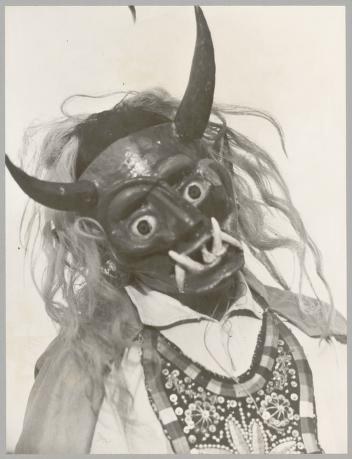
Devil Dancer Mask.
Unknown artist
- Source:
- Library of Congress
- Rights:
- Public domain — free to use, share and adapt.
- Recorded as:
- Public Domain
Devil dances and masked trickster figures are foundational to many world performance traditions, appearing in carnival, ritual, and theater from medieval Europe to contemporary Asia. This mask is evidence of a live performance practice and the craft traditions that supported it, capturing a costume object at a moment when ethnographic and performance documentation was becoming systematic. Without photographs like this, the material culture of masked dance traditions—especially those from communities without written records—would be invisible to later scholars and performers.
What you are looking at
A dramatic mask dominates the frame, carved or molded with exaggerated demonic features. The face is dark wood or painted dark, with a prominent curved horn rising from the crown and a second horn visible at the upper left. The expression is fierce and playful: a wide grin exposes carved teeth, the eyes are large and round with intense stare, the nose is broad and flared. Below the mask's chin hangs a voluminous mass of long hair or fiber in shades of gray and white, creating an impression of age, wildness, or otherworldly power. Around the neck and chest area, strands of beaded necklaces in white and pale tones are visible, suggesting ornamentation for a performer. The photograph is in black and white, shot close enough that the mask fills most of the frame, isolating it against a neutral background so that every carved detail and texture is legible.
The dancing
This is not a photograph of a dancer in motion, but of a mask object itself—a costume piece or ritual object rather than a moving body. The mask is presented frontally and statically, as an artifact for documentation. Where a dancer would wear this, the dual horns and the weight of the long fiber attachment suggest a character that projects height, animal nature, and supernatural authority. The carved grin and staring eyes suggest a performer using this mask would embody aggression, chaos, or demonic power through facial expression.
The dance depicted
The mask is identified as a 'Devil Dancer Mask,' suggesting it was worn in a devil or demon dance tradition. Devil dances appear across multiple global sacred and theatrical traditions—European folk mummery, Alpine carnival, Asian masked dance theater (notably Japanese Noh and Southeast Asian masked forms), and various indigenous shamanic and ceremonial practices. The specific style, materials, and construction are not distinctive enough from this photograph alone to identify the precise tradition or geography. The mask's form—horned, long-haired, grinning—is consistent with European carnival devil figures, but horned masks with wild hair appear in many cultures' ritual dances representing trickster, demon, or wild-man figures.
How it was made
This is a black-and-white photograph, likely mid-20th century based on the photographic stock and printing style. The image is a documentary photograph of a three-dimensional object, not a representation of a dance in progress. The close framing and even lighting are consistent with museum or archival photography intended to record an artifact's form and surface detail for identification and scholarly reference. The photograph reveals the mask's carving technique (hand-carved wood with incised details) and the attachment of the fiber element, information that would be lost in a distant or action photograph.
About this work
This is a photographic record of a devil mask, dated 1957 and held in the Library of Congress. The mask is a costume object for a masked dance or performance tradition in which a performer wearing it would embody a demonic or trickster character. Devil dances and masked devil characters appear across European, Asian, and many other performance traditions, often in carnival, mummery, or sacred ritual contexts. The photograph documents the mask as a craft object and performer's tool, preserving its form at a moment when such traditions were being recorded by American archives.
How to look at it
Pay attention to the carver's choices in the face: the grin is not merely fearsome but playful, suggesting the devil character is meant to entertain and provoke as much as to threaten. The staring eyes and the horn placement create a vertical emphasis that would make the masked figure appear taller and more commanding when worn. The long fiber attachment was crucial to the performance—it would move and obscure the body, making the wearer seem less human and more spirit or creature. The beaded necklaces suggest the mask was one part of a complete costume, and the photograph's close framing isolates it in a way the performance never would.
The artist
The mask itself is credited to no named artist in the record. It was photographed for archival purposes by the Library of Congress around 1957, likely as part of a collecting or documentation project. The maker and the tradition it comes from are unknown from the information available.
The period
The 1950s saw American museums and the Library of Congress undertaking systematic ethnographic and performance documentation, often photographing costume and craft objects in isolation as artifacts. This approach treated masks, costumes, and instruments as museum specimens to be recorded photographically. At the same time, masked dance traditions worldwide were shifting under pressure from modernization, colonialism, and cultural change; archival photography became a way of preserving evidence of practices that were disappearing or transforming. Devil dances and masked performance remained vital in European carnival (particularly Alpine and Mediterranean traditions) and in Asian classical and folk theater (Noh, Kabuki, Southeast Asian masked forms), but documentation of them was uneven and often came from outsider perspectives.
Where it lives
The mask is held by the Library of Congress, catalogued with minimal information: no artist name, no cultural origin, no maker's name. It was acquired or received by the Library around 1957. The source notation 'loc' indicates it comes from LC's collections, but the record contains no accession number, exhibition history, or acquisition context.
Dance in this work
Questions about this work
What is a devil mask used for?
Devil masks are worn in masked dances and dramatic performances across many cultures, where the wearer embodies a demonic, trickster, or wild character. These appear in European carnival traditions (especially mummery and Alpine carnival), Japanese Noh and Kabuki theater, Southeast Asian masked performance, and various indigenous ritual dances. The mask transforms the wearer's identity and allows the performer to embody chaos, threat, humor, or supernatural power.
Where is this mask from?
The catalogue record does not identify the mask's cultural origin or maker. Based on its form alone—the carved wood, horns, long hair, and carved grin—it could belong to a European carnival tradition, an Asian masked theater form, or another masked dance tradition worldwide. The photograph and record provide no geographic or cultural context.
How would this mask have been used in performance?
The wearer would have worn this over their face, with the long fiber hanging down the back and sides of the body. The horns extend upward, adding height and otherworldly presence. The performer's facial expressions would be replaced by the carved grin and intense stare of the mask. The beaded necklace and fibers would move with the dancer's body, creating a visually powerful and somewhat alien presence.
More dance artwork





