49 works in this view — arrow keys or swipe to move between them.
Dance in Art · 1919
Tango
Unknown artist
- Source:
- Library of Congress
- Rights:
- Public domain — free to use, share and adapt.
- Recorded as:
- Public Domain
This work testifies to tango's rapid assimilation into European theater and popular entertainment in the years immediately following World War I. As a commercial artifact, it shows how avant-garde or exotic dance forms were packaged and sold to urban audiences through bold graphic design and celebrity caricature.
What you are looking at
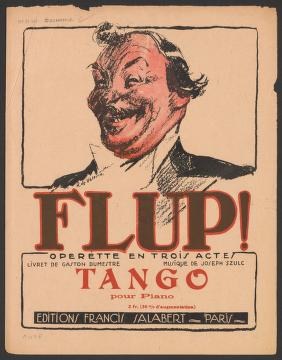
A caricatured male face dominates this cover design, rendered in bold red and black ink on a tan ground. The figure has exaggerated, grotesque features—a prominent nose, heavy brow, and theatrical mustache—characteristic of early 20th-century caricature. The face is framed in a simple black border, with the large text "FLUP!" in red below, followed by smaller type indicating "OPERETTE EN TROIS ACTES" and "d'après un motif dansé" (after a danced motif). The bottom line reads "TANGO" in prominent lettering, with publication details for Éditions Francis Salabert in Paris. The design is typical of theatrical advertising from 1919—economical, bold, and designed to catch the eye of passersby. There is no depiction of actual dancers or choreography visible; the image is purely typographic and caricatural.
The dancing
There are no dancing figures in this image. The work is a cover design featuring a single caricatured male head, not a representation of dance movement or dancers in performance.
The dance depicted
The image is identified in the record as related to Tango, and the text explicitly states "TANGO" and references a "motif dansé" (danced motif). However, the image itself contains no representation of the tango dance—no dancers, no hold, no movement, no costume or setting associated with the style. This is a theatrical cover, not a dance illustration. The connection to tango exists only in the text and in the commercial context (this being a cover for a 1919 operetta). The caricatured face may be that of a performer or character, but nothing visual tells us this is about tango rather than any other dance or theatrical production.
How it was made
This is a color lithograph or letterpress design with hand coloring, characteristic of theatrical announcements and sheet music covers of the 1919 period. The bold, flat color application and the economic use of red and black suggest rapid, economical production suited to wide distribution as a poster or cover. The technique allowed for cheap reproduction and eye-catching street visibility, which was the primary purpose of theatrical promotion in this era.
About this work
This is a theatrical cover design for a 1919 operetta called "Flup!" that is identified as being based on a tango motif. The work sits at the intersection of commercial graphic design and dance history—it advertises a dance-related theatrical production but does not itself depict dancing. It is valuable as evidence of how tango entered European theatrical culture in the immediate postwar years, and as an example of how dance genres were marketed and consumed in the popular theater. The work belongs in a gallery of dance in art because it documents the cultural moment when tango became fashionable enough to anchor a commercial theatrical production, even if the cover itself traffics only in caricature and typography.
How to look at it
The cover is designed to arrest attention through exaggeration and color contrast, not to inform the viewer about tango specifically. The grotesque face may have been meant to amuse or intrigue; the caricature tradition invites a knowing, ironic distance from the subject. The prominence of the word "TANGO" and the publisher's name tells you this is a commercial object meant to move through the world quickly—pasted on walls, reproduced in newspapers, passed hand to hand. Attend to the date and the publisher as much as to the image itself.
The artist
The artist is not recorded. The work bears only the publisher attribution to Éditions Francis Salabert in Paris. Salabert was a major music publisher of the period, specializing in popular theater and dance music. The design is professional and confident but stylistically generic to the commercial theater poster tradition of the era.
The period
Tango entered European consciousness in the 1910s as an exotic import from Argentina, often viewed with moral suspicion but irresistible to urban middle-class audiences. By 1919, the tango craze had consolidated: it appeared in music halls, cabarets, and operetta. The postwar period saw accelerated consumer culture and advertising; theatrical covers and posters became a major form of commercial and artistic expression. This cover reflects the moment when tango was no longer scandalous novelty but marketable entertainment—sensational enough to anchor a full operetta, yet presented through the safe, ironic register of caricature.
Where it lives
This work is held by the Library of Congress and appears to be a loose theatrical cover or poster page, likely collected as an artifact of commercial theater advertising and music publishing history rather than as fine art.
Questions about this work
Why is there no tango dancing in a cover about tango?
This is a theatrical cover, not an illustration of choreography. Its purpose was to advertise and sell the operetta to passersby, not to depict how tango was actually danced. The bold caricature and typography were designed for visual impact on the street or in a shop window. Text, not image, tells you what dance the show featured.
Who is the caricatured figure?
The record does not identify the subject. It may be a performer associated with the operetta, or a generic theatrical stock character. Without additional documentation, it cannot be determined from the image alone.
When did tango become popular in Europe?
Tango arrived in Europe from Argentina in the 1910s and was rapidly absorbed into urban popular culture. By 1919, when this cover was printed, tango was established enough in Paris to anchor a full operetta production. It had moved from scandalous novelty to respectable (if still slightly risqué) entertainment.
More dance artwork





