49 works in this view — arrow keys or swipe to move between them.
Dance in Art · 1913
Tango
Unknown artist
- Source:
- Library of Congress
- Rights:
- Public domain — free to use, share and adapt.
- Recorded as:
- Public Domain
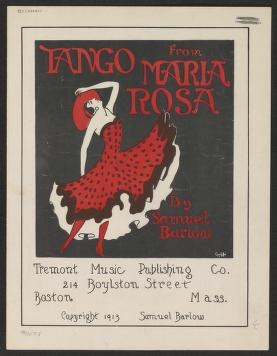
This image is crucial evidence of how tango was understood in early 20th-century North America—as exotic, sensual, theatrical, and acrobatic. The exaggerated dip and the woman's vulnerability reflect both the reality of tango's technique and the cultural anxiety it provoked. As a sheet music cover, it shows how dance was distributed, consumed, and imagined in the era before recording and film: through images and music that traveled separately, each shaping interpretation of the other.
What you are looking at
A vivid promotional image for tango, rendered in bold Art Deco style. The composition is dominated by a woman in a striking red dress that dominates the lower two-thirds of the frame, her body arched backward in the characteristic dip of a tango pose. A male figure in dark formal dress supports her, visible as a silhouette or shadow behind and above. The woman's pose is extreme—her torso nearly horizontal, one arm extended upward in an elegant line, her head tilted back. The red of her dress is intense and patterned, suggesting the sensuality and passion associated with the dance. The background is dark, throwing the figures into sharp relief. At the bottom, printed text identifies this as sheet music cover for "Tango Maria Rosa," composed by D. Perceval Barona, published by Tremont Music Publishing Co. in Boston in 1913.
The dancing
Two figures in a closed dance frame: the woman reclines in a pronounced backbend, her weight supported by her partner's arm and body. Her upper body is nearly horizontal, creating the dramatic dip that tango is known for. One arm extends upward in an elegant arc; the other rests on her partner. The male figure is largely obscured, seen as a dark mass behind her, his posture upright and controlling. The pose captures the asymmetry and drama of tango: the woman's vulnerability and extension contrasted with the man's strength and support.
The dance depicted
This is Argentine tango, identifiable from the characteristic dip (caída), the formal partnered embrace, and the woman's extended, arched position. The dance depicted here is tango as it was understood in North America in the 1910s—theatrical, highly visual, and sensual. Argentine tango had only recently arrived in the United States and Europe from Buenos Aires in the early 1900s, and it generated both enthusiasm and moral anxiety. This image captures the dance as it was being marketed to middle-class audiences through popular music: dramatic, romantic, and slightly dangerous.
How it was made
This is a color lithograph, a process well suited to bold graphic design and flat areas of vivid color. Lithography allowed for relatively inexpensive reproduction, making this accessible as a sheet music cover for domestic and commercial distribution. The technique's capacity for strong color saturation and sharp line work is fully exploited here: the red of the dress reads as an emotional statement, not mere description. As a sheet music cover, this object circulated widely among piano owners and music lovers, serving both as commercial advertisement and as a visual record of how tango was understood and marketed in America.
About this work
This is a color lithographed sheet music cover from 1913, promoting a tango composition at the height of the dance's vogue in North America. The image captures tango not as it was danced in Buenos Aires—intimate and close to the ground—but as it was being performed and imagined in theaters and salons: dramatic, acrobatic, and deeply sensual. The woman's extreme backbend, supported by her unseen partner, presents tango as a display of trust, strength, and abandon. The work belongs in a dance gallery because it is a primary document of how a specific dance was translated for a specific audience at a specific moment: American consumers of the 1910s encountering a foreign dance through the filter of popular music and commercial graphic design.
How to look at it
Attend to the extreme extension of the woman's body and the trust it implies: the tango dip became one of the most recognizable images of the dance, and this cover exploits it fully. Notice too how the male figure is almost erased—reduced to a dark silhouette—so that the viewer's eye is drawn entirely to the woman's red dress and extended form. This is tango as spectacle, designed to be looked at. The color contrast between the red dress and the dark background was a bold choice for a 1913 sheet music cover, and it would have been eye-catching in a music shop window or in a home piano room.
The artist
The artist is not recorded in the catalogue. The style is consistent with commercial Art Deco graphic design of the 1910s, and the work was produced for commercial circulation as a sheet music cover. The compositional choices—the bold color, the dramatic pose, the elegant lettering—suggest a professional commercial artist working within the conventions of the period, creating an image designed to sell both the music and the fantasy of tango.
The period
Tango arrived in Paris and New York around 1910–1912 and ignited a craze among wealthy and middle-class dancers. The dance's association with Buenos Aires brothels and working-class origins gave it a thrilling, slightly illicit appeal that attracted both enthusiasts and critics. In the same period, Art Deco was emerging as the dominant commercial graphic style, with its bold colors, geometric clarity, and embrace of modernity. This cover sits at the intersection: a dance new to the West being sold to mass audiences through a cutting-edge visual language. By 1913, tango had already begun its transformation from street dance to ballroom standard, and images like this one record that process of translation and sanitization.
Where it lives
This is a color lithograph sheet music cover published by Tremont Music Publishing Co., 214 Boylston Street, Boston, in 1913. The work entered the Library of Congress collection. As a sheet music cover, it was mass-produced and distributed for sale to the public, making it a commercial object designed for wide circulation.
Dance in this work
Questions about this work
Is this really how people danced tango in 1913?
Partly. The dip (caída) is an authentic element of Argentine tango, but this image is exaggerated for dramatic effect and commercial appeal. In Buenos Aires at the same time, tango was danced much closer to the ground and with less theatrical extension. This cover shows how tango was adapted for stage performance and for consumption by American ballroom dancers, who found the dip thrilling and photogenic.
Why is the male dancer almost invisible?
The design prioritizes the visual spectacle of the woman's extended body and red dress, the elements most likely to attract buyers and catch the eye. In the marketing of tango to American audiences, the woman's beauty, vulnerability, and sensuality were emphasized, even though the technique requires equally skilled, strong partners. This reflects both the aesthetics of Art Deco graphic design and the gender politics of the era.
What is Tremont Music Publishing?
A Boston-based music publisher active in the early 20th century, producing sheet music for popular consumption. Publishing a song called 'Tango Maria Rosa' in 1913 places it squarely in the moment when tango was becoming fashionable in North America. Sheet music covers like this one were important marketing tools and were often displayed in shop windows and homes.
More dance artwork





