49 works in this view — arrow keys or swipe to move between them.
Dance in Art · 1871
Artisan quadrilles
Unknown artist
- Source:
- Library of Congress
- Rights:
- Public domain — free to use, share and adapt.
- Recorded as:
- Public Domain
This work is a direct window into how the quadrille was marketed, taught, and imagined in the decades before it was displaced by the waltz and later by ballroom ragtime dances. The title and design conventions reveal that quadrilles were not static historical artifacts but living, themed, continuously reinvented entertainments. For dance historians, the image documents not just the dance itself but the publishing infrastructure, visual culture, and social practices surrounding it.
What you are looking at
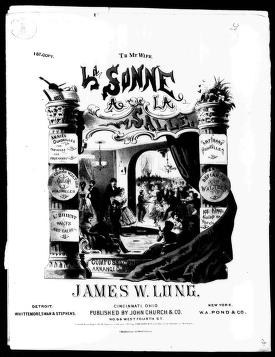
This is a chromolithographic poster or title page for a work titled "Artisan Quadrilles," credited to James W. Linde. The image is densely decorated in the mid-Victorian commercial style, with ornamental cartouches and banners arranged around a central vignette. The central scene depicts couples in formal dress engaged in a quadrille, a structured group dance requiring four couples arranged in a square. The composition uses elaborate architectural framing—columns decorated with trade emblems and heraldic devices—suggesting the "artisan" theme involves working-class or trade occupations. The central vignette shows figures in mid-dance gesture, with women in full skirts and men in formal coats, captured in a moment of coordinated movement. The overall design is busy and chromatic, typical of commercial dance music covers of the 1870s, with text announcing the publisher (John Church & Co., Cincinnati; G. Schirmer, New York) at the base.
The dancing
The dancers in the central vignette are arranged in the standard quadrille formation: four couples, with partners in closed or near-closed hold. The women wear voluminous skirts typical of the 1870s, extending to the floor, while the men stand upright in formal dress coats. The postures suggest movement in progress—bodies angled, arms positioned to maintain frame and guide partners through the prescribed figures of the dance. The poses are graceful but formal, reflecting the structure and decorum required of the quadrille.
The dance depicted
This work documents the quadrille, the dominant social and theatrical dance form of the mid-nineteenth century. The quadrille was performed by four couples arranged in a square and executed a series of fixed figures, typically to marchlike or galop music. The title "Artisan Quadrilles" suggests themed variations in which the figures or characters represented trades or occupations, making this part of a popular genre of topical quadrilles that allowed dancers to adopt costume and choreography appropriate to blacksmiths, millers, sailors, or other professions. The quadrille was equally at home in ballrooms and on the concert or theatrical stage, and music publishing for the form was enormous in the 1870s.
How it was made
This is a chromolithograph, a color lithographic process that allowed multiple colors to be printed in sequence from separate stones or plates. The technique is evident from the layered, slightly offset color fields and the crisp registration of text and ornamental detail. Chromolithography was ideal for music covers because it could produce eye-catching, fully colored designs at reasonable cost for mass distribution. The ornamental cartouches and heraldic devices are typical of commercial design of the period, using visual complexity to attract buyers browsing sheet music in retail stores.
About this work
This chromolithographic cover for a published quadrille (likely a instrumental score for piano or small ensemble) captures the aesthetics and dance culture of the 1870s American ballroom. The quadrille was not merely a ballroom dance but a structured, hierarchical form with published variations, themed versions, and a substantial commercial apparatus of teachers, dancing masters, and music publishers. The "Artisan" theme reflects a mid-Victorian fascination with picturesque occupational imagery—the ballroom reimagined as a site where social classes could be playfully inverted or celebrated through costume and choreography. The poster's visual complexity—its architectural framing, decorative abundance, and multiple registers of text—mirrors the quadrille's own complexity: a dance that required memorized figures, a partner, three other couples, and an orchestra, yet could be executed by almost any educated person of either sex.
How to look at it
Attend to the central vignette and the postures of the dancers: they are captured mid-movement, bodies angled and arms positioned to guide partners through the coordinated figures of the quadrille. The ornamental surround—the cartouches, text, and heraldic devices—tells you this was a commercial product designed to sell; the visual complexity was meant to draw the eye and suggest sophistication. The formal dress of the figures and the careful arrangement of couples indicate that this was a dance of social consequence, governed by rules and decorum. The title "Artisan Quadrilles" invites you to imagine how the basic form could be adapted, themed, and made specific to different occupations or characters.
The artist
James W. Linde is credited as the artist of this cover design. Little is known of Linde's practice beyond his work for music publishers; he appears to have specialized in ornamental and commercial lithographic design for the music trade in the 1870s. His role was to create visually arresting covers that would stand out in a retail environment and communicate the style and social standing of the dance to potential buyers.
The period
The 1870s were the height of the quadrille's popularity in America, even as the waltz was beginning to challenge its supremacy. The quadrille had been the dominant ballroom dance form since the early 1800s and was central to the transmission of social etiquette and courtship ritual. Dance music publishing was a major commercial enterprise, with composers creating thousands of variations, themed versions, and pedagogical arrangements. The quadrille's structure made it ideal for both social and theatrical performance, and it appeared in both ballrooms and on the concert stage. By the 1880s, the quadrille would decline, but in the 1870s it was still generating enormous publishing revenue.
Where it lives
This is a published music cover, held by the Library of Congress. It was issued by John Church & Co. (Cincinnati) and G. Schirmer (New York), both major American music publishers of the period. The work is a commercial product—a printed advertisement and sales vehicle for sheet music.
Dance in this work
Questions about this work
What is a quadrille?
A quadrille is a ballroom dance for four couples arranged in a square. Dancers execute a series of fixed figures (typically eight to twelve) in a prescribed order, to marchlike or galop music. Each figure has a name (Pantaloon, L'Été, Poule, Trénitz, Finale) and involves specific patterns of movement. The quadrille was the dominant social dance of the nineteenth century and also appeared frequently on the theatrical stage.
What are 'Artisan Quadrilles'?
Themed variations of the quadrille in which the figures or costumes represent trades or occupations. A set of Artisan Quadrilles might feature a blacksmith figure, a miller figure, a sailor figure, and so on. The choreography and costume allowed dancers to adopt the character and gestures associated with each occupation, turning the ballroom into a site of playful social commentary.
Who danced the quadrille?
The quadrille was danced by educated, middle- and upper-class people in both ballrooms and theaters. It required instruction and was central to ballroom etiquette and courtship ritual. Dancing masters taught it to young people as part of their social education. It also appeared on the concert stage as an entertainment form and was frequently performed by professional dancers.
Why was this published as sheet music?
The quadrille required musical accompaniment and was typically performed by a pianist or small ensemble. Publishers issued quadrille music for home performance and ballroom use. Sheet music sales were a major source of revenue, and publishers hired composers and commercial artists to create new variations, themed versions, and arrangements. The ornamental cover was part of the marketing—designed to catch the eye and suggest the sophistication and social value of the dance.
More dance artwork





