49 works in this view — arrow keys or swipe to move between them.
Dance in Art · 1857
Pupil's Polka.
Unknown artist
- Source:
- Library of Congress
- Rights:
- Public domain — free to use, share and adapt.
- Recorded as:
- Public Domain
The polka was one of the first dances to achieve truly mass popularity across classes and national boundaries; this print is evidence of how that popularity was visualized and marketed. It shows the ballroom polka as it was actually danced—social, partnered, and designed for public assembly rooms—rather than as a theatrical novelty, and it documents the aesthetic and material context (the ballroom, the dress, the academy structure) in which social dance was embedded.
What you are looking at
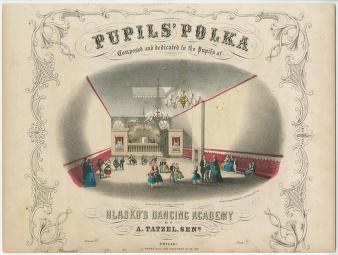
A lively ballroom scene rendered in colored engraving or lithograph, set within an ornate proscenium frame decorated with scrollwork. The interior shows a grand hall with chandeliers, mirrors, and architectural detail suggesting a fashionable dance academy or ballroom. Couples in mid-nineteenth-century dress fill the floor in various attitudes of motion. Women wear full skirts with corseted bodices and bonnets or hair ornaments; men are in dark tailcoats and trousers. The figures are distributed across the space at different depths, some in sharp focus in the foreground, others becoming increasingly atmospheric toward the back. The composition captures the festive, social energy of a public dance, with clusters of dancers, musicians, and spectators. The hand-coloring—visible in the subtle gradations of the women's gowns and the warm tones of the wood paneling—suggests this was a popular commercial print.
The dancing
The dancers adopt closed ballroom holds: men place a hand at the woman's waist, women rest one hand on the man's shoulder. The weight is carried upright and forward, with bodies angled in the characteristic V-frame of ballroom carriage. Several couples are captured mid-turn or in traveling steps across the floor, their legs and skirts suggesting swaying, directional movement rather than high elevation. The poses are energetic but controlled, consistent with social dancing of the 1850s—not theatrical or acrobatic, but the graceful deportment expected in a respectable assembly room.
The dance depicted
This is a polka, as stated in the title and confirmed by the period, setting, and costume. The polka was a craze across Europe and North America in the 1840s and 1850s, reaching peak popularity precisely around 1857. It was danced in public ballrooms, at private parties, and at dance academies like the one depicted here (Hasluck's Dancing Academy, as the subtitle indicates). The image shows the polka as a social partner dance in the ballroom setting where it was most commonly performed—neither theatrical nor folk, but a fashionable social form. The couples' upright posture, closed hold, and traveling action across the floor are consistent with the polka's characteristic movement: a lively, bouncing step with a 2/4 meter, covering ground in couples.
How it was made
This is a hand-colored lithograph or engraving, typical of the commercial dance prints that were produced in vast quantities in the mid-nineteenth century. The technique allowed for rapid, economical production and wide distribution—these prints were affordable souvenirs, teaching aids, and advertisements for dance academies and fashionable entertainments. The theatrical proscenium frame and the careful attention to architectural and costume detail suggest this was marketed both as a souvenir of a specific venue (Hasluck's Academy) and as a document of current fashion and social practice. The engraving's crisp outlines and the lithograph's capacity for tonal gradation are both evident here, and the hand-coloring adds commercial appeal and clarity.
About this work
This is a commercial print documenting the polka's dominance in European and American ballroom culture during the 1850s. It serves as a historical record of how the dance was performed in social settings—the hold, the frame, the energy, the costume, the architectural context—and as an advertisement for a specific dance academy. The work sits at the intersection of popular print culture, ballroom dancing history, and social history. It belongs in a dance collection because it captures not choreography or theatrical spectacle, but the lived practice of a social dance at the height of its fashion, seen through the eyes of a commercial artist documenting a thriving dance culture for a middle-class audience.
How to look at it
Attend first to the geometry of the holds and frames: the uniformity of the couples' posture and arm position tells you this is a codified, taught dance, not an improvisation. Look at the depth of field and the compositional choices—the artist has positioned the viewer as a spectator in the ballroom, not as an external observer, and has given prominent space to the couples nearest the front, emphasizing their graceful carriage. Notice the detail of the women's skirts: they billow and catch the motion of rotation and travel, suggesting the tempo and weight of the movement. Finally, observe the social context—the musicians, the spectators, the architecture—which frames this as a respectable, fashionable, public entertainment, not a folk or theatrical spectacle.
The period
The polka emerged in Bohemia in the early 1830s and became an international phenomenon by the 1840s. By 1857, when this print was made, it had been the dominant ballroom dance for nearly two decades. The 1850s saw the publication of hundreds of polka prints, polka quadrilles, polka variations, and instructional materials; the dance appeared on sheet music, in novels, and in visual art across Europe and America. Ballroom dancing itself was undergoing democratization: while quadrilles and cotillions had been exclusive to aristocratic assemblies, the polka was danced by merchants, professionals, and shopkeepers in public venues. Dance academies like Hasluck's proliferated to meet demand for instruction. At the same time, lithography and hand-coloring made illustrated prints accessible to a middle-class audience for the first time, and commercial artists capitalized on the appetite for images of fashionable social life.
Where it lives
This print is housed in the Library of Congress. It is a commercial, hand-colored lithograph or engraving, produced for sale or advertisement, likely distributed by the academy itself, by a music or dance publisher, or by a print seller catering to fashionable audiences.
Dance in this work
Questions about this work
What was the polka and why was it so popular?
The polka was a lively, simple couple dance in 2/4 time that emerged from Bohemia in the 1830s and swept across Europe and North America in the 1840s–50s. It was faster and more energetic than the quadrille or cotillion, easier to learn, and open to all social classes. It became the first truly mass-market social dance, performed in public ballrooms, private homes, and dance academies.
How does this print document the polka as it was actually danced?
The image shows the closed ballroom hold, upright carriage, and forward-traveling action that characterize the polka. The couples' posture and frame are consistent across the floor, indicating a standardized, taught technique. The women's full skirts and the suggestion of rotational and linear momentum in their poses capture the movement's tempo and weight—a bouncing, energetic step rather than a gliding one.
What was Hasluck's Dancing Academy?
Hasluck's was a fashionable dance academy, likely in London or a major European city, that offered instruction in ballroom dances including the polka. The print was likely produced as an advertisement for the academy and as a souvenir of the polka's fashionability and social prestige.
Why would someone buy this print in 1857?
A middle-class person or aspiring dancer might have bought it as a souvenir of a ballroom visit, as a teaching aid to show the correct polka hold and carriage, as a fashionable decoration for the home, or as a record of current social trends. The print made dance instruction and ballroom culture visible and accessible to people who might not have attended an academy in person.
More dance artwork





