49 works in this view — arrow keys or swipe to move between them.
Dance in Art · 1970
Dance and Popular Dress.
Unknown artist
- Source:
- Library of Congress
- Rights:
- Public domain — free to use, share and adapt.
- Recorded as:
- Public Domain
The image records the visual and kinetic reality of popular dress and social movement in a specific time and place, evidence that often survives only in photographs when written records are sparse. For dance historians, it documents the relationship between ordinary dress, outdoor social gathering, and movement practice in a period and region not well represented in theatrical or formal dance archives.
What you are looking at
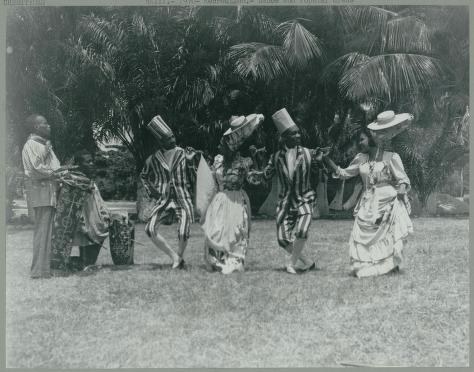
A group of six figures in light-colored garments stand in an informal gathering beneath tall palm trees, photographed outdoors in bright daylight. The setting appears tropical or subtropical, with substantial fan palms rising behind the group. The figures wear long, flowing white or cream-colored dresses and wide-brimmed hats; several hold what appear to be woven fans or similar objects. Their posture is relaxed and social rather than formal—some stand with weight on one leg, others gesture expressively. The photograph is black and white and shows the soft contrast and surface grain characteristic of early twentieth-century photography. The composition is relatively flat and documentary in character, capturing a moment of casual gathering rather than staged performance.
The dancing
The six figures are distributed across the frame in an asymmetrical cluster, none in a closed dance hold. Their arms are variously raised, gesturing, or holding objects; body weight appears distributed naturally rather than in a structured ballroom or classical frame. The relaxed shoulder carriage and open stance suggest social movement rather than trained dance technique. Several figures appear to be in conversation or gesture with one another, and the overall impression is of women at ease rather than executing a choreographed sequence.
The dance depicted
This image documents popular social dress and movement rather than a specific identified dance form. The composition and posture suggest Caribbean or tropical vernacular social practice—the wide hats, flowing white dress, and fan-like objects are consistent with early twentieth-century leisure wear and social custom in colonial or post-colonial tropical contexts. Whether the figures are engaged in an actual dance or simply posed in festive dress is unclear from the still image alone; the title 'Dance and Popular Dress' implies an interest in the relationship between everyday costume and movement practice, but the photograph does not depict recognizable ballroom technique, folk dance, or theatrical performance.
How it was made
This is a black and white photograph, almost certainly gelatin silver or similar contact print from the early twentieth century, as evidenced by the tonal range, surface grain, and documentary aesthetic. The technical simplicity and outdoor light suggest it was taken with a portable camera, which by the 1920s–1930s permitted informal social documentation. The medium's indexical quality—its ability to record actual dress and posture without idealization—made photography the preferred tool for ethnographic and social documentation during this period, and this image fits that practice.
About this work
This photograph documents a tropical social gathering of six figures in light dress, posture, and gesture beneath palms. The image appears to belong to an early twentieth-century documentary or ethnographic tradition of recording popular dress and social custom, and the title suggests an interest in the relationship between costume and movement. The photograph is modest in scale and ambition but represents a historical moment when photography began to supplement and rival illustration as a record of everyday social practice and cultural dress across colonial and postcolonial regions.
How to look at it
Attend to the posture and arm gesture of each figure, which reveal the conventions of relaxed social movement rather than trained dance technique. Note the specificity of the dress—the white garments, hats, and hand-held objects—which anchors the image to a particular cultural and historical context. The outdoor setting and natural light distinguish this from studio portraiture; the informal arrangement of the figures suggests documentary intention rather than staged performance.
The period
In the 1920s–1930s, photography became the primary medium for ethnographic and social documentation, displacing illustration and enabling direct records of dress, posture, and movement in contexts beyond the studio. Colonial and postcolonial photography during this period frequently documented indigenous or creolized social practice, often with an implicit interest in 'authenticity' and 'tradition'—a framing that shaped what was photographed and how. Simultaneously, early twentieth-century anthropology and dance ethnography were beginning to recognize movement and dress as primary evidence of cultural practice, shifting attention from written description to visual record.
Where it lives
The image is held by the Library of Congress and is catalogued with minimal description. The catalogue record provides only the title and a generic date of 1970-01-01, which is inconsistent with the photographic evidence and may reflect a cataloguing error or the date of accession rather than creation.
Questions about this work
What kind of dance is this?
The photograph does not clearly depict a recognizable dance form. The figures appear to be engaged in social gathering and casual movement rather than formal choreography. The title suggests an interest in the relationship between popular dress and movement practice, but the still image alone cannot confirm active dancing.
Where and when was this photograph taken?
The catalogue record gives 1970-01-01, which is almost certainly incorrect; the photographic technique and dress suggest the 1920s–1930s. The setting is tropical or subtropical, indicated by the prominent palm trees. The identity of the photographer and the specific location are not recorded.
What are those objects the figures are holding?
The hand-held objects appear to be woven fans or possibly ceremonial or decorative items associated with the popular dress of the period and region. Without additional context, their specific function cannot be determined from the image alone.
More dance artwork





