49 works in this view — arrow keys or swipe to move between them.
Dance in Art · 1874
Clog dancing made easy. The elements and practice of that art arranged, simplified and corrected, with examples
Unknown artist
- Source:
- Library of Congress
- Rights:
- Public domain — free to use, share and adapt.
- Recorded as:
- Public Domain
Clog dancing was a major vernacular art form in nineteenth-century America, yet most of what we know about it comes from descriptions, photographs, and surviving manuals like this one. This engraving is evidence of a thriving popular dance pedagogy that made theatrical forms accessible to amateurs and working people at low cost. It also documents the tension between improvisation and codification: what was performed as spontaneous skill on stage was simultaneously being systematized into learnable steps for the general public.
What you are looking at
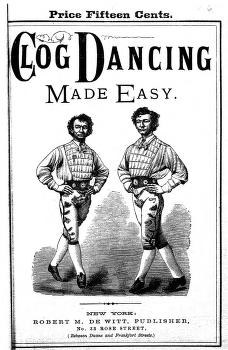
This is an instructional cover or title page for a dance manual, presented as a wood engraving or relief print. At the top, the price "Fifteen Cents" appears in a banner. The title "CLOG DANCING" is printed in large decorative letters, with "MADE EASY" beneath it in smaller capitals. Below the text are two figures depicted in a frontal, static pose: they wear practical working clothes—suspenders, rolled sleeves, work shirts—and stand with legs positioned as if mid-step or in a characteristic clog-dancing stance. Both figures are rendered in the stiff, schematic style typical of instructional manual illustrations of the 1870s. The composition is symmetrical and formal, designed to convey the steps or positions that will be explained within the text. At the bottom, publication information reads "PUBLISHED BY ROBERT M. DE WITT, 33 ROSE ST., N.Y." with a note about printed materials. The overall effect is utilitarian and pedagogical rather than theatrical—this is a working document meant to teach rather than to celebrate performance.
The dancing
Both figures stand facing forward with weight distributed on both feet, legs slightly apart, in what appears to be a preparatory or resting stance rather than a moment of dynamic movement. Their arms hang naturally at their sides or rest lightly on their bodies. The posture is upright and formal. Neither figure shows the twisted trunk, lifted heel, or weight shift that characterizes actual clog dancing in motion; the positions are simplified and schematic, designed for clarity rather than fidelity to the dance's kinetic reality. The rendering treats the two dancers as identical templates, suggesting this is an instructional model rather than a representation of live performance.
The dance depicted
Clog dancing in the 1870s was a popular theatrical and social form, performed in minstrelsy, variety shows, and music halls, particularly in America. The art involved rapid footwork in wooden-soled shoes (clogs) that produced distinctive percussive rhythms. This manual, titled to promise that clog dancing could be made 'easy,' was aimed at amateurs and students learning the form from a printed guide. The stiff, frontal poses of the figures suggest the manual would break down steps into discrete, teachable positions—the opposite of the fluid, improvisational performance style that characterized advanced clog dancers. The book purports to 'arrange, simplify and correct' the practice with 'examples,' indicating it aimed to systematize and demystify a form that was otherwise learned through watching live performance or direct instruction.
How it was made
This is a wood engraving, a relief printing technique in which an image is carved into the end-grain of a wooden block—the raised portions accept ink and print as black lines and solid areas against white paper. Wood engraving was the standard method for reproducing images in printed books and newspapers in the 1870s and allowed for fine detail and sharp lines. The technique was fast and economical, making it ideal for popular instructional publications sold at fifteen cents—a price point suggesting a mass market aimed at working people and amateurs rather than wealthy collectors. The stiff, linear quality of the image is partly a product of the medium's capacity for crisp definition, but also serves the instructional purpose: clear outlines and unambiguous poses are easier to diagram, understand, and learn from.
About this work
This is the title page of a mid-nineteenth-century instructional manual for clog dancing, a percussive dance form popular in American variety shows and music halls. The engraving depicts two figures in basic clog-dancing attire and stance, designed to illustrate rather than celebrate the form. The work is significant as a document of how clog dancing was taught, codified, and marketed to amateurs—it reveals that what was performed as virtuosic improvisation on stage was packaged as a learnable sequence of steps for home or studio practice. The manual itself is no longer widely known, but the image survives as evidence of a thriving popular dance pedagogy in the Gilded Age, when instructional dance manuals proliferated and made theatrical forms accessible to ordinary people.
The illustration exemplifies the instructional aesthetic of its period: simplified, symmetrical, schematic. It does not depict a moment of actual performance or even training; it presents an idealized model of the body in basic positions. This approach—breaking dance into teachable, reproducible units—was the foundation of nineteenth-century dance pedagogy and connects to later systems of notation and codification.
How to look at it
Look at the stillness of these figures. Clog dancing is all about sound and speed, about feet striking the floor in rapid, complex patterns. This engraving offers no hint of that motion—the poses are static, frontal, schoolbook-simple. The artist has chosen to show clog dancing as a series of positions rather than as movement, which is entirely appropriate for an instructional manual but tells you that the real dance—the rhythmic complexity, the virtuosity—happens in performance and cannot be fully captured in a single image. The formal, symmetrical composition, with both figures identical, suggests this is a template or model: these are not two specific dancers but two instances of the basic clog-dancing stance, ready to be broken down step by step in the pages that follow.
The period
Clog dancing flourished in America from the 1850s through the early twentieth century, with roots in both Irish step dancing and African American rhythmic traditions. In the 1870s, when this manual was published, clog dancing was a staple of variety theater, minstrelsy, and music halls. The form was performed by solo dancers or in ensembles and was characterized by rapid, complex footwork in wooden-soled shoes. Instructional dance manuals were a growing market in the nineteenth century, driven by the rise of popular dance forms and the desire of urban amateurs to learn theatrical styles. Publishers like Robert M. De Witt specialized in cheap, mass-produced instructional books on practical topics. The promise that clog dancing could be 'made easy'—simplified, arranged, corrected—reflects both the growing commercialization of dance pedagogy and a democratizing impulse: the techniques of the music hall stage were presented as available to anyone who could afford fifteen cents and had space to practice.
Where it lives
This work comes from the Library of Congress. The title page is from a printed instructional manual, 'Clog dancing made easy,' published by Robert M. De Witt, a prolific publisher of popular instructional and entertainment literature in nineteenth-century New York.
Dance in this work
Questions about this work
What is clog dancing?
Clog dancing is a percussive dance form performed in wooden-soled shoes (clogs) that create a distinctive rhythmic sound. It was popular in nineteenth-century American variety shows, music halls, and minstrelsy and involved rapid, complex footwork. The form has roots in both Irish step dancing and African American rhythmic traditions and remained widespread until the early twentieth century.
Why would someone buy this manual in 1874?
Instructional dance manuals were sold to amateurs and students who wanted to learn theatrical styles without access to a live teacher or stage experience. At fifteen cents, this manual was cheaply priced for a mass market of working people and home learners. The promise to 'simplify' and 'correct' the art made clog dancing seem achievable for ordinary people, not just stage professionals.
Why are these figures so stiff and static?
This is an instructional image designed to show basic positions and stances that can be explained, broken down, and practiced systematically. The stillness and simplicity make it easy for a reader to understand the fundamental posture and frame of the dance. Real clog dancing is fast and rhythmically complex; this image is a pedagogical tool, not a performance record.
How do we know clog dancing existed?
Manuals like this one, along with photographs, newspaper advertisements, playbills, and descriptions by contemporaries, document the form. Clog dancing was a major attraction in American variety theaters and music halls from the 1850s onward and remained popular into the twentieth century.
More dance artwork





