49 works in this view — arrow keys or swipe to move between them.
Dance in Art · 1913
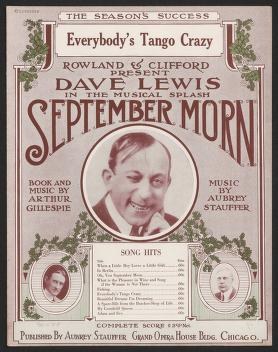
Everybody's tango crazy
Unknown artist
- Source:
- Library of Congress
- Rights:
- Public domain — free to use, share and adapt.
- Recorded as:
- Public Domain
This advertisement is direct evidence of the commercial explosion of tango in early 1910s America. It shows how quickly a social dance trend was absorbed into theatrical entertainment and marketed to mass audiences. For understanding how dance moves from ballrooms into popular culture and mass media, this single object documents the entire chain: social trend → commercial entertainment → promotional advertising.
What you are looking at
This is a printed theatrical advertisement for a musical comedy, dominated by a large central portrait photograph of a smiling man in formal dress. The layout follows the popular chromolithographic style of 1910s theatrical promotion, with decorative floral borders in the corners and bold typography announcing the production. At the top, a banner reads "The Season's Success." The title "Everybody's Tango Crazy" appears in large letters below the photograph, with credits to Rowland & Clifford for the book and music, and the show title "Dav Stamis September Morn" (likely a musical splash or subtitle). Two smaller photographs flank the central image—one of a woman on the left and another figure on the right—suggesting cast members. Below these portraits is a "Song Hits" section listing musical numbers from the show. The overall composition is promotional and designed to advertise the theatrical event, printed by Aubrey Stauffer at the Grand Opera House in Chicago.
The dancing
The central figure is photographed in a static, formal pose typical of theatrical portraiture of the era—facing the camera with a composed expression and conventional studio lighting. The two smaller photographs on either side show additional performers in similar formal poses. No active dance movement or choreographic positioning is visible; these are publicity stills rather than dance documentation. The dress is formal evening wear appropriate to the theatrical context.
The dance depicted
The title explicitly references the tango craze that swept the United States in the early 1910s. While the advertisement does not depict tango dancing itself, it markets a show that capitalized on this social dance phenomenon. The tango became a symbol of cosmopolitan sophistication and mild transgression in American popular culture during this period, and theatrical producers quickly mounted musical comedies to capitalize on the trend. This advertisement is evidence of how ballroom dance—specifically Argentine tango—penetrated American commercial entertainment and mass culture.
How it was made
This is a chromolithographic theatrical poster and advertisement, a mass-produced promotional print. The technique allowed color reproduction at scale and low cost, making it ideal for widespread distribution to theaters, hotels, and public spaces. The combination of photographic portraits (likely halftone reproductions) with hand-drawn lettering and ornamental borders was standard practice in theatrical advertising of the 1910s. This object is evidence of how theatrical culture was marketed to the American public and how dance trends were commercialized through popular media.
About this work
This is a theatrical advertisement for a musical comedy that explicitly advertised itself as cashing in on the tango craze of the early 1910s. The show was produced in Chicago and performed at the Grand Opera House. The advertisement does not depict tango dancing but instead uses the trend's cultural cachet to market the theatrical entertainment. It is an artifact of how social dance trends moved from ballrooms into commercial entertainment and how that entertainment was promoted through chromolithographic mass media.
For historians of dance and entertainment, this advertisement is valuable documentary evidence of the tango boom in America. The show's title made the tango the central selling point—a reflection of how intensely this Argentine social dance had captured public attention. The format and design tell us who the audience was (urban theater-goers in Chicago) and how they were reached (printed advertisements distributed through public spaces).
How to look at it
The viewer should recognize this as a document of commercial culture, not a depiction of actual tango dancing. The advertisement's power lies in what it tells us about how rapidly the tango became a marketable commodity: a show could be sold entirely on the basis of the title and the cultural moment, without needing to show the dance itself. The formal theatrical portraits and the chromolithographic printing style are typical of 1910s mass entertainment promotion; the small scale and distribution method (a printed handbill or poster) suggest it was meant to reach working- and middle-class theater audiences in an industrial American city.
The artist
The artist or designer is not recorded. This is a product of the theater's advertising operations or a commercial printing house. Aubrey Stauffer is credited as the printer (or may be the producer/publisher), and the Grand Opera House in Chicago is the venue. Such advertisements were typically designed by in-house theatrical staff or commercial artists working for printing firms, and individual authorship was rarely credited.
The period
The tango arrived in the United States around 1911–1912 and caused a moral and social panic among conservatives who saw it as sexually suggestive and un-American. Simultaneously, it became a craze among young urbanites and was rapidly incorporated into ballrooms, cabarets, and theaters across America. This advertisement dates to the peak of that initial frenzy. Theatrical producers across the country quickly mounted tango-themed shows to capitalize on the trend, and musical comedies with tango numbers became standard fare. This represented a moment when a specific social dance style achieved mass cultural penetration and commercial saturation within months.
Where it lives
This object is held by the Library of Congress and comes from their theatrical poster and advertisement collection. It is a chromolithographic promotional print for a theatrical production staged at the Grand Opera House in Chicago, credited to the printing firm of Aubrey Stauffer.
Dance in this work
Questions about this work
What was the tango craze in America?
In 1911–1912, the Argentine tango suddenly became fashionable in American ballrooms, cabarets, and theaters, causing both excitement and moral outrage. Conservatives condemned it as sexually suggestive and foreign; modernists embraced it as cosmopolitan and thrilling. The craze reached its peak around 1912–1914 and was quickly absorbed into commercial entertainment.
Does this advertisement show actual tango dancing?
No. This is a theatrical publicity document with formal studio portraits of the cast. It marketed the show on the basis of the tango trend itself, using the craze as a selling point rather than documenting how the dance was performed. The advertisement is evidence of the cultural phenomenon, not of the dance itself.
Why is this object important for dance history?
It documents a moment when a social dance style achieved rapid mass cultural penetration and commercial saturation. Within months of arriving in America, the tango had moved from ballrooms into theaters and become the basis for marketable entertainment. This advertisement shows that entire chain of dissemination.
More dance artwork





