49 works in this view — arrow keys or swipe to move between them.
Dance in Art · 1849
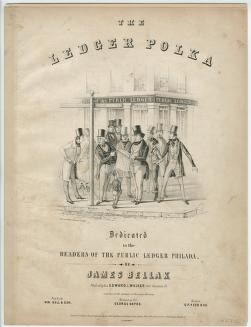
The Ledger Polka.
Unknown artist
- Source:
- Library of Congress
- Rights:
- Public domain — free to use, share and adapt.
- Recorded as:
- Public Domain
The polka was one of the first dances to achieve truly international popularity through a combination of musical publication, visual advertising, and commercial dance halls—a pattern that would define dance culture into the modern age. This print is a primary source for understanding how the dance looked in performance and how it was marketed to the middle-class public as a fashionable leisure activity.
What you are looking at
A bustling indoor ballroom or public dance hall, depicted in this engraving titled *The Ledger Polka*. The venue appears to be a covered structure with a decorative roof supported by columns; gas lamps or chandeliers illuminate the space. A crowd of well-dressed figures fills the foreground and middle ground—men in dark coats and top hats, women in full skirts typical of the 1840s. In the center, several couples are visibly dancing, while others stand in groups conversing or observing. The perspective draws the eye toward the back of the hall where additional dancers and spectators cluster. The overall composition captures the social energy and mingling of a mid-19th-century public dance occasion, with the polka clearly establishing itself as a fashionable social form.
The dancing
The dancers visible in the composition adopt the closed ballroom position characteristic of couple dancing: partners face one another with hands joined, maintaining an upright frame. The women wear full skirts that extend to the ankle, their narrow waists emphasized by the cut of their dresses; their arms are positioned for the hold. The men stand taller in their formal dress, their posture erect and controlled. Several couples are captured mid-stride or turn, suggesting the quick, energetic tempo of the polka. The spectators and non-dancing figures stand in formal attitudes typical of the era, with men's arms at their sides or clasped, and women holding their skirts.
The dance depicted
This is a depiction of the polka, a Bohemian couple dance that became a sensation across Europe and North America in the 1840s. The title *The Ledger Polka* suggests either a specific musical composition associated with a business ledger or a popular polka named after a place or publication. The engraving celebrates the polka's role as a democratic, public social dance—not confined to aristocracy but danced by the middle classes in commercial dance halls and assembly rooms. The rapid, hopping character of the step, though frozen in the print, would have been known to contemporary viewers from experience and from the musical notation that typically accompanied such prints.
How it was made
This is a wood engraving or steel engraving, a technique allowing fine detail and mass reproduction. The print's crisp lines, careful cross-hatching for shadow and depth, and the decorative typography of the title indicate professional publication. The technique was ideal for distributing dance imagery to a broad public audience—sheet music covers, dance manuals, and popular prints all relied on engraving. Such prints could be hand-colored or left in black and white; this example appears to be an uncolored proof or print. The medium allowed the artist to capture both architectural setting and the specific gesture language of the dance with precision.
About this work
This engraving documents the polka at the height of its fashionable popularity, capturing a moment in the 1840s when this couple dance had become a defining social form across the Atlantic world. The print serves both as a record of how the dance was performed and as evidence of its reach into public, commercial venues beyond the court or aristocratic salon. It belongs in a history of dance imagery because it shows how the visual arts circulated knowledge of new dances and helped establish them as social markers of the era.
How to look at it
Look first at the architectural setting and crowd composition: this is a public, commercial space, not a private salon or court ball. Then examine the couples in motion: note the closed ballroom hold, the upright posture, and the way the women's skirts are drawn mid-movement. The engraver has frozen the moment mid-step, suggesting the quick, hopping action of the polka rhythm. Observe how the artist distinguishes the dancers from the spectators—the dancers occupy the open floor while the observers cluster at the margins, a spatial logic that tells us how these occasions were actually organized.
The period
The 1840s saw the emergence of the polka as the dominant social dance across Europe and North America, displacing the waltz in popular favor. Bohemian in origin, it arrived in Paris around 1840 and spread rapidly through sheet music, dance instruction manuals, and vivid accounts in newspapers and illustrated periodicals. The dance's energetic character and accessibility to non-professional dancers made it ideal for commercial dance halls and public assemblies—new venues of the industrial era where the middle classes gathered. Engraved prints like this one were published in large numbers to capitalize on the craze, often tipped into sheet music or sold as standalone illustrations.
Where it lives
The work is held by the Library of Congress and derives from their collections of American prints and popular engravings of the nineteenth century. It is catalogued as a popular print, likely published as a standalone sheet or tipped into sheet music, and reflects the commercial print culture through which dance fashions were circulated to the public.
Dance in this work
Questions about this work
What is the polka and why was everyone dancing it in the 1840s?
The polka is a lively couple dance in 2/4 time that originated in Bohemia. It swept Europe and America in the 1840s because it was exciting, accessible to amateurs, and marked fashionable modernity. Unlike the waltz, which required some training, the polka felt fresh and democratic—anyone could learn it, and the commercial dance halls made it available to the middle classes rather than just the elite.
How does an engraving like this get made and circulated?
An engraver would sketch the scene and then painstakingly incise lines and cross-hatching into a steel or wood block. The resulting plate could be inked and printed hundreds or thousands of times. These prints were sold as standalone sheets, tipped into sheet music, or bound into illustrated periodicals. They served both as advertising for the dance craze and as a way for people who had not seen the polka to visualize it.
Can I tell from this print exactly how to dance the polka?
You can see the frame, the closed hold, and the upright carriage—enough to understand the basics. For the exact footwork and the characteristic hop and accent, you would need the music or a written dance manual. But the engraving shows you what a ballroom full of polka dancers looked like in 1849, which is valuable information no text alone can provide.
More dance artwork





