49 works in this view — arrow keys or swipe to move between them.
Dance in Art · 1978
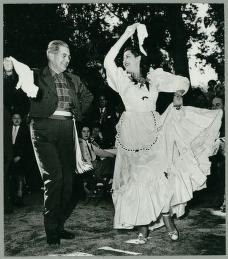
Dancing Zamba, Argentina.
Unknown artist
- Source:
- Library of Congress
- Rights:
- Public domain — free to use, share and adapt.
- Recorded as:
- Public Domain
Zamba is a foundational Argentine folk dance whose presence in visual documentation from the 1970s helps establish both its continued vitality and its codified movement vocabulary at a particular moment in time. The photograph is evidence of how regional Argentine dances maintained their social and aesthetic function in the late twentieth century, and it provides material for comparison with earlier and later representations of the form.
What you are looking at
A black-and-white photograph captures two dancers in a moment of zamba, the folk dance of northwestern Argentina. The man, positioned to the left, wears dark trousers and a light-colored shirt, his posture upright and attentive. The woman to the right is dressed in a full white or cream skirt with a fitted bodice, her arms raised gracefully above her head, the fabric of her skirt caught mid-swirl, creating visible volume and movement. Both dancers face slightly away from the camera, creating a sense of intimate performance. The setting appears to be outdoors or in a naturally lit interior space, with foliage or trees visible in the soft, diffused background. The photograph is dated 1978, placing it in the late twentieth century.
The dancing
The woman's raised arms and lifted shoulders suggest an upward, expansive upper body, characteristic of courtship dances. Her skirt is mid-twirl, indicating rapid lower-body rotation or a deliberate turn, the fullness of the fabric emphasizing the movement. The man's posture is more grounded and controlled, his frame erect but not rigid, positioned to observe or respond to his partner's movement. The spatial relationship between them—close but not in a locked hold—is typical of zamba's playful, flirtatious dynamic where partners move in proximity but retain individual mobility.
The dance depicted
Zamba is a traditional partner dance of Argentina, popular especially in the provinces of the northwest (Jujuy, Salta, Tucumán, and Catamarca). It is a courtship dance performed to music in 6/8 time, characterized by rhythmic footwork, body rotation, and a playful, teasing dynamic between partners. The woman typically wears a full skirt that becomes part of the visual vocabulary of the dance—swirling, lifting, and held as a prop. The man follows and responds to the woman's movements. This photograph captures a moment of the woman's dominant, flirtatious turn, with the skirt as the primary visual element of the choreography, which is consistent with how zamba is documented in mid-twentieth-century Argentine folk dance practice.
How it was made
This is a black-and-white photograph, most likely a gelatin silver print or similar mid-century photographic process. The soft, natural lighting and the slight graininess visible in the image are consistent with documentary photography of the 1970s. The photographer has chosen a close, intimate framing that emphasizes the dancers' bodies and clothing rather than a full spatial context, which focuses attention on the quality of movement and the relationship between the performers. The image was likely produced for documentary or journalistic purposes, part of the Library of Congress folk culture or cultural documentation efforts.
About this work
This photograph documents zamba, one of Argentina's most important regional folk dances, frozen at a moment that captures its essential aesthetic: the woman's control of her swirling skirt, the man's responsive presence, and the courtship tension between them. Dating to 1978, it is a record of how zamba was being danced and transmitted in late-twentieth-century Argentina, when the dance remained vital in regional celebrations and family gatherings. The image is valuable precisely because it captures a specific moment of folk practice—not a staged theatrical production, but a living dance—and it shows the centrality of the woman's costuming and movement quality to the form.
How to look at it
Attend to the woman's control and confidence in the moment of the turn: her raised arms and the way her body is rotated suggest not a passive partner but an active choreographer of the moment. The skirt is not incidental—it is central to zamba's visual language, and the photographer has caught it at peak expansion, which would be the intended effect in performance. Notice the man's positioning and gaze; he is not leading but rather following and responding, which inverts the conventional hierarchy of partnership dances familiar to ballroom contexts. The moment chosen is one of display and pleasure in movement, not effort or strain.
The period
In 1978, zamba was recognized as a national cultural heritage form in Argentina, though it remained primarily practiced in the northwestern provinces and at folk festivals. This photograph dates to a period when ethnographic and folk documentation was increasing internationally, driven by UNESCO initiatives and national cultural preservation efforts. Argentine folk dances, including zamba, were being systematized, taught in dance schools, and increasingly featured in folklórico ensembles that performed both nationally and internationally. The image reflects the documentary impulse of mid-1970s cultural institutions to record folk practices before they might disappear or transform further.
Where it lives
The photograph is held by the Library of Congress, sourced from their American Folklife Center or related cultural documentation collections. The image represents the type of documentary photograph produced as part of systematic efforts to record and preserve folk practices from around the world.
Dance in this work
Questions about this work
What is zamba and where is it from?
Zamba is a traditional partner courtship dance from northwestern Argentina, particularly Jujuy, Salta, Tucumán, and Catamarca. It is performed to music in 6/8 time and is characterized by rhythmic footwork, body rotation, and a playful dynamic between dancers. The woman's full skirt is essential to the dance, serving as both costume and choreographic tool.
How does zamba differ from tango?
While both are Argentine dances, zamba and tango are distinct forms from different regions and social contexts. Zamba is a folk dance from the provinces with roots in Spanish and indigenous traditions, performed in 6/8 time with a more upright posture and emphasizing the woman's movement and skirt. Tango is an urban dance that developed in Buenos Aires in 4/4 time, performed in a close embrace with a more dramatic, melancholic character.
Why is the woman's skirt so important in zamba?
In zamba, the woman's full skirt becomes a visual and kinetic element of the choreography. The dancer deliberately swirls and lifts it as part of the dance vocabulary, creating a striking visual effect that emphasizes the rotational movements of the body. The skirt also allows for freedom of movement in the hips and legs, supporting the rapid footwork and turns that characterize the form.
When was this photograph taken and why?
The photograph dates to 1978 and was produced as part of the Library of Congress's cultural documentation efforts. The late 1970s saw increased interest in recording folk practices globally before they might transform or disappear. This image is part of that systematic documentation of Argentine regional dance traditions.
More dance artwork





