49 works in this view — arrow keys or swipe to move between them.
Dance in Art · 1911
Life is like a dance
Unknown artist
- Source:
- Library of Congress
- Rights:
- Public domain — free to use, share and adapt.
- Recorded as:
- Public Domain
The print reveals how dance metaphors extended beyond theatre and ballroom into sport and popular culture in the early 1900s. It documents a moment when equestrianism was celebrated as a graceful, almost balletic discipline—a shift in how physical excellence was perceived and gendered. The connection between movement forms—equestrian, choreographic, athletic—makes this a valuable artifact of how 'dance' functioned as an ideal of controlled, aesthetic motion in the early modern period.
What you are looking at
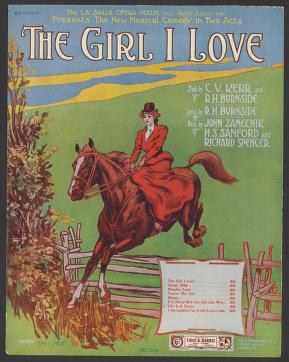
A woman in a brilliant scarlet riding habit sits sidesaddle on a chestnut horse, frozen mid-jump over a low wooden fence. The horse is captured at the apex of its leap, forelegs tucked and hindquarters extended, while the rider maintains an elegant, composed frame—spine straight, one arm extended forward along the horse's neck, the other held at her side. The landscape behind is stylised: pale green fields under a golden-yellow sky suggest late afternoon light, with ornamental trees flanking the composition. The fence in the foreground is rendered in muted browns and greens. The woman's scarlet coat is the visual anchor of the image, a brilliant accent against the soft pastels of the background. This is an action portrait, not a narrative scene—the focus is entirely on the moment of equestrian skill and the controlled grace of the rider.
The dancing
The woman's body is the sole human figure, positioned in the classical sidesaddle seat: both legs angled to the left, upper body squared toward the viewer, head level and gaze directed forward with composure. Her right arm extends along the horse's neck in a line of connection and balance; her left arm is held quietly at her side. The pose conveys complete control even at the moment of greatest effort. Her weight is anchored through her seat and legs despite the horse's powerful movement beneath her. The scarlet coat, fitted at the waist and falling in controlled folds, emphasises the formality and discipline of the discipline.
The dance depicted
This is not a representation of dance in the conventional sense, but rather of equestrianism—specifically, the formal sport of show jumping or hunting as practiced by the upper classes in the early 20th century. However, the image is titled 'Life is like a dance,' which invites a metaphorical reading: the woman's composed, rhythmic control of her mount, the balance and timing required, and the aesthetic grace of the moment all align with dance vocabulary. The print may represent an allegorical or sentimental association between equestrian skill and the metaphorical 'dance' of life. The posture and frame are performative in nature—this is movement designed to be seen and admired. Equestrian exhibitions were indeed social spectacles in this era, combining sport with display.
How it was made
The work is a colour lithograph or chromolithograph, as indicated by the soft-edged registration, the subtle gradient washes of colour, and the warm tone of the cream stock. Lithography allowed for rapid, economical production and mass circulation; the bright inks and flattened perspective are characteristic of the medium. The technique was widely used for theatrical posters, popular prints, and sheet-music covers in the early 1900s. The text at the top—visible as a title banner—and the publisher's mark (visible at lower right) confirm this is a commercial print, likely issued as a souvenir, advertisement, or song illustration rather than as fine art.
About this work
This is a chromolithographic print from 1911 depicting a woman on horseback executing a jump in elegant sidesaddle form. The work combines sporting subject matter with allegorical language—the title 'Life is like a dance' frames equestrian performance as a metaphor for life's rhythms and grace. The image belongs in a gallery of dance in art not because it depicts literal dance, but because it uses the visual and conceptual language of dance—balance, control, aesthetic display, and the coordination of body and music-like timing—to celebrate a moment of human grace. The work captures the early 20th-century fascination with female athleticism and the aesthetics of refined movement in sport.
How to look at it
Focus on the woman's posture and composure at the moment of maximum movement: the horse is at full stretch, yet the rider's body remains vertical and controlled. Notice how the scarlet coat acts as a visual anchor, drawing the eye to the stability of the human figure amid animal energy. The soft, almost dreamlike landscape suggests that this is not a documentary image of a specific hunt or event, but an idealised portrait of a moment—which is why the allegorical title rings true. The artist has chosen to freeze the instant of effort in a way that emphasises grace rather than strain.
The artist
The artist is not recorded in the catalogue. The print is clearly a commercial product: the presence of text, publisher information, and the chromolithographic technique all indicate this was a mass-produced popular print, possibly tied to theatrical promotion, a song, or a sporting publication. Such prints were usually created by studios or commercial artists rather than signed fine artists; attribution would require research into the publisher's archive and the specific context of the print's issue.
The period
In 1911, equestrianism was undergoing a transformation in Western culture. The horse was transitioning from a necessity to a luxury and sport; riding, especially for women, was increasingly codified as an elegant accomplishment rather than mere utility. The same period saw the emergence of the female dancer as a public spectacle (the Ballets Russes debuted in 1909), and there was broader cultural fascination with the aesthetics of female movement and athleticism. The allegorical title 'Life is like a dance' reflects the period's Romantic and early Modernist tendency to treat movement—whether balletic, equestrian, or athletic—as a metaphor for grace, control, and the conduct of life.
Where it lives
The print is recorded as sourced from the Library of Congress. It is a commercial chromolithograph, likely one of many thousands produced and distributed in the early 1900s for popular consumption—as sheet-music cover art, theatrical advertising, or sporting publication. No individual artist, publisher, or accession details are recorded in the catalogue consulted.
Questions about this work
Why is a picture of horse-jumping in a dance gallery?
The work uses the metaphor of dance—balance, grace, perfect timing—to describe equestrianism. The title 'Life is like a dance' invites us to see athletic and aesthetic movement across different domains. In the early 1900s, both dance and equestrianism were understood as refined arts requiring control and beauty. The print belongs here because it explores how 'dance' functions as an ideal of elegant, coordinated human movement, not because it depicts literal choreography.
Who is the woman riding the horse?
She is not identified in the catalogue. She appears to be a type or ideal—'the accomplished horsewoman'—rather than a portrait of a specific person. The print was likely commercial and aimed at a broad audience. Her identity, if she was a known figure, would require research into the original context of publication.
What does 'sidesaddle' mean?
Sidesaddle is a style of riding in which both of the rider's legs rest on the same side of the horse, usually the left. It was the formal, socially prescribed way for women to ride from the medieval period until well into the 20th century. It required considerable skill and balance, as the rider's weight was asymmetrical. The sidesaddle became associated with elegance, propriety, and refined femininity—qualities this print celebrates.
When did this print come out, and how do we know?
The catalogue records it as 1911. The chromolithographic technique, the style of dress, the pale colour palette, and the typography all confirm a date in the early 1910s. The print was likely produced for mass circulation—possibly in connection with a theatrical production, a song, or a sporting or women's magazine of the period.
More dance artwork





