49 works in this view — arrow keys or swipe to move between them.
Dance in Art · 1912
Temperamental dances
Unknown artist
- Source:
- Library of Congress
- Rights:
- Public domain — free to use, share and adapt.
- Recorded as:
- Public Domain
For historians of early-twentieth-century dance and theatre, this object is evidence of how commercial dance entertainment—particularly women performers—was visualized and packaged for mass consumption. The emphasis on the performer's face and title rather than on choreography or technique reflects the star system and the personality-driven marketing of Edwardian theatre, in which 'temperament' and charisma mattered as much as skill.
What you are looking at
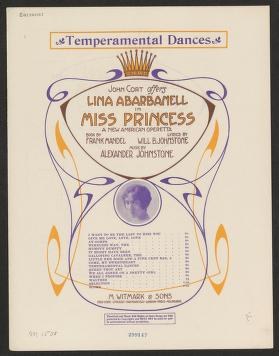
This is a decorative title page or poster for a theatrical production titled *Temperamental Dances*, from 1912. A crowned woman's head in profile occupies the central medallion, rendered in soft purple tones. The composition frames this portrait within an Art Nouveau border of elegant curves, stylized flames in orange and gold at the corners, and ornamental flourishes in purple and gold. The word "Miss Princess" appears prominently below the crown, with credits listing "John Cecil Carr" at the top and references to cast and production team below. The overall design is symmetrical and highly decorative, typical of Edwardian theatrical printing. The text is integrated into the design rather than simply overlaid, suggesting this is a carefully composed advertising or programme cover for a stage production.
The dancing
Only a single head is depicted—that of a woman shown in profile, wearing a crown. There is no visible body, dance posture, or movement; the head is static and iconic rather than active. This is a portrait, not a depiction of dancing bodies in motion.
The dance depicted
The title *Temperamental Dances* and the character name *Miss Princess* suggest this is promotional material for a theatrical dance production, likely a music hall or variety show from the Edwardian era. The absence of any depiction of actual dancing—only a portrait head and the word "Temperamental"—means the image itself does not show us what the dances looked like, their style, hold, or technique. The material appears to advertise the star performer rather than document the choreography or movement vocabulary.
How it was made
This is a lithographic print, evident from the soft blending of colors, the way the purples and golds are laid down in flat planes with gentle gradations, and the quality of the line work. The medium's capacity for bold graphic design and colour separation made it ideal for theatrical advertising in the early 1900s. Lithography allowed for rapid, affordable production of posters and programmes that could be distributed widely, suggesting this was a commercial entertainment aimed at a substantial paying audience.
About this work
This is a theatrical programme cover or poster for a 1912 stage production called *Temperamental Dances*, featuring a performer known as Miss Princess. It is an object of theatrical ephemera—the kind of printed advertisement and programme material that circulated in music halls and theatres of the Edwardian era. Although the title promises dances, the image itself is a decorative portrait and does not document the actual dance material; it is instead a window onto how dance entertainment was marketed to the public and how theatrical performers were promoted through glamorous, stylized portraiture. The work belongs in a gallery of dance imagery because it shows how dance was sold, framed, and made desirable in early-twentieth-century popular theatre.
How to look at it
Attend to the programme's design strategy: the name and crown at the center, the decorative border, and the absence of any choreographic or movement information. This is not a record of what the dances looked like, but rather a statement that a famous performer will be on stage. The soft, flattering portrait and the ornamental frame were designed to intrigue a potential theatregoer and associate the show with luxury and glamour. The visual language is about personality and prestige, not technique.
The artist
The artist is not recorded in the catalogue. The credits visible on the programme cite "John Cecil Carr" at the top, but it is unclear whether this refers to the producer, director, composer, or another role. The lithographic technique and design sensibility are consistent with London or European theatrical printing of the period, but without further documentation, the maker of the visual design cannot be identified.
The period
In 1912, theatrical dance in Britain existed largely in the music hall, pantomime, and variety contexts rather than in classical ballet (which was still establishing itself through the Ballets Russes and other imported companies). 'Temperamental Dances' likely refers to character dances or solo turns performed by a featured female entertainer. The Art Nouveau ornament and the emphasis on the performer's beauty reflect the visual vocabulary of commercial theatre advertising of the period, in which posters and programmes were designed to appeal to a mass audience and sell tickets through the appeal of a named star.
Where it lives
This is held in the Library of Congress. It is a lithographic programme or poster for a commercial theatrical production in Britain or America circa 1912.
Questions about this work
What does 'Temperamental Dances' mean?
In early-twentieth-century theatrical parlance, 'temperamental' usually referred to character or personality-driven performance—dances that displayed emotion, mood, and the performer's individual style rather than formal, technical choreography. It likely indicates a solo or featured turn by a female performer in a music-hall or variety-theatre context.
Who was Miss Princess?
The catalogue record does not identify the performer. Stage names like 'Miss Princess' were common in Edwardian music hall, and the same performer might have been billed under different names in different venues or on different occasions. Further research would be needed to connect this name to a specific historical performer.
Is this a poster or a programme cover?
It could be either, or both. The design and format suggest it served as a cover for a printed theatre programme, but lithographic posters of the same design would have been produced for public display. The Library of Congress often acquires such objects as examples of graphic design and theatrical history.
What can this image tell us about the dances themselves?
Very little. The image is promotional material, not choreographic documentation. It tells us that the show was marketed on the strength of the performer's personality and glamour, that the dances were likely solo or featured turns in a variety-theatre context, and that the production had access to good lithographic printing. To understand what the actual dances looked like, you would need to consult reviews, playbills with cast lists, or other period sources.
More dance artwork





