49 works in this view — arrow keys or swipe to move between them.
Dance in Art · 1912
Dancing man
Unknown artist
- Source:
- Library of Congress
- Rights:
- Public domain — free to use, share and adapt.
- Recorded as:
- Public Domain
The poster documents an important moment in American musical theatre when dance was central to Broadway comedy but was marketed primarily through the celebrity and faces of performers rather than through representations of movement or choreography. It shows how theatrical dance was consumed by the early-twentieth-century public and what advertising strategies producers used to fill seats. For dance historians, it is evidence of the industrial and commercial apparatus surrounding stage dance in this era.
What you are looking at
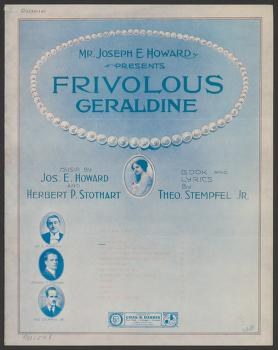
This is a theatrical poster or cover for a 1912 production titled 'Frivolous Geraldine,' presented by Mr. Joseph E. Howard. The design centers on an elegant pearl or beaded oval frame containing the title in blue lettering against a pale blue background. Below the oval are four circular photographic portraits arranged vertically—headshots of what appear to be principal performers in the production. The layout is symmetrical and formal, with decorative beading forming a border that suggests luxury and theatrical glamour. The overall composition is that of promotional material for a stage production, with the photographs serving to advertise the cast to potential audiences. The color palette is restrained: pale blue, white, and black-and-white photography, giving the piece a refined, early-twentieth-century theatrical aesthetic.
The dancing
Four performers are shown in individual head-and-shoulders portraits arranged in a vertical column. Each photograph captures a static pose rather than dance movement—they are studio portraits of the type used for theatrical promotion. The subjects wear theatrical costume or styling typical of the Edwardian era, though individual costume details are difficult to discern in these small black-and-white images. No gesture, hold, frame, or footwork is visible; these are advertising portraits, not action photographs.
The dance depicted
The title 'Frivolous Geraldine' and the Edwardian theatrical context suggest this was a musical comedy or musical theatre production of the early 1910s. The presence of a composer credit (Joseph E. Howard was a notable musical-theatre composer of the era) and the four lead performers indicates this was likely a song-and-dance comedy rather than ballet or concert dance. However, the poster itself provides no evidence of specific dance styles, choreography, or movement. It is promotional material rather than a depiction of dance in action.
How it was made
This is a printed theatrical poster, most likely a lithograph or chromolithograph typical of early-twentieth-century theatrical promotion. The design uses photographic reproduction for the portraits—a relatively new technique that allowed theatrical producers to advertise the actual faces of performers. The printing technique allowed for mass production and wide distribution of the poster in newspapers, theatres, and public spaces. The combination of decorative typographic design with photographic reproduction was a hallmark of Art Nouveau and early modernist theatrical publicity.
About this work
This is a 1912 theatrical poster for the musical comedy 'Frivolous Geraldine,' presented by composer and producer Joseph E. Howard. It is a work of theatrical promotion rather than a direct representation of dance, but it documents the advertising and casting practices of early-twentieth-century American musical theatre. The poster exemplifies how dance and musical comedy productions were marketed to the public: through the celebrity of lead performers, whose faces were reproduced in photographic form and circulated widely. The restraint and elegance of the design—the beaded oval frame, the pale blue palette, the formal arrangement—reflects the refined theatrical culture of the Gilded Age and early twentieth century. This is an artifact of theatre history and commercial art as much as of dance history.
How to look at it
Read this as promotional material, not as a depiction of dance in action. The interest lies not in movement but in the theatrical brand and the celebrity of the performers. Notice the formal, restrained design: the beaded frame signals luxury and theatrical refinement, while the pale blue background conveys elegance without distraction. The four portraits are of equal size and importance, suggesting an ensemble production rather than a star vehicle. The typography is art nouveau—notice the elongated, flowing letterforms in the title and the careful kerning and spacing. This is a document of how theatrical producers packaged and sold entertainment to the public in the 1910s.
The artist
The poster credits Joseph E. Howard as the presenter. Howard (1867–1943) was a major American composer, lyricist, and theatrical producer who dominated musical comedy on Broadway in the 1900s and 1910s. He composed the music and often co-wrote the librettos for dozens of musical comedies, and was known for integrating popular songs and dance into his productions. He was a central figure in the development of American musical theatre as a commercial entertainment form. The poster does not credit a designer or artist; the design and layout are the work of theatrical printing firms of the era.
The period
In 1912, American musical comedy was at its height. The form—a mixture of popular song, comedy sketching, and dance—had evolved from minstrelsy and vaudeville into a dominant form of Broadway theatre. Producers like Howard, George M. Cohan, and the Shubert brothers were manufacturing hit productions at high volume, and dance was a standard part of the appeal. The Edwardian era celebrated physical beauty, elegance, and the allure of the stage performer, especially the female performer. Theatre photography and theatrical portraiture were booming industries; the faces of stars were as marketable as their talent. This was also the moment when chromolithographic colour printing was at its technical peak, allowing for the production of vivid, detailed theatrical posters at scale.
Where it lives
This object is held in the Library of Congress and catalogued as a theatrical poster from 1912. It is one of many thousands of theatrical posters and prints held in the Library's Prints and Photographs Online Catalog, documenting American theatrical production and advertising practice.
Questions about this work
Why is this a dance artwork if it shows no one dancing?
This is a theatrical poster for a musical comedy production in which dance was performed on stage. While the poster itself does not depict movement, it is a primary artifact of the commercial and cultural context in which early-twentieth-century theatrical dance was made, performed, and consumed. It documents how dance was marketed and what cultural work it did in American theatre and entertainment.
Who were these four performers?
The poster credits Joseph E. Howard but does not identify the other performers by name. Theatre records of the era would list the cast, but that information is not visible on the poster itself and would require consultation of contemporary theatre programs or newspapers.
What is Joseph E. Howard known for?
Joseph E. Howard (1867–1943) was one of the most prolific composers of American musical comedy in the early twentieth century. He wrote the music for dozens of Broadway shows and was instrumental in developing the form of the musical comedy—a blend of popular song, comedy, and dance. He was a contemporary and rival of George M. Cohan and dominated Broadway in the 1900s and 1910s.
What happened to 'Frivolous Geraldine'?
This specific production has left little trace in theatrical records. It was one of hundreds of musical comedies produced in the early 1910s, most of which closed after a run of weeks or months and were never revived. The poster is now more famous than the production.
More dance artwork





