49 works in this view — arrow keys or swipe to move between them.
Dance in Art · 1894
Illustrated portfolio of artistic dancing
Unknown artist
- Source:
- Library of Congress
- Rights:
- Public domain — free to use, share and adapt.
- Recorded as:
- Public Domain
This object documents the professionalization and public presentation of dance outside major theatrical centers, and the gender dynamics of that process—a named woman practitioner positioned as the subject of artistic attention and documentation. It shows how dance was marketed and celebrated in the 1890s American West, and registers the influence of European Art Nouveau aesthetics on regional cultural life.
What you are looking at
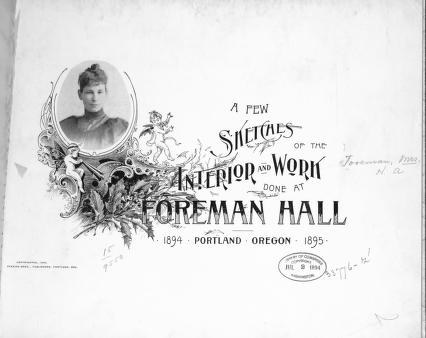
This is a decorative portfolio cover or title page for a collection of artistic dance imagery, printed in 1894 in Portland, Oregon. The composition centers on a portrait photograph of a young woman with an upswept Edwardian hairstyle, positioned in an oval frame at top left. She wears a high-necked dark dress typical of the 1890s. The surrounding design is a dense, ornamental arrangement of allegorical and naturalistic elements in the Art Nouveau style: flowing ribbons, peacock feathers, roses, cherubs, and scrollwork create an elaborate frame around the central portrait. The title "A Few Sketches of the Interior of Work Done at Foreman Hall" is inscribed in decorative typography across the center and lower portion. The date "1894 Portland, Oregon 1895" appears at bottom. The overall effect is theatrical and aspirational, suggesting this portfolio documented performances or dance instruction at a specific venue.
The dancing
The portrait shows a single female subject facing forward, head turned slightly, with the composed expression and formal bearing typical of late 19th-century photographic portraiture. No active dancing body is visible—the figure is static and posed. The decorative elements surrounding her are not bodies in motion but ornamental motifs drawn from nature and mythological tradition.
The dance depicted
The image itself does not depict dance movement or dancers in action. However, the title explicitly references "sketches of the interior of work done at Foreman Hall," suggesting this portfolio documents dance or theatrical performances that took place at that venue. The elaborate, ornamental frame and the subject's formal dress indicate that the contents aimed to celebrate artistic or theatrical practice of some distinction. Without seeing the interior pages, we cannot determine which dance forms were included, though the period and setting suggest a mixture of theatrical, ballroom, and possibly folk or character dances popular in the 1890s Pacific Northwest.
How it was made
This is a printed portfolio cover, likely a lithograph or photomechanical reproduction combining photography (the central portrait) with engraved or lithographed decorative borders. The mixed technique—photograph within ornamental printing—was typical of high-end performance documentation and promotional materials of the 1890s. This method allowed both the fidelity of photographic portraiture and the artistic elaboration of printed ornament, and suggests a production aimed at a paying or cultured audience rather than mass distribution.
About this work
This is the cover or title page of a portfolio documenting dance and theatrical work from Foreman Hall in Portland, Oregon, dated 1894–1895. It belongs to a documented moment when theatrical dance and "artistic dancing" were being promoted as legitimate cultural practice in the American West. The portfolio's emphasis on a named venue and a specific female practitioner, combined with the Art Nouveau elaboration of the design, signals ambitions to raise the status of dance as an art form worthy of publication and preservation. The work sits at the intersection of photographic portraiture, theatrical promotion, and the emerging aesthetic of modern dance.
How to look at it
Attend to the formal portrait photography at the center: the careful lighting, hairstyle, and dress speak to the status of the subject and the ambitions of the documentation. The ornamental frame surrounding it—with its peacock feathers, roses, and mythological references—elevates the portrait from routine documentation to artistic celebration, following conventions of theatrical and musical portraiture of the period. The careful placement of the venue name and dates creates a sense of official record-keeping and institutional legitimacy.
The artist
Unknown. The portfolio was printed in Portland, Oregon in 1894–1895, but no artist or publisher is named on the visible portion of the cover. The Art Nouveau ornamental style suggests exposure to contemporary European design idioms, either through training, publication, or local aesthetic influence.
The period
The 1890s saw a wave of interest in "artistic dancing" and theatrical performance across the United States, distinct from both popular ballroom dance and the emerging classical ballet tradition. The era coincided with Art Nouveau's international ascendancy and with new technologies of photomechanical printing that made high-quality illustrated portfolios economically feasible. Portland in the 1890s was an ambitious cultural center with theatrical venues and touring performers. The documentation of named practitioners and specific locations reflects the professionalization of performance and the growing prestige of dance as a subject worthy of preservation.
Where it lives
The work is held by the Library of Congress. It is catalogued as part of their collections but specific accession details are not provided in the record.
Questions about this work
What is Foreman Hall?
The record does not identify Foreman Hall beyond its location in Portland, Oregon. It was evidently a theatrical or performance venue of some note in the 1890s, but further historical information is not available from this object alone.
Is this a photograph or a print?
It is a printed portfolio cover combining photographic and printed elements. The central portrait appears to be a photograph, while the ornamental border is engraved or lithographed. This mixed technique was standard for promotional and documentary materials of the period.
What kind of dancing would have been performed at Foreman Hall?
The portfolio title does not specify. The 1890s was a period of diverse theatrical and social dance practice in America. The artistic ambitions signaled by the elaborate design suggest aspirations toward 'high' forms—possibly ballet, character dance, or theatrical interpretive forms—though ballroom and folk traditions may also have featured.
More dance artwork





