49 works in this view — arrow keys or swipe to move between them.
Dance in Art · 1871
Annie's Quadrilles
Unknown artist
- Source:
- Library of Congress
- Rights:
- Public domain — free to use, share and adapt.
- Recorded as:
- Public Domain
The quadrille was the democratic successor to the courtly dances of the 18th century, and by 1871 it was codified and mass-produced. This print shows how dance was commodified in the 19th century—specific choreographies were named, published, and circulated to thousands of dance studios and ballrooms. The formal geometric hold and the architectural composition of this engraving reveal the mathematical precision and social ritual at the heart of the quadrille.
What you are looking at
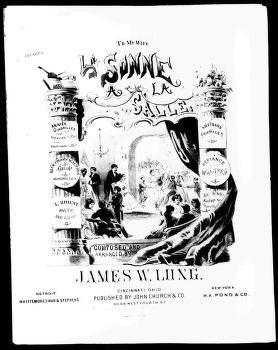
This is a wood engraving of a ballroom quadrille, densely populated with figures arranged in multiple scenes across the compositional space. The central focus shows couples in formal dress executing the figures of the dance, the women in full skirts of the period, the men in tailcoats. The composition is architectural and theatrical: paired columns frame the action, and figures are stacked and arranged to show multiple moments or groups within the same quadrille. The top of the image carries a banner with the title "Annie's Quadrilles" in decorative lettering. The lower register shows spectators and musicians, establishing this as a social ballroom scene rather than a stage performance. The entire composition is rendered in fine black lines on white paper, typical of commercial wood-engraved dance prints of the Gilded Age.
The dancing
The couples visible in the central section are in the closed ballroom hold standard to the quadrille: partners face each other in pairs, the woman's right hand on the man's shoulder, his left hand at her waist, free hands joined. The women's bodies are corseted and upright, their full skirts marked with parallel lines to suggest volume and movement. The men stand tall in tailcoats. The spacing and repetition of these pairs suggests the geometric precision of quadrille formation—couples arranged in a square or rectangular set, with the interlocking arm positions and frame that the dance demands. The engraver has captured multiple phases or groups to show the social pattern of the dance rather than a single frozen moment.
The dance depicted
This is a quadrille, the dominant social dance of the 19th century, here depicted in what appears to be a named variant called 'Annie's Quadrilles'—likely a published sequence of quadrille figures attributed to or popularized by a dancer or choreographer named Annie. The quadrille was a formal set dance for four couples arranged in a square, consisting of five figures: the first couple would begin, others would join in a prescribed sequence of chassés, turns, promenades, and reversals. From the title and the composition, this appears to be a commercial print advertising or commemorating a specific choreography, possibly from a dancing master's studio or a published instruction manual. The dress and density of figures confirms the date as mid-to-late 19th century.
How it was made
This is a wood engraving, a technique in which a design is cut into the endgrain of a hardwood block (typically boxwood), with lines cut away to leave ink-bearing ridges. The fineness of the lines, the ornamental hatching, and the complexity of the composition visible here are characteristic of commercial wood engraving of the 1860s–1880s. Wood engravings were relief-printed and could be printed in large editions and distributed widely; they were the standard medium for illustrated newspapers, song sheets, dance manuals, and promotional prints. The ornamental border, the title banner, and the theatrical framing visible here suggest this was a song sheet cover or a stand-alone print for sale or distribution to dancing teachers.
About this work
This is a mid-Victorian-era wood engraving promoting or commemorating 'Annie's Quadrilles,' a specific choreography of the quadrille—the most fashionable social dance of the 19th century. The composition shows multiple couples in formal ballroom dress executing the dance in geometric formation, with spectators and musicians arranged in the lower register. As a wood engraving, it would have been widely circulated and relatively inexpensive, serving both as advertisement and as visual instruction for dancers learning the particular steps of this variant. The work documents not only the choreography and costume of the quadrille but also its place in commercial popular culture: dance sequences were published, named after their choreographers, and sold as commodities to a mass ballroom audience.
How to look at it
Observe the repetition of the coupled figures and the geometric framing: the columns and architectural elements divide the composition into regular sections, each containing a pair or a group of couples in the formal hold. The engraver has used parallel lines and fine hatching to suggest the weight and fabric of the women's skirts and the formality of the men's dress. Notice also the integration of the musicians and spectators: this is not a stage performance but a social ballroom event, with attendants visible in the margins. The title and decorative banners suggest this is a commercial print, likely a song sheet or advertisement designed to promote a specific sequence of figures to paying students and curious dancers.
The period
The quadrille originated in France in the early 18th century and became the dominant social dance across Europe and America by the 1840s. Unlike the waltz, which required couples to embrace closely and move continuously around the room, the quadrille was a set dance for four couples arranged in a square, with prescribed figures, clear hierarchies of leadership, and frequent changes of partner and position. This made it suitable for mixed-gender social groups and less threatening to Victorian propriety. By the 1860s and 1870s, when this print was made, the quadrille had become codified and standardized; dancing masters published their own variations and sequenced figures, which were given names and sold to students. The wood-engraved print was the ideal medium for disseminating these choreographies: cheap, clear, and suitable for use as sheet-music covers or instruction sheets. By 1900 the quadrille had begun to fade as the waltz and later the foxtrot took hold, but in 1871 it was still at the center of ballroom life.
Where it lives
The record indicates this work is held in the Library of Congress. It is catalogued as a historical print from 1871 and appears to be a single-sheet engraving, possibly the cover of a published dance instruction or song sheet. No publisher, printer, or artist is recorded.
Dance in this work
Questions about this work
What is a quadrille?
A quadrille is a set dance for four couples arranged in a square or rectangular formation. Each couple takes turns executing a series of choreographed figures—chassés, turns, reversals, and promenades—in a precise sequence. The dance originated in France and became the dominant social ballroom dance of the 19th century, favored for its formality, its mathematical precision, and the fact that it allowed dancers to change partners within the dance while maintaining clear social hierarchies. By the 1870s, dancing masters throughout Europe and America were publishing their own variations on the basic quadrille figures.
What does 'Annie's Quadrilles' mean?
The title suggests these are a specific sequence of quadrille figures choreographed by or popularized by a dancer named Annie. In the 19th century, it was common for dancing masters to create and name their own variations on standard dance forms and to publish and sell them to other studios and students. This print appears to be either a promotion for Annie's choreography or part of an instruction manual or song sheet collection designed to teach these particular figures.
Why were dance prints made and distributed?
Dance prints served multiple purposes: they were advertisements for dance studios and choreographers; they were instruction aids for students learning specific sequences; they were often printed as song-sheet covers for the music that accompanied the dance; and they were souvenirs of popular dances and ballroom fashion. Wood engraving made this distribution possible and affordable. A print like this could be mass-produced and sold inexpensively to dozens of dancing masters and ballrooms, spreading a particular choreography across an entire city or region.
More dance artwork





