49 works in this view — arrow keys or swipe to move between them.
Dance in Art · 1981
Dancing.
Unknown artist
- Source:
- Library of Congress
- Rights:
- Public domain — free to use, share and adapt.
- Recorded as:
- Public Domain
Maypole dances are a touchstone of folk revival and educational dance pedagogy, yet photographs that show them in actual motion are rare. This image captures the rotational geometry and embodied exuberance of the dance, making it valuable for understanding how the tradition was enacted and experienced. The photograph is also a document of twentieth-century community or institutional dance practices—evidence of who danced, when, and what aesthetic values were at stake.
What you are looking at
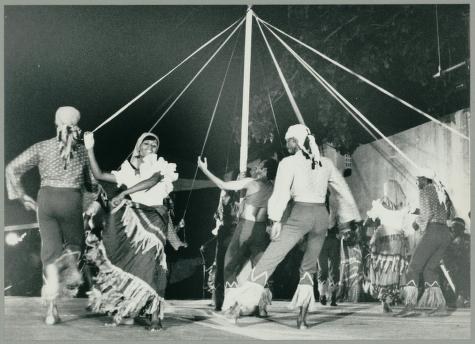
A maypole dance captured in a black-and-white photograph showing four dancers in motion around a central pole. The pole extends upward into darkness, its ropes radiating outward in a geometric starburst pattern. Three dancers in the foreground wear light-colored clothing—one in a patterned vest and trousers on the left, one in a white blouse and patterned skirt (her garment caught mid-swirl), and one on the right in a white shirt. A fourth figure is partially visible on the far right. The dancers' bodies are angled and bent, caught in the rotational movement of the dance, with the photographer's flash creating strong contrasts and sharp shadows across the ground. Additional figures appear in the background, suggesting this was a public or participatory event. The composition is low and dynamic, shot from near ground level, emphasizing the thrust of bodies and the geometric energy of the radiating ropes.
The dancing
The dancers' bodies are articulated in spiral and rotational positions characteristic of processional or circular group dances. The woman in the center-foreground leans sharply inward with her skirt flying outward—a moment of centrifugal tension. The other dancers bend at the waist and torso, their arms engaged with the ropes or extended for balance. The postures suggest vigorous, weight-committed movement rather than ballroom frame or classical placement. The spacing and configuration indicate this is a group dance where individual bodies orbit a fixed center point.
The dance depicted
This is a maypole dance, a folk tradition in which dancers circle a central pole wound with ribbons or ropes while holding the ends, traditionally performed at spring festivals and communal celebrations. The photograph documents the dance in action, showing the characteristic moment when dancers have begun their spiral and the centripetal geometry becomes visible. Maypole dancing has deep roots in European folk culture and was revived and reinvented throughout the 20th century in recreational, educational, and theatrical contexts. The informal costume and outdoor setting suggest either a community event or a theatrical/pedagogical restaging of the tradition.
How it was made
This is a black-and-white photograph, likely taken with flash or in controlled lighting conditions given the sharp contrast and the visibility of movement across all figures. The low angle and freeze-frame technique capture rotational energy that would be impossible to convey in a static drawing. The photograph's grain and contrast are consistent with mid-to-late twentieth-century documentary or event photography. This medium was ideal for capturing folk dance revival and educational dance programs of the period—photographs were used to record, publicize, and teach these practices.
About this work
This photograph documents a maypole dance—a centuries-old European folk tradition that experienced widespread revival in the early-to-mid twentieth century through schools, folk societies, and theatrical contexts. The image captures the characteristic moment of the dance in action, when the radiating ropes create a visual geometry of collective motion. The photograph is evidence of how folk dance was being performed, taught, and staged during the twentieth century, and it preserves a moment of kinaesthetic energy that still communicates the pleasure and communal participation central to the tradition.
How to look at it
Attend to the moment of rotation: the photographer has frozen the instant when the dancers' outward momentum and the inward pull of the ropes create maximum visual tension. The woman's skirt, caught mid-swirl, is the strongest evidence of speed and centrifugal force. Notice the geometry of the ropes radiating outward—the composition emphasizes the visual order that emerges from collective, circular motion. The low angle of the shot, looking up at the pole, gives the viewer a sense of participation and scale: we are positioned among or below the dancers rather than observing from a distance.
The period
The photograph dates to 1981, a period when folk dance revival was well established in schools, youth organizations, and cultural institutions throughout the English-speaking world. By the 1980s, maypole dancing was taught as a matter of course in primary schools in the UK and Commonwealth countries, often tied to May Day celebrations or seasonal festivals. At the same time, documentary and theatrical photographers were recording these practices as part of a broader interest in folk culture, ritual, and participatory performance. The informality of the costume and setting suggests this may have been a school or community event rather than a professional theatrical production.
Where it lives
The photograph is held by the Library of Congress and catalogued in their dance history collections. It is a documentary photograph, likely part of a broader archive of twentieth-century folk dance practice or performance.
Dance in this work
Questions about this work
What is a maypole dance?
A maypole dance is a traditional circle dance performed around a central pole wound with ribbons or ropes. Participants hold the ends of the ropes and dance around the pole in a pattern that weaves the ribbons together. The dance has medieval and pre-Christian roots in European spring fertility rituals and was revived as a folk tradition and educational practice in schools throughout the twentieth century.
Why was maypole dancing so popular in schools?
Maypole dancing was promoted by educators and dance pedagogues as a way to teach coordination, cooperation, and cultural history. It is choreographically simple but requires sustained group focus and provides immediate visual reward—the growing pattern of interwoven ribbons. By the mid-twentieth century, it was considered a wholesome, patrimonial practice and a safe entry point to folk dance for children.
Is this a professional performance or a school event?
The informal costume, outdoor setting, and mix of ages visible in the background suggest this is more likely a community or school event than a professional theatrical production. However, the photograph itself is a professional or semi-professional documentation, indicating that the event was considered worth recording and preserving.
More dance artwork





