48 works in this view — arrow keys or swipe to move between them.
Dance in Art · 1908
Dance Hilda
Unknown artist
- Source:
- Library of Congress
- Rights:
- Public domain — free to use, share and adapt.
- Recorded as:
- Public Domain
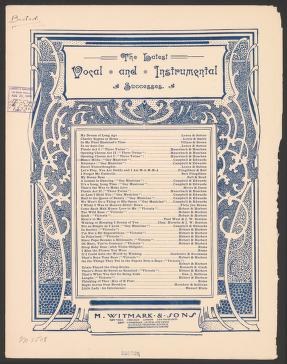
This page is not a dance artwork and does not belong in a gallery of dance in art. Its inclusion appears to result from a metadata error or overly broad search.
What you are looking at
This is a decorative title page or contents list for a vocal and instrumental music publication from 1908, not a depiction of dance. The page is framed by an ornate Art Nouveau border in blue and cream, with stylized floral and geometric motifs characteristic of early 20th-century design. The border features elaborate corner roundels and flowing vine-like patterns that frame the central text area. Within this frame sits a dense, carefully typeset list of compositions, arranged in multiple columns with page numbers aligned to the right. The title at the top reads "The Best Vocal and Instrumental" with additional ornamental text. The overall presentation is that of a music publisher's catalogue or index page, designed for practical reference rather than artistic display. No dancers or dance scenes appear anywhere on the page.
The dancing
There are no human figures or dancers depicted on this page. It is purely a typographic and decorative design.
The dance depicted
This page does not depict dance. It is a music publication catalogue or contents page. While the list likely contains vocal and instrumental compositions—some of which may have been composed for dance or accompanied dance performances in the Edwardian era—the page itself contains no representation of dancing bodies, costumes, or movement.
How it was made
This appears to be a letterpress or relief-printed page, characteristic of early 20th-century music publishing. The crisp, uniform type and the precise alignment of the ornamental border suggest skilled compositional and presswork. The Art Nouveau border design may have been cut as a wood block or metal engraving, allowing the same frame to be reused across multiple pages or publications. This technique was economical and allowed fine control over the presentation of text—essential for a reference document like a contents page.
About this work
This is a decorative contents or title page from a 1908 music publication, not a dance artwork. It documents the repertory available from a music publisher at a specific moment in the Edwardian era. While music publishing of this period was closely tied to dance—many compositions were written for ballroom, theatrical, or social dancing—this particular object is a record of publishing, not a representation of dance. Its presence in a dance image archive is likely due to cataloguing error or because it was retrieved as a related document alongside actual dance imagery from the same period or publisher.
How to look at it
This is not a work to approach as art-historical representation. Instead, read it as a historical document: a snapshot of what music was considered worth publishing and preserving in 1908. The fact that dance music likely appears in this catalogue—though the specific titles are difficult to read in reproduction—tells us about the cultural centrality of dance in Edwardian leisure and entertainment.
The artist
The publisher or printer is not identified on the visible portion of the page. The design of the border suggests familiarity with Art Nouveau conventions current in London and continental Europe around 1900–1910. The typographic refinement and decorative ambition indicate a publisher of some standing, likely serving the middle-class amateur music market in Britain.
The period
In 1908, music publishing was a significant commercial enterprise in Britain. The rise of the middle class had created demand for domestic music-making—piano pieces, songs, and instructional works. Many of these compositions were dance-related: waltzes, mazurkas, two-steps, and ragtime pieces for the drawing room, or theatrical dances for stage performance. Art Nouveau design, prominent here, was already becoming historically conscious by 1908, even as it remained fashionable in publishing and decorative arts.
Where it lives
The page is held by the Library of Congress. It appears to be a single leaf from a music publisher's catalogue or promotional publication, likely produced in London. The source code indicates it derives from LODance, a digital collection of dance-related materials, which may have acquired it as contextual documentation of the period rather than as a primary dance artwork.
Questions about this work
Is this a dance artwork?
No. This is a music publisher's catalogue or contents page from 1908. While it documents music that may have included dance compositions, the page itself contains no depiction of dancers, movement, or choreography.
Why is it in a dance archive?
It may have been catalogued as contextual material related to dance music of the Edwardian era, or it may represent a cataloguing error. Music publishing records and dance history are closely linked, but this particular object is a record of publishing rather than a dance artwork.
Can I read the composer names and titles?
The type is small and the reproduction quality makes it difficult to transcribe reliably. A higher-resolution scan or the original would be needed for accurate identification of the contents.
More dance artwork





