37 works in this view — arrow keys or swipe to move between them.
Dance in Art · 1879
Kelly and Ryan's Hibernian ballet songster
Unknown artist
- Source:
- Library of Congress
- Rights:
- Public domain — free to use, share and adapt.
- Recorded as:
- Public Domain
Kelly and Ryan represent a strain of nineteenth-century popular dance entertainment—Irish-American variety performance—that exists largely outside the canonical history of theater dance and remains understudied. This songster is rare primary evidence of how such acts were marketed, what entertainment they promised, and how performers of Irish origin branded themselves in an American working-class context.
What you are looking at
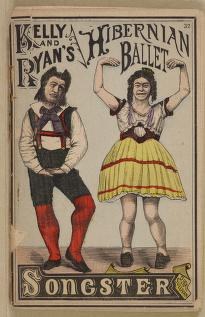
This is a printed cover for a songster—a cheaply produced collection of popular songs and entertainment material—advertising "Kelly and Ryan's Hibernian Ballet." The design presents two figures in theatrical dress against a plain background. On the left stands a man in a burgundy jacket with brass buttons, yellow-gold knee breeches, red stockings, and black shoes, his posture relaxed and informal. On the right is a woman in a yellow skirt with pronounced horizontal pleating or gathered tiers, a dark bodice, and the same red stockings. Both figures are positioned as if presenting themselves to the viewer rather than dancing together. The style is characteristic of mid-nineteenth-century popular entertainment ephemera, using bold outline and flat color typical of cheap lithographic or letterpress production.
The dancing
The two figures are isolated and frontally posed rather than in active interaction or embrace. The man's weight appears evenly distributed, his arms at his sides in a neutral stance. The woman similarly stands with neutral posture and no visible weight shift or extension that would suggest active step or momentum. Neither figure shows the closed hold, frame, or body relationship typical of couple dancing. Their positioning suggests they are performers announcing themselves or a show rather than dancers caught mid-performance.
The dance depicted
Kelly and Ryan were an Irish-American song-and-dance duo popular in the mid-nineteenth century, particularly in working-class theaters and variety halls. This songster collects songs, patter, and entertainment material associated with their act. The term "Hibernian ballet" is a marketing label for their mixed entertainment rather than a precise dance form—it reflects the Irish identity branding of their act. The image does not depict recognizable ballet technique or a formal theatrical dance; instead, it presents the performers as character types within a tradition of Irish-American popular entertainment and minstrelsy.
How it was made
This is a printed cover, almost certainly a lithograph or wood engraving produced for mass circulation in the 1870s–1880s, when such songsters were common cheap merchandise sold in theater lobbies, on streets, and in variety halls. The bold outline, flat color, and simplified forms are characteristic of popular lithographic production, which allowed rapid printing and low cost. The technique and format indicate an audience of working people attending variety shows, not collectors of fine prints.
About this work
This is a mid-nineteenth-century entertainment ephemera—the printed cover of a songster collecting songs and patter associated with the song-and-dance team Kelly and Ryan, Irish-American performers working in variety and working-class theaters. It functions as both advertisement and souvenir, displaying the two performers in stage dress without depicting a specific dance action. The work belongs to a vast, largely forgotten tradition of cheap printed entertainment material that documented the actual repertoire and appeal of popular performers rather than elite theatrical productions. Its interest lies less in artistic quality than in its documentary value: it shows what was actually performed and sold to ordinary theater-goers, and it preserves the name and image of performers who have otherwise left little historical record.
How to look at it
Observe that the two figures are not dancing together or even in dynamic relationship. They stand separately and frontally, as if posing for advertisement. The woman's tiered yellow skirt is the most visually prominent element—eye-catching and theatrical, typical of stage costume rather than balletic dress. Note the deliberate use of color (the bold reds and yellows) typical of cheap lithography, designed for visual impact from a distance. The overall composition announces performers and a show rather than capturing a moment of dance in progress.
The artist
The artist is not recorded. The work was produced as commercial ephemera by an unknown printer or lithographer working for a publisher in the U.S. entertainment trade. Such covers were often designed by hack jobbers who remained uncredited; attribution and artistic intention were rarely the concern of such mass-market production.
The period
In the 1870s–1880s, variety halls and working-class theaters in American cities featured mixed entertainment including songs, dances, comic sketches, and acrobatics. Irish performers and Irish-themed acts were enormously popular, both among Irish immigrant audiences and more broadly. Kelly and Ryan were part of a larger wave of Irish-American entertainers who dominated variety stages. This period was also the heyday of the songster trade—cheap printed collections that allowed fans to reproduce and circulate the songs and material from popular acts. Meanwhile, ballet as an art form was becoming professionalized and moved into elite theaters, creating a growing distance between popular variety performance and canonical "dance."
Where it lives
The source is listed as LOC (Library of Congress). This is a mass-produced printed object from the entertainment trade and would have existed in thousands of copies; individual copies likely survive in various library and archive collections.
Questions about this work
Who were Kelly and Ryan?
Kelly and Ryan were an Irish-American song-and-dance performance duo active in the mid-nineteenth century, popular in variety halls and working-class theaters, particularly among Irish immigrant and Irish-American audiences. They represent a significant but understudied tradition of popular entertainment that existed outside elite theater. Little biographical information survives; this songster is part of the primary evidence of their work.
What is a songster?
A songster is a cheap printed booklet, usually 8–32 pages, containing song lyrics, comic patter, jokes, and dance descriptions associated with popular performers or acts. Songsters were sold in theater lobbies, on streets, and at shows as cheap souvenirs, typically costing a few cents. They allowed fans to circulate and reproduce material from live performances and remain important primary sources for popular entertainment history.
What does 'Hibernian ballet' mean here?
"Hibernian" refers to Ireland or Irish culture; "ballet" here is a marketing term for mixed entertainment (songs, dances, comedy) rather than a technical designation. The label capitalizes on both Irish identity branding and the prestige associations of the word ballet, even though the act was working-class variety performance, not classical ballet.
Is this a dance image?
It is an entertainment advertisement featuring performers known for dance and song, but it does not depict dancing. The figures are posed frontally and statically rather than captured in movement or in dance hold. Its value is documentary—it shows how the performers presented themselves and how their act was marketed—rather than showing the actual choreography or movement quality.
More dance artwork





