33 works in this view — arrow keys or swipe to move between them.
Dance in Art · 1977
Darlene Blackburn Dance Troupe, Museum of Science and Industry, Chicago, Illinois
Unknown artist
- Source:
- Library of Congress
- Rights:
- Public domain — free to use, share and adapt.
- Recorded as:
- Public Domain
For dancers and historians of Native American performance, such objects are essential primary sources: they reveal the material tools and aesthetic traditions through which communities structured their own movement practices. Understanding the rattle, the shield, the patterns, and the craft quality is inseparable from understanding the dances in which they were used.
What you are looking at
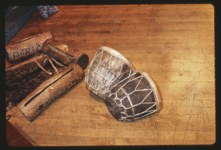
A still-life composition of two Native American objects against a warm, textured background that suggests aged wood or leather. On the left is a long cylindrical rattle or percussion instrument with wrapped cordage detail visible along its length. On the right is a circular shield or ceremonial object with geometric patterns—concentric circles and linear designs in white or light pigment against a darker ground—typical of Plains or Southwestern indigenous craft. The lighting is warm and directional, casting subtle shadows that emphasize the three-dimensional form of both objects. The composition is intimate and documentary in character, presenting these objects as artifacts worthy of close study rather than as elements of a narrative scene.
The dancing
There are no human figures in this image. The work contains no dancers and no depiction of bodily movement or gesture.
The dance depicted
This image does not depict dance. It is a still-life photograph or reproduction of ethnographic artifacts. Although the objects shown—a rattle and a shield—may have been used in ceremonial or ritual contexts that included dance, the work itself documents the objects in isolation rather than capturing dance in motion or performance.
How it was made
The work appears to be a photograph or photographic reproduction, likely a color or hand-tinted print given the warm, sepia-toned palette and the subtle gradations of light. The technique captures surface texture and dimensional form effectively; the directional lighting is characteristic of museum documentation or fine-art photography designed to reveal the object's craftsmanship. The print quality and mounting suggest this may be an archival document or publication plate rather than an exhibition print.
About this work
This is a documentary photograph of two Native American artifacts—a wrapped rattle and a geometric shield—presented in a museum or archival context. The image belongs in a dance archive not as a depiction of dance itself, but as evidence of the material culture that accompanied or enabled ceremonial and social dance in indigenous American communities. Objects like these were integral to the soundscape and visual grammar of traditional dance practice, and their preservation and study contribute to the historical record of indigenous performance traditions.
How to look at it
Attend to the craftsmanship visible in the wrapped cord on the rattle and the precision of the geometric designs on the shield. These details speak to the skill and intention invested in objects used in performance. The warm, careful lighting is meant to honor the objects and invite close study—this is not casual documentation but presentation. Consider what sound the rattle would make and what movement and visibility the shield would add to a dancer's body.
The artist
The catalogue record attributes this work to no named artist and provides no creator information. The photograph may be a documentation image produced by the Museum of Science and Industry in Chicago or by a photographer commissioned by that institution. Such institutional photography was typically unsigned and treated as archival documentation rather than artistic work.
The period
In 1977, the year of this image, American museums were beginning to shift their approach to Native American collections in response to growing indigenous rights movements and scholarly reexamination of ethnographic practice. The Darlene Blackburn Dance Troupe's appearance at the Museum of Science and Industry suggests a public programming initiative that brought indigenous performance to a general audience. The still-life documentation of objects reflects the curatorial conventions of mid-twentieth-century ethnographic museums, which presented artifacts as discrete, decontextualized specimens. This approach is now understood as partial and problematic, but it shaped how indigenous material culture was photographed and archived during this period.
Where it lives
This photograph is held in the Library of Congress and is associated with the Darlene Blackburn Dance Troupe and the Museum of Science and Industry in Chicago. The context of the troupe and venue suggests this was produced in connection with an exhibition or public program, possibly as promotional or archival documentation.
Questions about this work
Why is a still-life of objects included in a gallery of dance in art?
Dance history encompasses not only the moving body but also the material culture—instruments, costumes, props, regalia—that structures and enables performance. Objects like rattles and shields were inseparable from Native American ceremonial and social dance and shaped how dancers moved and sounded. Their documentation is part of the historical record of dance practice.
What is the Darlene Blackburn Dance Troupe?
The catalogue record links this image to the Darlene Blackburn Dance Troupe and a 1977 date at the Museum of Science and Industry in Chicago, suggesting the troupe performed there or the museum exhibited or documented indigenous performance. Without further documentation, the specific nature and repertoire of the troupe cannot be established from this image alone.
What do the geometric patterns on the shield mean?
The shield shows geometric designs—concentric circles and linear elements—typical of Plains or Southwestern indigenous artistic traditions. These patterns likely carried cultural, ceremonial, or protective significance within the community that made and used the object, but their specific meanings cannot be determined from the photograph alone.
More dance artwork





