25 works in this view — arrow keys or swipe to move between them.
Dance in Art · 1879
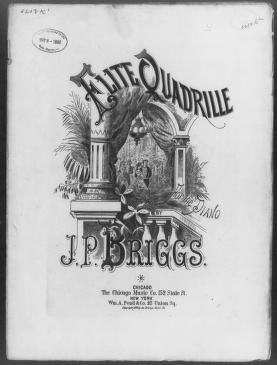
Elite quadrille
Unknown artist
- Source:
- Library of Congress
- Rights:
- Public domain — free to use, share and adapt.
- Recorded as:
- Public Domain
This work preserves the visual and commercial culture of 19th-century social dancing at the moment when the quadrille was losing ground to newer dances. It shows how ballroom dance was packaged and sold to domestic consumers, and the aesthetic ideals—symmetry, ornament, architectural refinement—that the Victorian era associated with genteel dancing. For historians of dance, music, and print culture, it is a primary source for understanding how choreography was disseminated and how dancers were taught.
What you are looking at
This is a sheet music cover or dance instruction title page for a quadrille, one of the most popular social dances of the 19th century. The composition is formal and symmetrical, with ornate decorative framing. At the center stands an elaborate architectural structure—a pavilion or gazebo with classical columns and a domed top—within which figures are arranged as if in a ballroom setting. The structure is crowned with the title "ELITE QUADRILLE" in bold letters. The entire design is rendered in fine engraving with careful crosshatching to create depth and shadow. The frame itself is decorated with flourishes and botanical motifs, typical of mid-Victorian print design. The overall effect is one of elegance and formality, suggesting this was a fashionable dance piece intended for the drawing rooms of the well-to-do.
The dancing
The figures within the pavilion are small and somewhat stylized, rendered in the miniaturized manner typical of ballroom illustration on printed music covers. While individual dancers are difficult to discern in detail, the composition suggests multiple couples arranged in the formation characteristic of quadrille choreography—lines or squares of dancers. The formality of dress (likely evening wear) and the stiff, posed quality of the figures are consistent with the rigid, geometric conventions of mid-19th-century social dance instruction and representation.
The dance depicted
This is a quadrille, the dominant social dance of the ballroom from approximately 1800 to 1880. The quadrille was a dance for four couples arranged in a square, performed to a series of five figures with distinct musical sections. It evolved from French cotillion traditions and became the standard opening dance at formal balls. The title "Elite Quadrille" suggests this was a fashionable or celebrated variant, possibly a composition with special appeal to the upper-middle and aristocratic classes who frequented formal dances. The date of 1879 places it near the end of the quadrille's reign as the paramount social dance, just as the waltz and other dances began to displace it.
How it was made
This is a steel engraving or wood engraving, as indicated by the fine line work, precise detail, and consistent crosshatching visible throughout. The technique allowed for high-volume printing and wide distribution of sheet music covers to music sellers and domestic musicians across the English-speaking world. The quality of the engraving—the delicate architectural detail and ornamental flourishes—suggests this was an expensive, prestigious publication, and the technique itself was a mark of respectability. Such covers were not merely functional but were display objects in themselves, often framed or collected.
About this work
The Elite Quadrille is a printed sheet music cover from 1879, depicting the quadrille through architectural and ornamental framing rather than explicit narrative action. As a design for a social dance at the height of the Victorian era, it documents both the dance itself and the aesthetic conventions by which the dance was represented to its audience. The quadrille was danced by thousands of people across Britain and America in the 19th century, yet few visual records show the actual movement of the dance in progress; instead, publishers created idealized, ornamental frames like this one, which promised elegance and exclusivity. This cover is thus a document of how the Victorian upper-middle class imagined their own social rituals.
How to look at it
Observe the architectural conceit of the design: the pavilion frames the dance as if it were a classical spectacle, lending it dignity and timelessness. The symmetry of the composition and the ornamental border suggest order, propriety, and refinement—the exact qualities that the Victorian ballroom was meant to embody. The smallness and formality of the figures within reflects the hierarchical distance between the idealized vision of the dance and the actual messy reality of people moving together. Notice also the printer's marks and publication details at the bottom: these anchor the object in the commercial world of Victorian music publishing and remind us that this was a mass-produced commodity, not a unique artwork.
The artist
The artist is not recorded. The engraving is attributed to J. P. Briggs (as noted in the imprint at the bottom of the page), but it is unclear whether Briggs was the engraver, the publisher, or the composer. Briggs & Co. was a London music publisher active in the mid-19th century. The anonymity of the designer is typical for commercial sheet music covers of the period, where the visual design was often considered a secondary product to the musical composition itself.
The period
The quadrille dominated fashionable ballrooms from the Regency period through the 1880s. By 1879, when this cover was published, the dance was already in decline; the waltz had risen in popularity, and new dances from America and the continent were beginning to reshape social dancing. The Victorian era saw an explosion of printed sheet music, with covers becoming increasingly ornate and ambitious in their graphic design. This cover reflects the high standards of Victorian commercial printing and the enormous appetite for dance music in the homes of the middle and upper classes. At this moment, the quadrille was beginning to be associated with an older generation, even as publishers continued to issue new quadrille compositions for conservative dancing masters and their pupils.
Where it lives
This is a printed sheet music cover from the Library of Congress, part of the historical record of American and British music publishing. It is one of thousands of similar covers produced in the mid-to-late 19th century and preserved in archives. The Library of Congress link indicates it is held in a public collection and is likely in the public domain or freely accessible.
Dance in this work
Questions about this work
What is a quadrille?
A quadrille is a social dance for four couples (eight people) arranged in a square. Each couple occupies one side of the square. The dance consists of five musical figures, each with its own choreography, performed to a lively tune in 2/4 or 6/8 time. It was the most fashionable ballroom dance of the 19th century and was danced at all formal occasions. The dance required memorization of the figures and was often taught by dancing masters.
Why is this called the 'Elite' Quadrille?
The title suggests this was a particularly fashionable or acclaimed composition, possibly one that was especially popular in elite ballrooms. Publishers often gave their quadrille compositions aspirational or flattering names to appeal to their target market of well-to-do musicians and dancers. 'Elite' may indicate that the music was considered sophisticated or that it was associated with fashionable society.
Who would have danced this?
The quadrille was primarily a dance of the Victorian upper-middle and aristocratic classes. It was taught by dancing masters, practiced in drawing rooms, and performed at balls, assemblies, and formal social events. By the 1870s, when this cover was published, the quadrille was becoming old-fashioned, but it remained part of the curriculum of respectable dancing instruction and was still danced by conservatives and traditionalists.
What does the architectural frame mean?
The pavilion or gazebo serves as a visual metaphor for the formality and grandeur of ballroom dancing. By framing the dancers within a classical structure, the designer elevates the social dance to the status of high art or classical spectacle. It is a visual convention of the period, meant to appeal to the aspirations of the sheet music's buyers and to suggest that the dance was refined, elegant, and timeless.
More dance artwork





