49 works in this view — arrow keys or swipe to move between them.
Dance in Art
Jitterbug Wolcott FSA
Marion Post Wolcott
- Source:
- Wikimedia Commons
- Rights:
- Public domain — free to use, share and adapt.
- Recorded as:
- public_domain
This image is crucial evidence of how African American communities danced before and apart from commercial entertainment or codified instruction. It shows jitterbug not as a spectacle or a named technique but as the ordinary social practice of a Saturday night, and it documents a lineage from blues and swing that shaped all subsequent American social dance. For historians and dancers, it answers the question of what the dance actually looked like in its lived context.
What you are looking at
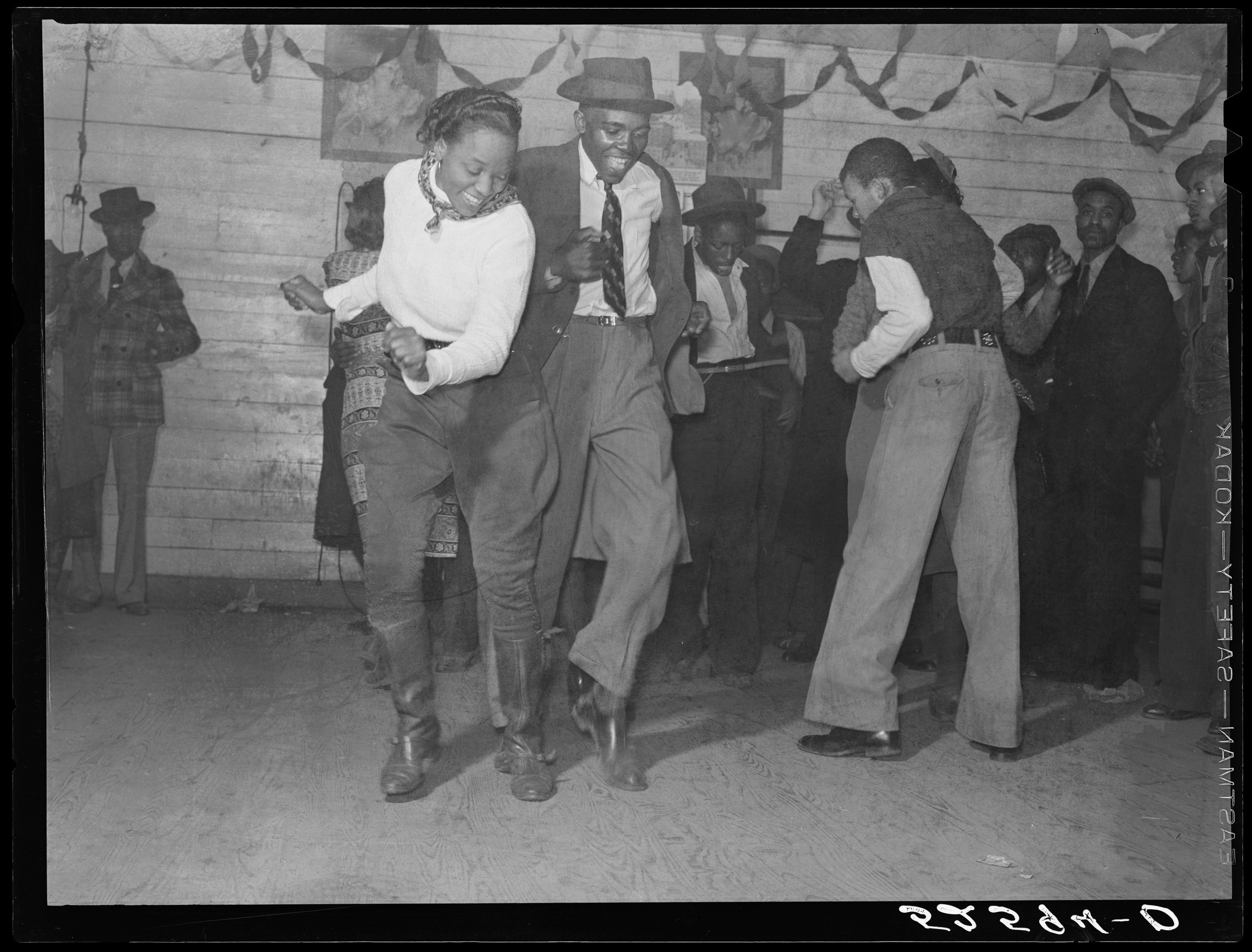
A juke joint interior on a Saturday evening, with a crowded social dance scene. In the foreground, three couples dance energetically on a wooden floor while a band plays in shadow at the back. The nearest couple dominates the composition: a woman in a white long-sleeved blouse and patterned skirt dances with a man in a vest and fedora, their bodies close and animated. To the right, another couple in white and light-colored clothing moves in similar close proximity. The walls are decorated with draped bunting and what appear to be pinned photographs or announcements. The lighting is soft and somewhat diffuse—characteristic of documentary flash photography—and the crowd visible in the background suggests this is a popular social venue. The informality of dress and the density of dancers convey the vitality and immediacy of weekend social dancing in rural Mississippi.
The dancing
The dancers hold each other in close social position with straight spines and engaged torsos. The lead man's left hand is visible on his partner's back or side; her right hand appears to rest on his shoulder or arm. Both dancers show bent knees and a forward-leaning weight distribution, suggesting active footwork and traveling steps rather than in-place movement. The woman's upper body is relatively upright while her hips and lower body move with clear energy. A second couple visible to the right mirrors this close hold and body position. The overall frame suggests partner dancing done in intimate proximity with active weight changes—consistent with swing or blues-influenced social dance.
The dance depicted
This is jitterbug or swing dancing as performed in African American juke joints of the late 1930s. Jitterbug emerged from swing music and lindy hop but in this setting represents vernacular social dancing—less codified than ballroom swing, more flexible and improvisational. The close hold, bent knees, and engaged partnership visible here differ from the open, aerially acrobatic lindy hop of competition or theatrical performance. This documentation captures how the dance was actually danced in working-class venues: practical, partner-focused, and integrated into the weekly social life of rural Black communities. The setting and participants establish this as social-blues or juke joint blues dancing rather than theatrical swing.
How it was made
This is a black-and-white photograph, most likely taken with available light and flash given the even, slightly flat illumination and the visible detail throughout the crowded interior. The photographer Marion Post Wolcott worked for the Farm Security Administration, which documented American life during the Depression and early 1940s with portable 35mm cameras. The photographic medium allowed the documentation of candid social moments impossible to capture in painting or drawing, and the FSA's circulation of such images to newspapers and publications gave them wide reach as evidence of American cultural life. The photograph's clarity and compositional focus on the dancing couple in the foreground demonstrate deliberate framing despite the informal, crowded setting.
About this work
This photograph documents jitterbug dancing in a juke joint near Clarksdale, Mississippi, in 1939—a moment of social pleasure and community gathering in the segregated rural South. It captures the close-partner, weight-engaged style of vernacular swing dancing as it was actually performed in working-class African American venues, distinct from the theatrical or competitive versions of the era. The work belongs in a dance gallery because it is precise social documentation: it shows hold, frame, energy, and the integration of dance into weekly social life, recorded by a photographer working systematically to capture American life in a moment of economic hardship and cultural vitality.
How to look at it
Attend to the dancers' weight distribution and the closeness of the hold—this is not the open, swinging lindy hop of competition footage, but a more compact, engaged partnership. Notice how both dancers' knees are bent and bodies are slightly forward, suggesting active footwork and traveling steps within a small space. The woman's facial expression shows concentration and engagement, not performance for an external audience. The presence of a working band in the background and the crowded room establish the social context: this is not a demonstration but a moment in an ongoing social evening, captured by a photographer who positioned herself to show the dance itself rather than the dancers' awareness of being photographed.
The artist
Marion Post Wolcott (1910–2002) was a pioneering documentary photographer who worked for the Farm Security Administration from 1940 to 1944, during the Depression and early World War II years. She was one of the few women photographers in the FSA's prestigious photography program and was known for her sensitive, intimate approach to documenting rural and small-town American life, particularly the lives of African American communities. Her photographs were widely published in contemporary newspapers and magazines and circulated by the FSA as evidence of American social conditions. This image is part of her systematic documentation of Southern life and leisure.
The period
In 1939, swing and jitterbug were at the height of their popularity across American dance culture, but they occupied different social spaces. While white ballrooms and competition venues featured codified swing and lindy hop, Black juke joints and social venues developed their own versions, less formally named but equally dynamic. The close-hold, blues-influenced dancing visible here reflects the continuity between 1920s blues dances and the swing era, adapted to the smaller spaces and intimate social contexts of rural juke joints. The photograph was made as swing was becoming a national phenomenon, yet it documents a local, lived practice rather than the spectacular versions being marketed to mainstream audiences.
Where it lives
This photograph is held by the Library of Congress as part of the Farm Security Administration photograph collection (FSA/OWI), a major American documentary archive. The FSA deliberately recorded the social and economic life of Depression-era America, and this image is part of that systematic documentation effort. The catalogue record identifies it by Marion Post Wolcott's name and the FSA archival system.
Dance in this work
Questions about this work
What is the difference between jitterbug and lindy hop?
Lindy hop, which emerged in the 1920s–30s in Harlem ballrooms, is characterized by swinging, aerially acrobatic movements and often an open position between partners. Jitterbug is a broader term for swing dancing in various contexts, including the close-partner, blues-influenced style visible in this juke joint. The close hold and weight-engaged footwork here reflect how swing was danced in intimate social venues rather than competition or theatrical performance.
Why are these dancers in such a close hold?
The juke joint's cramped interior meant dancers had limited space for the open, traveling footwork of lindy hop. The close hold also reflects the influence of blues dancing and slower swing tempos common in smaller venues. This practical adaptation became a distinct regional and class-based style of swing dancing, as valid and enjoyable as its ballroom counterpart.
Who was Marion Post Wolcott?
Wolcott was a documentary photographer for the Farm Security Administration in the 1940s, one of the few women in that program. She specialized in intimate, respectful portraits of rural and small-town American life, particularly in the South. Her work circulated widely in newspapers and magazines, shaping public understanding of Depression-era America.
Where was Clarksdale, Mississippi, and why was it significant?
Clarksdale is in the heart of the Mississippi Delta, one of the oldest and most significant centers of African American blues culture. The region produced legendary blues musicians and was a center of juke joint culture. The FSA photographers documented this region extensively as part of their record of American life during economic hardship.
More dance artwork





