Juke Joint Blues
Also known as: Jukin', Jookin', Juke Blues
- Origin
- Rural Mississippi Delta and the Deep South, later Chicago and Texas
- Era
- 1890–1960
- Rhythm
- Shuffled triplet subdivision over 4/4, with weight changes syncopated against the backbeat
- Tempo
- Approximately 60-110 BPM
- Character
- Grounded, earthy, compact, percussive
History & Cultural Context
Jukin' is blues dancing made for a small, crowded, low-ceilinged room. Juke joints were the first secular gathering places Black Americans built for themselves after Emancipation, growing out of plantation community rooms and the barrelhouses at sawmill and turpentine camps, and spreading widely during Prohibition at highway crossings and railroad stops. The name descends through the Gullah joog, rowdy or disorderly, from the Wolof dzug. Because there was no space to travel, the dancing drove downward and inward: sharp, punctuated weight changes, deep knee bend, and articulation concentrated in the hips. The Spurlock Museum exhibit records several named idioms in this family. The Funky Butt, referenced in song and print since the late nineteenth century, pairs side steps with a rocking backward extension of the hips that counterbalances a partner's weight. The Grind is essentially stationary, built on a step with a circular hip movement up and to the side. The Piedmont uses a relaxed but fast shuffling triple against fingerpicked guitar; the Texas Shuffle slides with a subtle triple pulse and alternating stretch and compression; the Chicago Triple articulates the triple itself as the foundation step over electrified Chicago blues.
Cultural Significance
The juke joint was a Black-owned and Black-run space under segregation, where owners often also sold groceries, moonshine or lodging to plantation workers and sharecroppers, and Paul Oliver called it a final bastion of refuge from racial pressure.
Characteristic Movement & Technique
Deep bent-knee grounding, hip-led articulation, small sharp weight changes, and rhythmic shuffling that stays within a few square feet.
Partnering Dynamics
Very close embrace with weight sharing and counterbalance; connection is maintained through the torso and hips rather than the arms, and communication is largely tactile.
Competitive Context
No formal historical competition structure; the modern revival scene runs Jukin' divisions at blues weekends, judged on musicality and connection rather than figures.
Regional Variations
Delta jukin' against country blues, Piedmont shuffling along the Atlantic seaboard and into Appalachia, Texas and West Coast shuffles, and the Chicago Triple over post-migration electric blues.
Common Misconceptions
Jukin' is not simply slow, sensual swaying — it is rhythmically dense and often fast, and the sexual reading imposed on it by outside observers has always flattened its range.
Peak Popularity
Notable Codifiers
- Damon Stone
Juke Joint Blues Music & Tempo
Drawn from 15 Juke Joint Blues tracks in the LODance music library.
Example tracks at practice tempo
- Blue And Lonesome - Single Version — Little Walter69 BPM
- One Good Man — Janis Joplin88 BPM
- Dark Road — Floyd Jones68 BPM
- I Just Can't Leave You - Single Version — Slim Harpo68 BPM
- She Moves Me — Muddy Waters61 BPM
- The Things That I Used to Do — Guitar Slim65 BPM
What to Wear
Attire guidance for Juke Joint Blues and other Blues & Slow Social Dance dances. Each card below is sized to the moment — class, practice, social, or competition — because the wardrobe shifts as the stakes do.
Reading the cards
In Class
Comfortable clothes you can sweat in, plus smooth-soled shoes you can pivot in — leather or suede soles are the norm and rubber gym soles grab the floor hard enough to hurt a knee. Most venues ask that you change out of street shoes at the door. Because this is a close-connection dance, leave off long necklaces, dangling earrings, watches and anything with hooks or a rough seam that will catch a partner or scratch a forearm.
Social Dancing
Blues venues run from juke-joint casual to dressy at exchanges and late-night rooms; look at what the local scene wears and match it, but nothing formal is required. Hygiene is genuinely part of the dress code here in a way it is not in most styles — deodorant, mints, and a change of shirt in your bag, because you will be in close embrace for several songs at a stretch. Go light on perfume and cologne; many dancers are scent-sensitive, and it lingers on everyone you dance with.
Competition
Blues has no formal competitive circuit with a costume rulebook; the competitive format that exists is the Jack & Jill or Strictly contest run at weekend exchanges. Wear something that reads clearly from across the floor and that will survive several fast rounds without adjustment — and keep the same close-embrace rules in mind, since your partner is randomly drawn. Community norms outrank aesthetics: close embrace is invited rather than assumed, and nothing you wear should create contact your partner hasn't agreed to.
Shoes
Smooth soles that pivot: suede or chrome leather, never a rubber gym sole, which grabs a wooden floor hard enough to torque a knee mid-turn. Low, stable heels or flats — blues sits into the floor with bent knees and a high heel fights that all night. Indoor-only, changed at the door; most venues explicitly ban shoes that have been worn outside. Aris Allen and Só Dança sit at the affordable end, with Saint Savoy, Bleyer and Nueva Epoca above them.
In Practice
Practice wear is a little more fitted than social wear, because blues is about weight, pulse and what the torso is doing, and a teacher cannot correct what a drapey top hides. Train in the shoes you will social dance in — sole friction changes everything about how a pivot and a drag feel. Layers matter: practice rooms start cold and you will be soaked an hour in, so bring the spare shirt to practice too, not just to the dance.
By Role
Leaders
Class: Nothing that interferes with the frame or the point of contact: a top with sleeves or an undershirt, since a partner's hand rests on your shoulder and upper back for whole songs, and a spare shirt so that stays pleasant late in the night. Skip rigid collars, chest-pocket pens and a large belt buckle — all of them press into a partner in close embrace.
Competition: Jack & Jill and Strictly contests carry no costume rules, so wear what you social dance in, in a colour that separates you from the floor and the crowd. Keep the frame legible — nothing bulky through the shoulders, nothing that hides where your weight actually is, since that is what a judge is reading.
Followers
Class: Anything that lets you sit into a deep bend and travel through a slow drag — a skirt needs enough width for that, or wear trousers, and a pencil skirt will simply stop you. Leave off long necklaces, dangling earrings and loose clips: in close embrace they catch on a partner, and a caught earring hurts.
Competition: Same clothes as a social night, chosen for how they read from across the room; a skirt with some weight makes the pulse and the drag visible in a way leggings do not. Secure anything that can shift or fall, because you are dancing with a randomly drawn partner in front of judges and there is no second take.
Common Pitfalls
- ✗Rubber-soled trainers on a wooden floor — they grip through a pivot and knee injuries follow.
- ✗Wearing the shoes you arrived in; almost every venue asks you to change at the door.
- ✗Heavy fragrance in a close-embrace room, where it lands on every partner you have all night.
- ✗Long necklaces, dangly earrings and loose hair clips, which catch and tear in close embrace.
- ✗Treating close embrace as the default: it is offered and accepted, never assumed, and clothing should not force it.
Price Range
- Budget: Clothes you own, plus a smooth-soled shoe you can pivot in — a cheap leather-soled dress shoe or well-worn flats will get you started for under $50.
- Mid: Aris Allen or Só Dança dance shoes roughly $60–110, a suede brush around $10, a shoe bag and a spare shirt.
- Premium: Saint Savoy, Bleyer or Nueva Epoca at roughly $150–280, often with replaceable soles — worth it if you dance several nights a week, and largely invisible to anyone but you.
Key Terms
- Close embrace
- Chest-to-chest connection, invited rather than assumed — what you wear should not create contact your partner has not agreed to.
- Chrome leather sole
- Soft tanned leather sole that slides and pivots predictably on wood; suede is the other standard. Rubber is the thing to avoid.
- Pulse
- The grounded vertical bounce that drives blues — danced with bent knees, which is why low heels and unrestrictive legwear matter.
- Jack & Jill
- Contest format with randomly assigned partners; the closest thing blues has to competition, and it has no dress code.
- Scent sensitivity
- Widely observed community norm — go light on perfume and cologne, since it transfers to everyone you dance with.
Quick Tips
- •Suede-soled shoes allow controlled sliding and pivoting — essential for most partner dances.
- •Avoid rubber soles on dance floors; they grip too much and can cause knee injuries.
- •Bring a separate pair of clean shoes for the dance floor to keep it in good condition.
Sources & Further Reading
Cultural & Historical Context
Juke Joint Blues emerged from Rural Mississippi Delta and the Deep South, later Chicago and Texas during the 1890s—1960s. Understanding the cultural roots, musical traditions, and social circumstances of this era enriches appreciation for the dance's characteristics and significance.
Formative Influences
Codifiers & Standardizers:
Damon Stone
Primary Source Documents
The Library of Dance contains public-domain primary sources for dance history. Copyrighted modern syllabi are indexed with purchase links to their respective copyright owners. Search by dance name or codifier to discover primary source documents.
Last reviewed: September 2026 — This dance profile synthesizes historical research, cultural documentation, and contemporary practice knowledge to provide authoritative context.
More in Blues & Slow Social Dance
Ballroomin' Blues
The upright, traveling branch of blues dance, developed in Northern ballrooms where floor space allowed couples to move along the line of dance to slow jazz-blues.
Slow Drag
The historic close-embrace blues form in which partners hold each other and sway and grind almost in place, documented in the South from the late nineteenth century.
Struttin' / Fishtail
A strutting and hip-articulating vocabulary danced solo or in an open close embrace, combining showy forward carriage with figure-eight motion through the pelvis.
Fusion Dance
A modern improvised partner dance that grew out of the blues revival, blending techniques from tango, contact improvisation, ballet and street dance to whatever music is played.
Juke Joint Blues in art
Browse the gallery →Works our catalogue identifies as depicting juke joint blues.
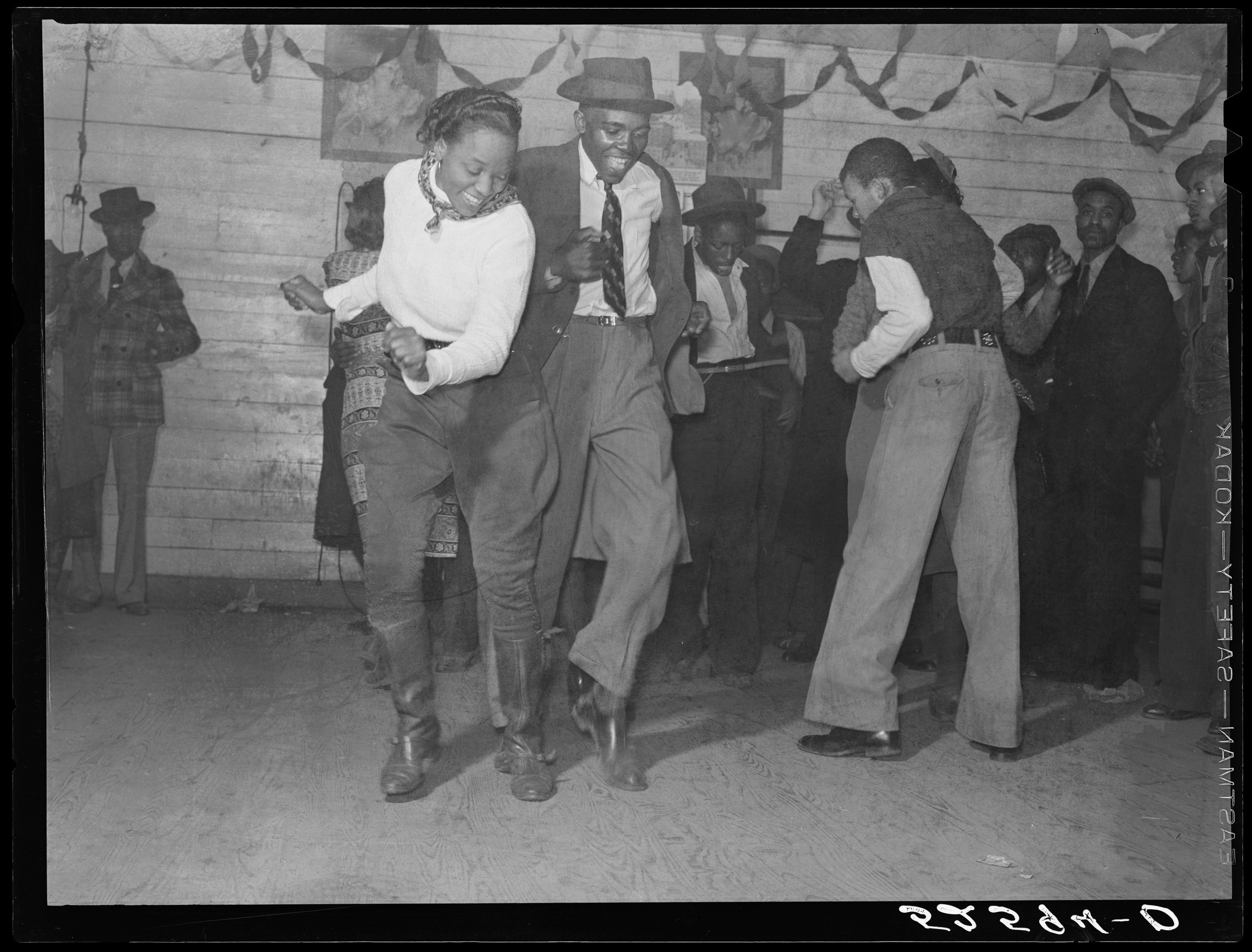
Jitterbug Wolcott FSA
Marion Post Wolcott
public_domain
Continue Exploring
Lineage of Dance
500 years of dance evolution
Champions of Dance
Winners of marquee national & world titles
Language of Dance
161 dance terms & translations
Listening of Dance
Tempo, timing & musicality tools
Gallery of Dance
5,700+ artworks from museum collections
Attire of Dance
Evolution of dance dress across eras
Keep the thread going
Dance history, technique, and the occasional rabbit hole — in your inbox. Thoughtful, infrequent, unsubscribe anytime.
Free. No spam. One click to leave.