49 works in this view — arrow keys or swipe to move between them.
Dance in Art
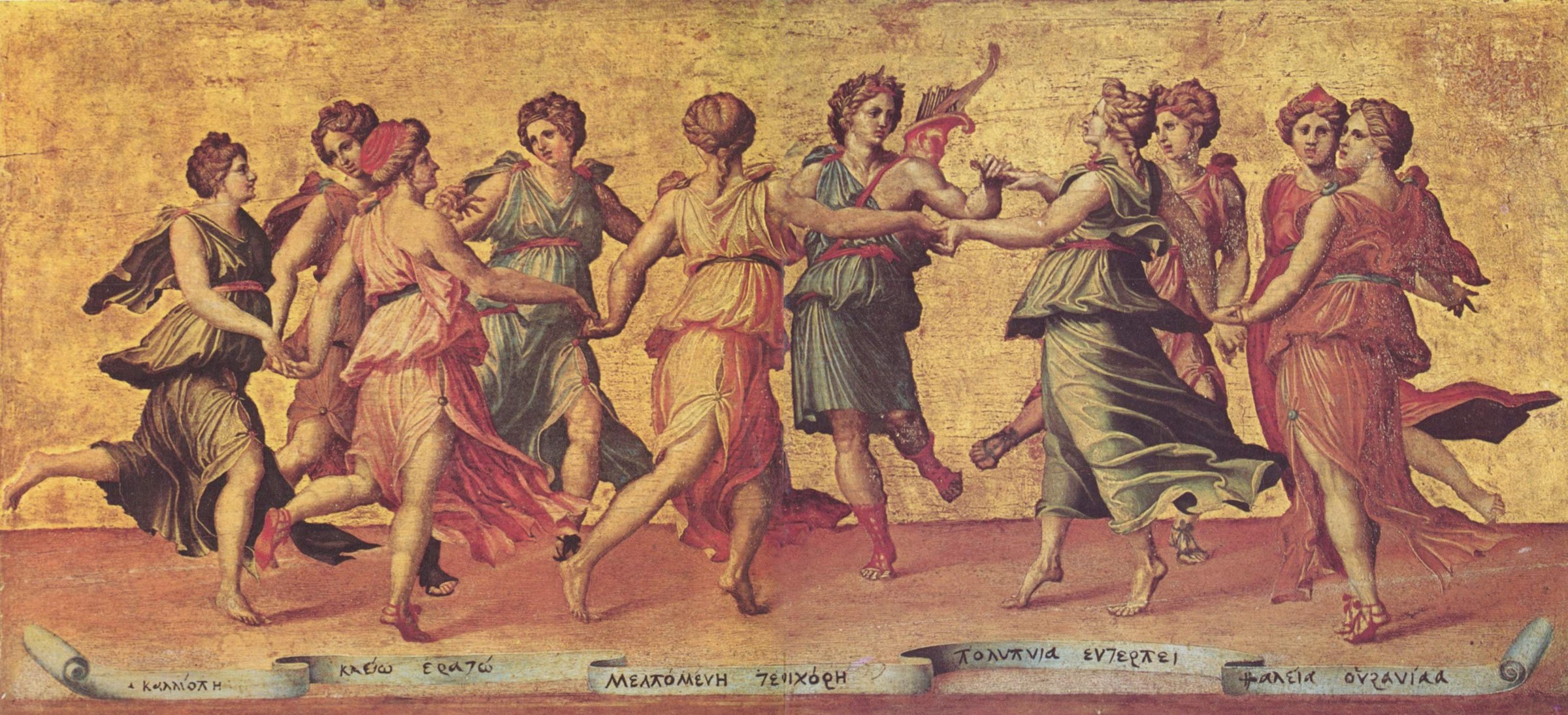
Tanz Apollons mit den Musen
Giulio Romano
- Source:
- Wikimedia Commons
- Rights:
- Public domain — free to use, share and adapt.
- Recorded as:
- public_domain
This image shows how Renaissance artists used classical mythology and Greek visual sources to imagine dance as an expression of cosmic and social order. For dance historians, it reveals the period's understanding of how movement could convey authority, community, and divine presence—ideas that would shape courtly and theatrical dance for centuries. The work is also rare evidence of how Greek inscriptions were used in Renaissance art to create learned, humanistic contexts for the representation of movement.
What you are looking at
A procession of ten figures in classical dress dances or processes across a warm, sandy ground against a golden background. The composition reads left to right as a continuous narrative: at the far left, a youth in dark drapery turns back to observe the scene; moving right, figures in warm yellows, pinks, and greens engage with one another—some clasping hands, others gesturing in conversation. At the center-right, a muscular figure in yellow (identifiable by the context as Apollo, god of music and dance) stands elevated, his right arm extended in what appears to be leadership or benediction over the assembled group. The figures nearest him respond with extended arms and engaged postures. The rightmost figures continue the interaction, with one turning away. All wear classical tunics and himations in soft, naturalistic folds. Bare feet are visible throughout. Four lines of Greek text at the base identify the subject and figures.
The dancing
The bodies move with classical contrapposto and varied orientations around Apollo as focal point. Most figures maintain engaged arm positions—some reaching toward neighbors, others with arms raised or extended in gestures of attention or devotion. The framing suggests neither a closed ballroom hold nor rigid formation, but rather a gathering where proximity and directional focus create social unity. The musculature is rendered with anatomical precision typical of Renaissance study of the antique. Footwork is not clearly distinguishable, but the ground-level placement and upright carriage suggest stately, processional movement rather than rapid or acrobatic action.
The dance depicted
This depicts a scene from classical antiquity—specifically Apollo dancing with or leading the Muses, a subject drawn from Greek mythology and ancient literature. The Greek inscriptions confirm this mythological identification. While not a documentary record of actual Greek dance practice, the image represents how Renaissance artists imagined the dignified, harmonious movement of gods and their attendants. The composition emphasizes Apollo's central role as both musician and dance leader, with the Muses responding to his authority and presence. This is allegorical or mythological dance rather than a depiction of a known Renaissance dance form, though it may reflect idealized notions of courtly or ceremonial movement.
How it was made
The image appears to be an engraving or etching, likely after a drawing or fresco, made in the sixteenth century. The fine linear hatching visible in the drapery, the warm tonal wash, and the framing text are consistent with printmaking technology of the period. The technique allowed wide circulation of such images, meaning this composition could inform artistic and literary culture across Europe. The presence of Greek text and the classical subject matter suggest this was created for a learned audience—humanists, artists, and patrons engaged with the recovery and study of antiquity.
About this work
This is a Renaissance interpretation of Apollo leading the Muses in dance, rendered as an engraving with Greek inscriptions. It sits at the intersection of two traditions: the Renaissance fascination with classical antiquity and the use of mythological subjects to explore idealized human movement and social harmony. The work is not a record of how ancient Greeks actually danced, but rather how a sixteenth-century artist—likely associated with Giulio Romano's workshop—visualized the dignity, order, and cosmic significance of divine dance. It belongs in a dance history collection as an example of how mythology has been used to legitimize and glorify movement, and how artists have repeatedly invented classical dance forms to serve their own cultural and aesthetic purposes.
How to look at it
Observe how Apollo's elevated, central position and extended gesture organize the entire composition: the Muses' bodies and gazes respond to his presence. Notice the variation in drapery and pose—each figure is individualized, yet all participate in a unified action. The Greek text at the base suggests this is not a snapshot of movement but a named, memorable event with cosmic significance. The artist has chosen a moment of coordination and attention rather than active movement, emphasizing the social and spiritual unity that dance creates rather than the virtuosity of any individual body.
The artist
Giulio Romano (c. 1499–1546) was a leading figure of the Mannerist workshop tradition and a student of Raphael. He was equally skilled as a painter, architect, and designer, and his workshop in Mantua produced engravings, frescoes, and designs that circulated widely. Romano was known for his erudite approach to classical subjects and his ability to synthesize anatomy, allegorical meaning, and visual splendor. While many works attributed to Romano are actually products of his workshop, his influence on how classical subjects—including dance—were visualized in the sixteenth century was profound.
The period
In the Renaissance, the recovery of classical texts and images sparked intense interest in how the ancients moved, gestured, and danced. Humanist scholars read Plato, Xenophon, and Lucian on dance; artists studied classical sculpture and coins for evidence of bodily comportment. At the same time, the Renaissance court was developing elaborate ceremonial dances (like the ballo and the branle) that aspired to classical decorum and harmony. This engraving sits in that cultural moment: it offers a visual argument that dance in antiquity was noble, orderly, and cosmically resonant—an ideal toward which contemporary court culture could strive. The use of Greek text reinforces the scholarly, humanist context in which such images were consumed.
Where it lives
The work derives from Wikimedia Commons; the holding collection is not recorded in the catalogue. It is a sixteenth-century engraving or print after a design, likely produced in or associated with Giulio Romano's workshop in Mantua.
Dance in this work
Questions about this work
Is this a record of how ancient Greeks actually danced?
No. This is a Renaissance artist's idealized interpretation, created more than 1,500 years after classical Greece. It reflects Renaissance values—order, harmony, the dignity of classical culture—more than it reflects surviving evidence of ancient Greek dance, which was often faster, more acrobatic, and more varied than this stately procession suggests. However, the image may have been informed by ancient sculpture, coins, and written descriptions that humanist scholars of the period studied.
Why are there Greek inscriptions?
The Greek text identifies the mythological subject (Apollo and the Muses) and creates a learned, humanist context for the image. Including classical language was a way Renaissance artists and patrons asserted their cultural sophistication and their engagement with the recovery of ancient texts and aesthetics.
What was Apollo's role in Greek and Roman ideas about dance?
Apollo was the god of music, poetry, and the arts, and in classical tradition he was closely associated with dance. Ancient sources describe Apollo dancing with the Muses, and he was invoked as a patron of mousikē (the integrated art of music, poetry, and dance). For Renaissance artists, depicting Apollo leading the Muses was a way to visualize dance as an expression of divine order and creative harmony.
Could this image have influenced Renaissance dance?
Indirectly, yes. Such images circulated among patrons, dancers, and choreographers, reinforcing the idea that dance should express classical values like harmony, order, and dignity. Renaissance court dances were increasingly designed to look 'classical' and orderly—influenced partly by such visual representations of idealized ancient movement.
More dance artwork





