49 works in this view — arrow keys or swipe to move between them.
Dance in Art
Handscreen, early 19th century
Unknown artistUnknown artist
- Source:
- Wikimedia Commons
- Rights:
- Public domain — free to use, share and adapt.
- Recorded as:
- public_domain
This object shows how early 19th-century elites visualized formal female dance performance—as a virtue-bearing act of refinement, conducted before authority and accompanied by musicians. It documents the persistence of allegorical and classical reference in dance imagery long after such forms ceased to dominate actual practice, offering insight into the gap between performed and imagined dance. The tambourine and the neoclassical setting connect this image to a broader European fascination with Mediterranean and "antique" performance styles during the Romantic period.
What you are looking at
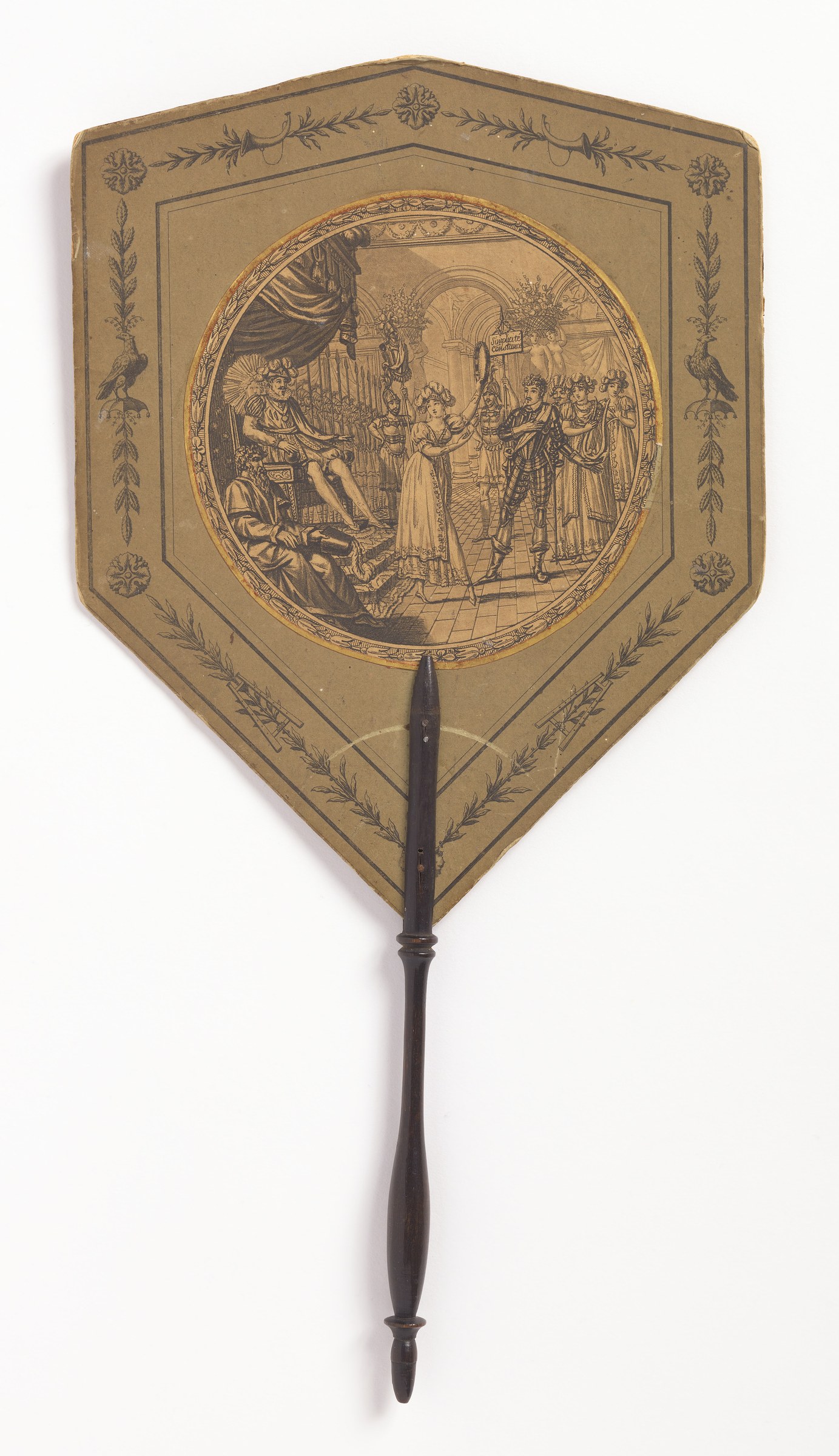
A shield-shaped hand screen features an inlaid or engraved central medallion depicting a formal court scene. A woman in a flowing white or pale gown stands at the center, playing a tambourine with one arm raised. She faces a seated male figure of rank—likely a king or nobleman—who sits elevated, wearing draped clothing and a crown or headdress. Around them, courtiers in classical dress stand in formal arrangement: some play pipe instruments on the left, others observe from the right in stiff, attentive poses. The scene is set within a grand interior with classical architecture—arched colonnades, vaulted ceilings, and ornamental details suggesting a palace. A military standard bearing the inscriptions "Simplicité" and "Constance" is held by a soldier at lower left. The composition is highly formal and hierarchical: the dancer commands the center, but is clearly performing for the seated authority. The lighting is consistent throughout, rendered in warm browns and golds characteristic of early 19th-century decorative engraving. The outer border of the shield is decorated with fine foliate scrollwork and small floral motifs at regular intervals.
The dancing
The central female figure stands in a relaxed yet graceful contrapposto, weight on one leg, the other bent. Her right arm is raised high with the tambourine, the elbow bent at roughly ninety degrees—a pose suggesting the moment of a tambourine strike or flourish. Her left arm hangs naturally. Her posture is upright but not stiff; the body leans slightly forward in a gesture of engagement with her audience. The male seated figure dominates the composition through placement and scale rather than action; he is static, observing. The surrounding courtiers are distributed symmetrically: pipe players on the left in animated but formal poses, courtiers on the right in standing attention. None of the attendants are dancing; all focus is on the soloist.
The dance depicted
This depicts a court entertainment or ceremonial dance performance, most likely from the early 19th century or earlier, in a classical or neo-classical setting. The woman is performing a solo dance or pantomime with musical accompaniment—the tambourine, combined with the piped music, suggests a Mediterranean or southern European tradition, though the neoclassical court setting suggests this may be an imagined or theatrical interpretation of an ancient Greek or Roman performance rather than a contemporary folk dance. The formal hierarchy of the scene—performer, musician, and authority figure—is characteristic of court entertainment in the late 18th or early 19th century, when such "antique" performances were fashionable. The inscription "Simplicité, Constance" (Simplicity, Constancy) suggests this may illustrate a virtue or allegorical theme rather than a named dance. The tambourine was associated in this period with representations of Bacchic or Terpsichorean entertainments, but the formal neoclassical setting makes this likely a ballroom spectacle or theatrical tableau rather than genuine ancient or folk practice.
How it was made
This is a decorative hand screen—a functional object held while reading, writing, or sitting by a fire—with an engraved or inlaid medallion. The technique appears to be line engraving, possibly with hand-coloring or inlay, mounted in a shield-shaped wooden frame with a turned wooden handle. The border ornament is engraved or tooled into the ground. Line engraving allowed fine detail and was an economical way to produce multiple copies for affluent domestic use. The shield shape and foliate border are characteristic of Regency-era (c. 1811–1820) or late-Georgian decorative taste. The presence of fine linear detail and formal composition indicates this was made for an educated, leisured audience—the kind of person who owned furnishings that combined practicality with allegorical or historical reference.
About this work
This hand screen presents a neoclassical court scene centered on a female performer playing a tambourine before a seated authority and assembled courtiers. The work is likely English or French, dating to the early 19th century, and belongs to the tradition of decorative domestic objects that referenced classical antiquity or theatrical performance. It is neither a straightforward record of contemporary dance practice nor a pure fantasy; rather, it represents the aesthetic taste of a specific moment when "antique" performance was fashionable in privileged circles. The allegorical inscriptions and formal composition suggest the image was meant to convey virtue or good conduct through the figure of the graceful, attentive dancer.
The screen combines practical function with fine ornamental engraving and reflects the Regency taste for neoclassical reference in interior decoration. Its survival in collections like Wikimedia Commons indicates it was a significant object in its time, valued enough to preserve and document. For a dance historian, it offers evidence of how early 19th-century viewers imagined classical or formal dance performance, and how such performances were integrated into court and theatrical contexts.
How to look at it
Observe the contrast between the solitary, animated female figure at center—her arm raised, her body engaged—and the static, formally arranged courtiers and authority figure. The artist has chosen not a moment of complex footwork or ensemble interaction, but a simple gesture of musical accompaniment: the raised arm with the tambourine. This stillness, paradoxically, reads as more classical and decorous than motion would have. Notice how the frame and composition push the female dancer forward while keeping the male observer elevated and central to the spatial logic. The symmetry of the attendants and the hierarchical arrangement of the scene convey ritual or ceremony rather than spontaneous pleasure. The fineness of the engraving—evident in the foliate borders and architectural detail—was itself a marker of refinement, inviting the hand-screen holder to associate themselves with the taste and education represented in the scene.
The period
The early 19th century saw intense interest in neoclassical aesthetics following the Napoleonic era and the rise of Romanticism. Dance, particularly female solo performance, was often represented in allegorical or historical terms—as the embodiment of Terpsichore, the muse of dance, or as recreations of imagined ancient entertainments. Domestic decorative objects like hand screens were major vehicles for such imagery. The tambourine, long associated with Mediterranean, Iberian, and Middle Eastern dance, became a fashionable attribute in European concert and ballroom performance during this period. Court entertainments and spectacular theatrical productions remained prestigious, and representations of them in domestic objects allowed middle and upper-class homes to reference aristocratic taste and classical learning.
The inscription "Simplicité, Constance" reflects the period's interest in virtue and moral instruction through allegorical representation. The formal, symmetrical composition and the prominence of the male authority figure also reflect gender hierarchies and the idealization of female performance as decorative and subordinate to male judgment—a theme persistent in dance imagery throughout the 19th century.
Where it lives
This is a decorative hand screen from the early 19th century, likely English or French in origin. It was digitized and is currently available on Wikimedia Commons, where it is held as a public-domain image. No accession number, museum holding, or specific provenance information is recorded in the source catalogue.
Dance in this work
Questions about this work
Is this a real dance from the time, or a fantasy?
It is likely a theatrical or allegorical fantasy. The neoclassical setting, the inscription, and the formal hierarchy all suggest this is an imagined scene—perhaps depicting a performance from classical antiquity or a theatrical spectacle—rather than a contemporary ballroom or folk dance. The tambourine and the female soloist are historically plausible, but the elaborate court setting and moral framing are designed to elevate and aestheticize the performance rather than to document it.
Who made this?
The artist is unknown. The work is unsigned and unattributed in the catalogue record. The quality of the engraving and the refinement of the design suggest a professional craftsperson working in England or France, but no further information is available.
What was a hand screen used for?
Hand screens were portable objects held in the hand to shield the face and neck from the heat of a fire, lamp, or candle, or from the sun. They were also status symbols, often decorated with fine art, allegory, or fashionable imagery. This screen combines utility with moral and aesthetic instruction, making it a prestige object for a literate, affluent household.
What does the inscription mean?
"Simplicité" and "Constance" are French words meaning "Simplicity" and "Constancy" or "Consistency." They appear on the military standard held by the soldier and suggest the scene is allegorical—the female dancer embodies or performs these virtues before the assembled court. This kind of moral framing was common in neoclassical art and design.
More dance artwork





